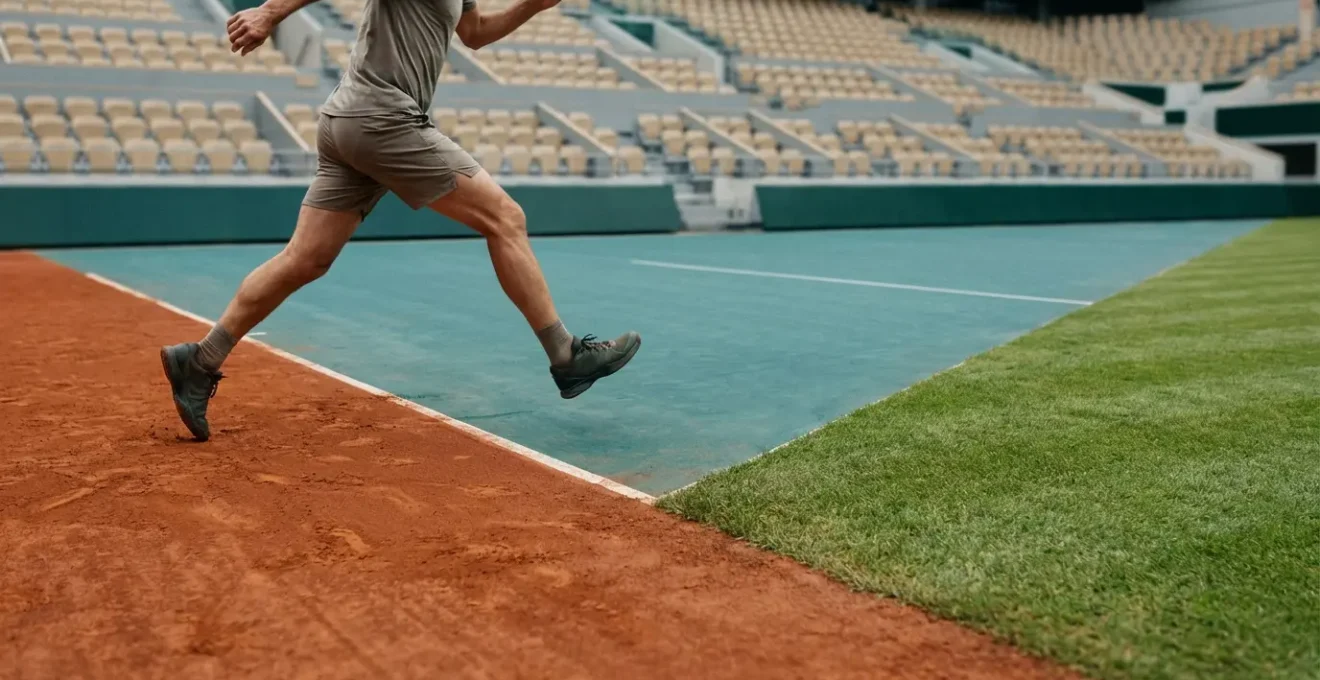
For the veteran player, choosing a court surface is not about finding a “safe” option, but about understanding and managing specific biomechanical risks.
- Clay courts statistically offer the lowest injury rates but require mastering specific sliding techniques to prevent muscle strains.
- Hard courts create the highest impact forces, while grass courts pose a significant risk of rotational knee injuries (like ACL tears) if improper footwear is used.
Recommendation: Your ideal surface is the one for which your body is conditioned and your equipment is specifically adapted. Prioritize clay for joint preservation, but only after mastering the movement and investing in the correct footwear.
As a competitive tennis player over the age of 40, you are intimately familiar with the dialogue between your ambition and your body. The explosive lunges, the rapid direction changes, the powerful serves—they all come with a physical cost. You’ve likely heard the common wisdom: “play on clay, it’s softer on the knees.” While there is truth to this, it is a dangerously incomplete picture for a player of your caliber. Treating this as a simple choice between “hard” and “soft” ignores the complex biomechanics at play and can lead you into a false sense of security.
The real key to longevity in this sport is not just avoiding impact, but understanding the intricate trade-offs between surfaces. It’s about the specific relationship between your shoes, the ground’s friction, and the way your body dissipates force through its entire kinetic chain—from the ankle, up through the knee and hip, and into your lower back. A surface that is forgiving in one aspect can be treacherous in another. A low-impact surface might demand more from your stabilizing muscles, while a high-friction surface can lock your foot in place, sending dangerous rotational forces directly into your knee joint.
This analysis, from the perspective of a sports medicine surgeon, will deconstruct these hidden risks. We will move beyond the platitudes to examine the precise biomechanical reasons why each surface presents unique challenges to the mature athlete. We will explore how to adapt your technique, your equipment, and even your training schedule to not only protect your joints but to continue playing at a high level for years to come. This is not about finding a “safe” court; it’s about making every court safer for you.
This guide provides a detailed breakdown of the biomechanical impacts of each court surface, the crucial role of footwear, and how to tailor your training to preserve your joints. The following sections will equip you with the knowledge to make informed decisions for your long-term tennis health.
Summary: A Biomechanical Guide to Court Surfaces for the Veteran Player
- Why hard courts increase micro-trauma in the lower back?
- How to adjust your slide on clay to prevent groin strains?
- Clay vs. Grass vs. Hard: Which offers the most consistent bounce for training?
- The footwear error on grass courts that leads to ACL tears
- When to switch court surfaces to peak for tournament season?
- Why herringbone patterns work on clay but slide dangerously on hard courts?
- Why heavy leg days ruin your court speed for 48 hours?
- Which Outsole Pattern Prevents Ankle Sprains on Clay Courts?
Why hard courts increase micro-trauma in the lower back?
The most common complaint I hear from veteran players who primarily play on hard courts isn’t just about their knees; it’s about a persistent, nagging ache in the lower back. This is not a coincidence. Hard courts, typically made of asphalt or concrete with a thin acrylic layer, are the least forgiving of all surfaces. They offer minimal force dissipation, meaning the shock from every footfall and sudden stop is sent directly back into the body.
Think of your body as a kinetic chain. When your foot strikes the ground, a shockwave of force is generated. On a softer surface like clay, a significant portion of this energy is absorbed by the court itself. On a hard court, that energy has nowhere to go but up. It travels from your foot, through the ankle, and is partially dampened by the knee and hip joints. However, a substantial amount of this repetitive, jarring force continues its path up the spine. Over the course of a two-hour match, this amounts to thousands of low-grade impacts.
This cumulative load is what we call micro-trauma. While a single impact is negligible, the relentless repetition can lead to inflammation of the facet joints in the lumbar spine, stress on the intervertebral discs, and chronic muscle fatigue as the core muscles work overtime to stabilize the torso against these jarring forces. For the player over 40, whose discs are naturally less hydrated and whose cartilage has seen years of wear, this effect is significantly amplified. The hard court is unforgiving, and your lower back often pays the price for its lack of energy absorption.
How to adjust your slide on clay to prevent groin strains?
Switching to clay is often recommended for joint health, and for good reason. Its softer composition absorbs impact beautifully. However, it introduces a new biomechanical challenge that can be just as debilitating if not properly managed: the slide. Many players who are new to clay or who have an improper technique end up with painful adductor muscle injuries, commonly known as groin strains. The key to prevention lies in a controlled, rotational movement, not just a straight-line skid.
A safe slide is initiated from the hips. As you approach the ball, you should lower your center of gravity and allow your outside leg to extend, with the inside of your foot making contact with the clay. The critical part of the movement is the hip rotation; you are not simply braking with your leg, but rather using the slide to decelerate your body’s momentum in a controlled manner. The hips and torso should rotate into the shot, allowing the large glute and core muscles to manage the braking forces, taking the strain off the smaller adductor muscles.
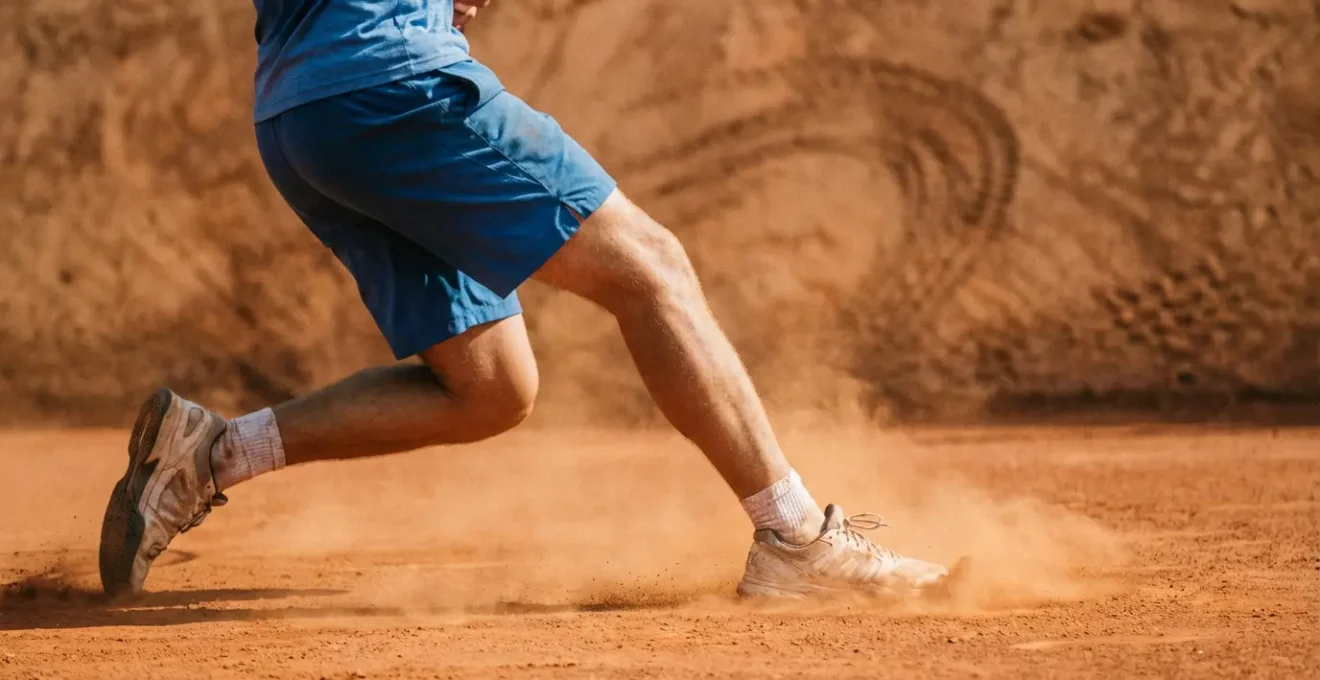
As the illustration demonstrates, a proper slide involves a deep knee bend and active engagement of the core. An incorrect slide, where the player keeps their hips square and tries to stop abruptly with the leg tensed, places immense eccentric load on the groin. This is the primary mechanism of injury. Mastering the slide transforms the clay court from a potential hazard for muscle strains into a true haven for your joints, allowing you to move powerfully and safely.
Clay vs. Grass vs. Hard: Which offers the most consistent bounce for training?
For a veteran player, effective training depends on rhythm and predictability. An erratic bounce can disrupt timing, force awkward movements, and increase the risk of injury. When comparing the three main surfaces, hard courts are the undisputed champions of consistency. The uniform, rigid surface provides a high and predictable bounce, allowing you to groove your strokes with near-perfect rhythm. This makes them an excellent surface for technical drills and refining mechanics.
However, this consistency comes at a significant physical cost. A comparative analysis of professional matches reveals a stark reality about injury rates. The table below synthesizes findings on how surface type correlates with player injuries and game dynamics.
| Surface Type | Injury Rate | Serve Speed | Rally Duration | Primary Risk |
|---|---|---|---|---|
| Hard Court | 9.7% | 185.2 ± 12.5 km/h | Shortest | Knee and ankle strain |
| Clay Court | 3.5% | 170.4 ± 11.2 km/h | Longest | Muscle fatigue |
| Grass Court | 6.2% | 192.3 ± 13.6 km/h | Medium | Muscle strains from rapid movements |
The data is clear: clay courts are associated with the lowest injury rate (3.5%). The trade-off is a slower, higher, and slightly less consistent bounce than a hard court, which demands better footwork and patience. Grass is the most unpredictable; the ball stays low and fast, and a single bad bounce from an imperfection in the turf can be dangerous. Furthermore, studies show that injury rates can be dramatically higher on high-friction surfaces like hard courts, where the foot is more likely to get “stuck” during a change of direction. Therefore, while hard courts are best for pure bounce consistency, clay offers the superior balance of playability and joint preservation for training longevity.
The footwear error on grass courts that leads to ACL tears
Grass is a unique, living surface that presents the highest risk of catastrophic knee injury for the unprepared player. The surface is slick, but the danger often comes from creating *too much* friction. This happens when a player makes a critical footwear error: wearing shoes designed for clay or hard courts on grass. The result can be a non-contact ACL injury, one of the most devastating injuries in sports.
The biomechanics are frighteningly simple. Grass courts require a shoe with a “pimpled” or “nubbed” outsole specifically designed to offer grip without locking the foot onto the turf. This allows for microscopic sliding during rapid pivots and direction changes. When a player wears a shoe with a deep herringbone tread (for clay) or a durable, high-friction rubber pattern (for hard courts), the shoe can dig into the turf and stop dead. Your body’s momentum, however, does not. This forces the knee into a position of high risk. As biomechanics researchers noted in a Medical Xpress biomechanics analysis:
sports people were found to land with their knee straighter and more rotated when running on surfaces with higher friction. This is considered to be a serious risk for knee anterior cruciate ligament (ACL) injury
– Biomechanics researchers, Medical Xpress biomechanics analysis
This “stuck foot” scenario sends a powerful rotational force directly through the tibia, placing the ACL under immense strain. The proper grass court shoe is therefore not an accessory; it is a critical piece of safety equipment designed to manage the unique coefficient of friction of the surface.
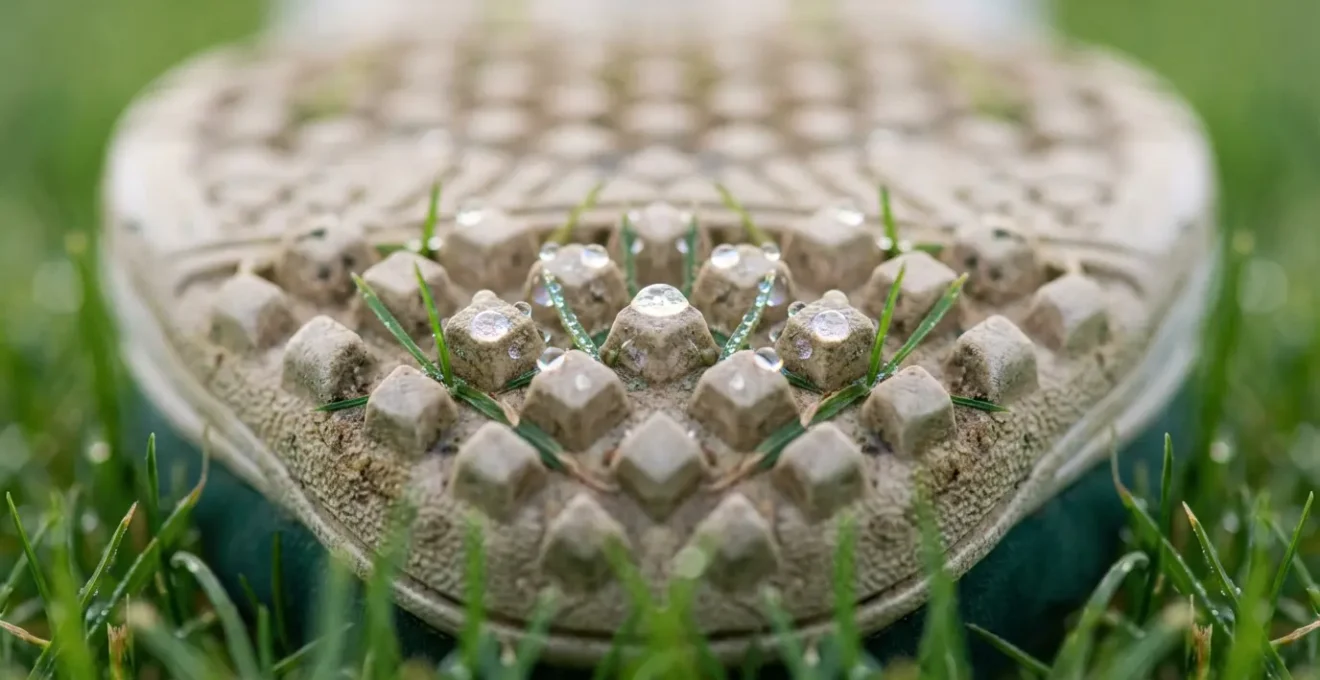
The specialized nub pattern seen here is designed to provide traction for acceleration while preventing the foot from locking in place during rotational movements. Ignoring this crucial equipment detail is a gamble that no player, especially one over 40, should ever take.
When to switch court surfaces to peak for tournament season?
For the competitive masters player, periodization is key. Peaking for a tournament involves more than just refining your strokes; it requires acclimating your body to the specific physical demands of the tournament’s court surface. Switching surfaces too late is a common and costly error. Your body, finely tuned to one set of biomechanical loads, can be pushed into an overload state when abruptly subjected to another, leading to injury and subpar performance.
The forces involved in tennis are staggering. During powerful movements, biomechanical analysis shows that peak forces can exceed 4.2 times a person’s bodyweight. Each surface modulates these forces differently. A hard court sends these forces back into your joints, demanding robust cartilage and bone density. A clay court requires greater muscular endurance and stability to manage long rallies and control slides. Grass demands explosive, fast-twitch muscle responses to handle the low, fast balls.
Your body’s neuromuscular system—the communication network between your brain and muscles—takes time to adapt. It needs to learn new firing patterns to anticipate a lower bounce on grass or to control deceleration on clay. This adaptation process takes, at a minimum, three to four weeks of consistent play on the new surface. Therefore, the rule is simple: you should transition to the tournament surface at least one month prior to the event. Playing on clay for two months and then switching to a hard court a week before your tournament is a recipe for shin splints, tendonitis, and general exhaustion, as your body is simply not prepared for the change in impact and force profiles.
Why herringbone patterns work on clay but slide dangerously on hard courts?
The herringbone outsole pattern is synonymous with clay court tennis, and for a very specific reason: its design is a masterclass in managing a loose surface. However, that same design can become a liability on a high-friction hard court. The difference lies in the subtle but critical geometry of the grooves, which dictates how the shoe interacts with the ground.
A clay court shoe’s herringbone pattern has two functions: to provide traction for forward movement and to allow for a controlled, predictable lateral slide. The grooves are typically wide and U-shaped. This shape doesn’t trap large amounts of clay, allowing the loose particles to be expelled as the shoe flexes. This maintains a consistent level of grip, preventing the shoe from suddenly “caking” and losing all traction, while also allowing it to slide smoothly when the player intentionally initiates a slide.
Using this shoe on a hard court is problematic. The wide grooves offer less surface area of rubber in contact with the court, resulting in suboptimal grip for the explosive stops and starts required on this surface. This can lead to dangerous, uncontrolled slips when trying to change direction aggressively. The science behind this distinction is quite specific.
Case Study: Biomechanical Analysis of Outsole Grooves
An analysis of outsole patterns highlights the fundamental design differences. In one biomechanics research paper comparing shoe types, it was noted that while both used a herringbone shape, the hard court shoes featured sharper, V-shaped grooves and a dedicated pivot point under the ball of the foot. The clay court shoes, in contrast, had wider, U-shaped grooves and a uniform pattern. This V-shape on hard court shoes maximizes grip by creating more sharp edges to bite into the surface, while the pivot point facilitates safer rotational movements that would be inhibited by a full clay court tread.
In essence, the clay court herringbone is designed for controlled release, while the hard court pattern is designed for maximal grip. Using one on the other’s surface is a fundamental mismatch of engineering and will compromise both performance and safety.
Why heavy leg days ruin your court speed for 48 hours?
Maintaining lower body strength is non-negotiable for protecting your knees and generating power. Strong quadriceps, hamstrings, and glutes act as the primary shock absorbers for your body. However, for the 40+ athlete, the *method* of strength training is as important as the training itself. The traditional “heavy leg day”—squatting and deadlifting near-maximal loads once a week—is a counterproductive and dangerous strategy for an in-season tennis player.
Heavy resistance training works by creating microscopic tears in your muscle fibers. The subsequent repair process is what builds stronger muscle. This process, however, can take 48-72 hours. During this recovery window, several things happen that are detrimental to your on-court performance and safety. Your muscles are fatigued, reducing their capacity to generate explosive power. More critically, your proprioception—your nervous system’s ability to sense the position and movement of your body—is significantly impaired. Your joints are less stable, your reaction time is slower, and your ability to make fine-tuned adjustments during a lunge or pivot is compromised. Playing a competitive match in this state dramatically increases your risk of an acute injury, such as an ankle sprain or muscle tear.
The goal is not to avoid strength training, but to integrate it intelligently. This involves shifting from a high-intensity, low-frequency model to a lower-intensity, high-frequency approach that builds strength without causing excessive fatigue and neuromuscular disruption.
Action Plan: The Surgeon’s Recommended Leg Strength Protocol
- Focus on muscle activation: Sit with your legs extended. Rotate your foot outward and consciously contract your VMO (the teardrop-shaped inner thigh muscle crucial for knee stability).
- Use timed holds, not heavy reps: Hold this contraction for 10 seconds. Aim for 10 sets with 30 seconds of rest between each. This builds endurance without causing major muscle damage.
- Increase frequency, not load: Perform these activation exercises and other low-intensity movements (like bodyweight squats) every other day, rather than one heavy session per week.
- Prioritize functional strength: Emphasize high-frequency, lower-intensity training that mimics the demands of the sport, building resilience without inducing performance-hampering fatigue.
- Monitor your stability: Regularly check your proprioception with simple balance tests (e.g., standing on one leg with eyes closed) post-workout to ensure you are not compromising your on-court stability.
Key Takeaways
- The ideal court surface depends on a trade-off: your choice is not simply between “soft” and “hard,” but about matching your movement style and footwear to the surface’s specific coefficient of friction.
- While clay courts offer the lowest statistical injury rates, this safety is conditional upon mastering the correct sliding technique to prevent muscular strains in the hips and groin.
- Footwear is a non-negotiable piece of medical equipment. Using the wrong outsole pattern for a given surface dramatically increases the risk of both acute rotational injuries (ACL) and chronic stress injuries.
Designing Your Personal Injury Prevention Strategy: The Final Check
We have established that for the mature tennis player, the court surface is a variable to be managed, not just chosen. True longevity in this sport comes from a holistic understanding of the forces at play and a proactive strategy to mitigate them. The final, and perhaps most critical, piece of this puzzle lies in your footwear. The outsole of your tennis shoe is the interface between your body and the court; getting this choice right is paramount, especially on the uniquely demanding surface of a clay court.
Preventing ankle sprains on clay is not about finding a shoe that eliminates all movement, but one that controls it. Ankle rollover injuries often happen during a slide when the outer edge of the shoe digs into the clay, causing the foot to roll inwards. Modern clay court shoes are engineered with specific features to prevent this exact scenario, providing a blend of grip for acceleration and controlled release for sliding.
The following table, based on an in-depth analysis of outsole designs, breaks down the essential features you should look for in a clay court shoe. Consider this your pre-purchase checklist for ankle safety.
| Pattern Feature | Location | Function | Safety Benefit |
|---|---|---|---|
| Full Herringbone | Entire outsole | Thinner outer tread | Controlled lateral sliding |
| Reinforced Lateral Edge | Outer edge | Rounded bumper design | Prevents foot rollover |
| Medial Pivot Point | Ball of foot | Circular pattern | Safer rotation control |
| Density Variation | Heel to toe | 0.6mm tread width difference | Progressive braking stability |
By understanding these principles, you are no longer a passive participant subject to the whims of the court. You become the architect of your own safety. You can now analyze a court not just for its speed, but for its impact profile. You can select a shoe not for its color, but for its engineered safety features. You can schedule your training not by convenience, but with a strategic understanding of bodily adaptation. This is the path to continuing the sport you love with power, confidence, and health for decades to come.
Take this knowledge and apply it proactively. Before your next season begins, audit your equipment, evaluate your training schedule against your competition calendar, and invest the time to master the specific movements required for your surface of choice. Your body will thank you.