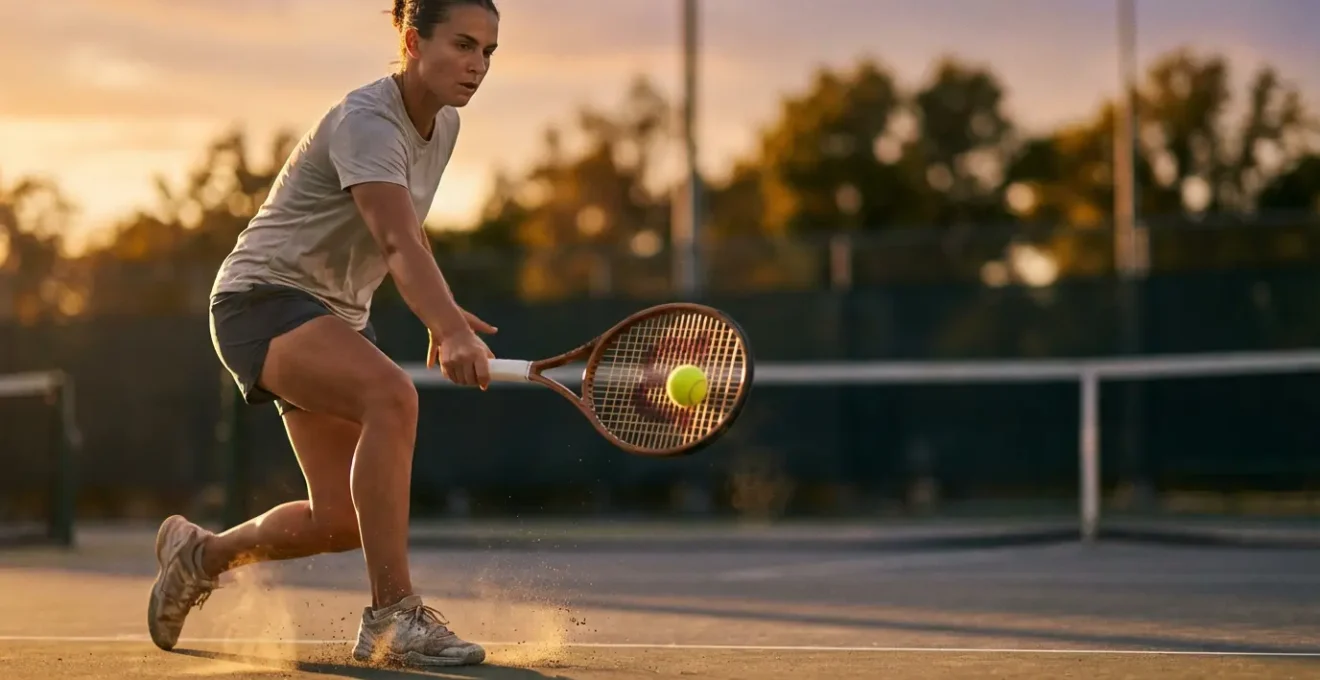
Mastering touch on fast courts isn’t a gift, but a science of force management.
- Grip pressure is a measurable and trainable skill, directly impacting shot consistency and your ability to absorb pace.
- Strategic positioning after a shot, based on tactical geometry, is often more critical for winning the point than the shot itself.
Recommendation: Focus on calibrating your equipment (strings) and systematically practicing touch shots under physical and mental fatigue to make them reliable weapons.
For any tennis or squash player facing a relentless power hitter, the match can feel like a one-sided storm. You’re pushed back, reacting to pace, with little room to impose your own game. The common advice is to develop a “soft game,” to use touch and finesse to disrupt their rhythm. But what does that truly mean? Coaches say “loosen your grip” or “feel the ball,” but this advice often feels vague and unhelpful when a 110-mph serve is coming your way. The frustration of a perfectly planned drop shot sitting up for a winner or a volley flying long is a familiar pain point for players trying to evolve beyond baseline bashing.
The truth is, the gap between your intent and the ball’s result isn’t magic; it’s physics. The prevailing wisdom often overlooks the fact that touch is not an innate, mystical talent. It’s an engineered skill—a calculated process of managing a series of interconnected forces. The problem isn’t that you lack “soft hands”; it’s that you haven’t yet learned how to calibrate the system of your body, your racket, and your position on the court to produce a desired outcome under pressure.
But what if the key to unlocking your touch game wasn’t about trying to *feel* more, but about *controlling* more? What if you could approach your drop shots, volleys, and slices with the precision of an engineer? This guide will deconstruct the components of touch, moving beyond platitudes to give you a tactical framework. We will explore how to measure and control grip tension, how to adapt your spin to the surface, and why your positioning *after* the shot is a non-negotiable part of the equation. We will treat your racket like a calibrated tool and your body like a system to be optimized, even under fatigue.
This article provides a structured roadmap to transform your touch game from a hopeful guess into a reliable, strategic weapon. Explore the sections below to delve into each critical component of engineering finesse and control on the court.
Summary: Beyond Soft Hands: How to Engineer Touch Accuracy on Fast Courts
- Why grip tension kills your drop shot (and how to measure it)?
- How to adjust slice backspin for clay vs. hard courts?
- Gut vs. Polyester: Which string setup allows for better short game touch?
- The positioning mistake that leaves you vulnerable after a drop shot
- When to practice touch shots in a tired state to mimic match endings?
- Why top-spin capability is non-negotiable for modern training machines?
- How to adjust your slide on clay to prevent groin strains?
- How to Use Minimax Strategy to Exploit Opponent Weaknesses?
Why grip tension kills your drop shot (and how to measure it)?
The most common advice for touch shots—”loosen your grip”—is also the most misunderstood. The issue isn’t simply being tight or loose; it’s about the inability to precisely regulate and maintain a low level of pressure through the kinetic chain. Excessive grip tension is the number one killer of the drop shot because it engages the forearm muscles, stiffens the wrist, and prevents the racket head from decelerating naturally. This tension turns a delicate “catch and release” motion into a rigid push, sending the ball too deep and high. The difference between elite players and amateurs lies in this very control; a 2024 study found that expert players have 95.0% accuracy in grip force control, a significant leap from the 84.6% achieved by amateurs.
To move from guessing to knowing, you must learn to measure and calibrate your grip. Think of it on a scale of 1 to 10, where 10 is a death grip and 1 is the racket about to fall. A successful drop shot or soft volley requires a grip pressure of 2-3. This is just enough to maintain control of the racket face angle at impact. The goal is to let the racket do the work, absorbing the ball’s energy rather than adding to it. This requires a relaxed arm, where the momentum comes from a slight body weight transfer, not a muscular push from the hand or arm.
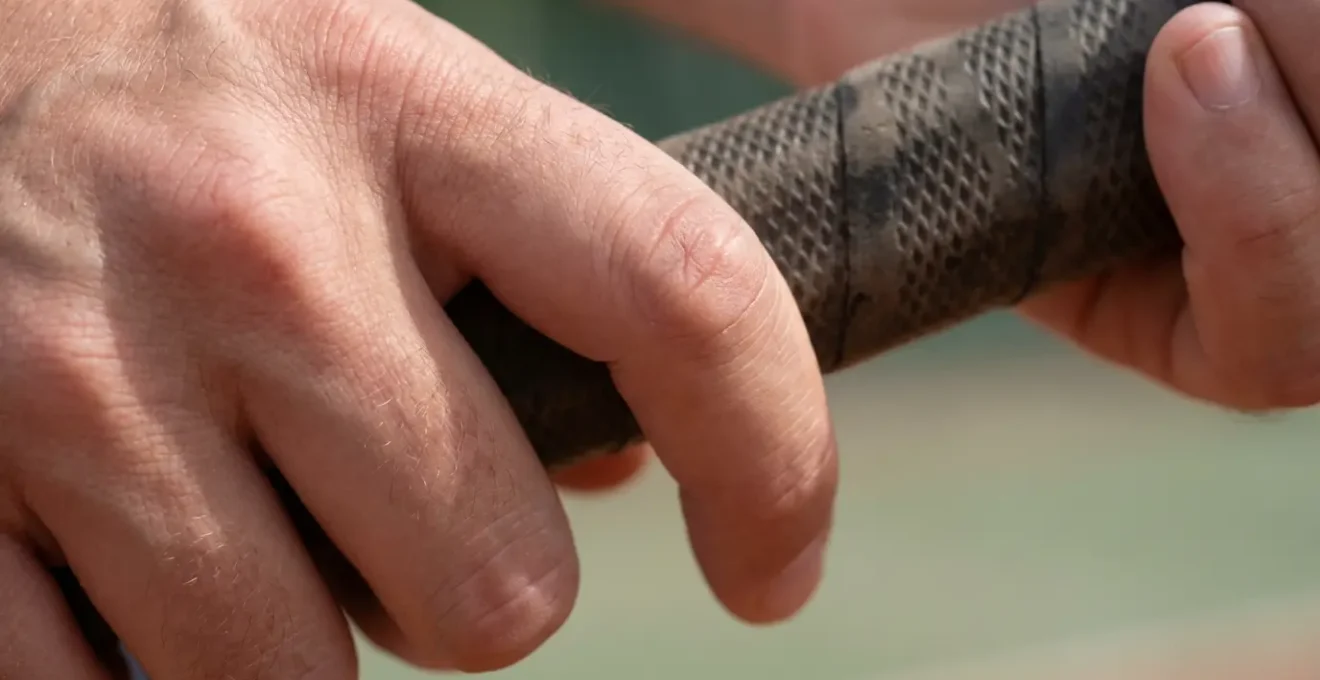
To develop this skill, practice holding the racket at what you perceive to be a level 2-3 pressure. Have a partner try to pull the racket from your hand; there should be minimal resistance. This provides tangible feedback. The following steps can help you build this into your muscle memory:
- Establish Baseline: Hold the racket just tight enough that it won’t fall from your hand. This is your target level 2-3 pressure. Memorize this feeling.
- The ‘Ragdoll Arm’ Test: Have a partner lift your hitting arm by the elbow and drop it. It should fall freely with no resistance from your shoulder to your wrist. If you unconsciously hold it up, you are carrying residual tension.
- Breathing Technique: Implement a slow, 4-second exhale immediately before and during contact. This physiological trick triggers muscular relaxation throughout the body, including the hand.
- Body Weight Transfer: Focus on initiating the shot with a forward lean of your core while maintaining a loose grip. The energy transfer comes from your body’s momentum, not your arm’s force.
How to adjust slice backspin for clay vs. hard courts?
A successful touch shot isn’t just about softness; it’s about spin, and that spin must be calibrated to the surface. Hitting the same slice drop shot on a high-bouncing clay court versus a slick, low-bouncing hard court will produce dramatically different results. On a hard court, the ball skids and maintains its momentum. On a clay court, the granular surface “grabs” the ball, exaggerating the backspin and causing it to stop, or even spin backward. Failing to account for this interaction is why many players see their “perfect” drop shots on clay bounce up harmlessly on a hard court.
The key is to adjust your swing path and racket face angle. For a hard court, you need a flatter, more horizontal swing path—almost like a knife cutting through the lower part of the ball. The goal is less about generating heavy backspin and more about killing the ball’s forward momentum so it dies after a low skid. On clay, the technique shifts to a more pronounced “U-shaped” or scooping motion. Here, you want to get under the ball and brush up sharply, imparting maximum backspin. This heavy rotation is what allows the ball to bite into the soft surface and die quickly.
Case Study: Carlos Alcaraz’s Surface-Specific Drop Shots
Analysis of Carlos Alcaraz’s game provides a masterclass in this adaptation. On the fast hard courts of Indian Wells 2024, his drop shots often feature a flatter trajectory with less visible backspin, designed to die quickly after the fast bounce. In fact, he won 11 of 20 drop shot points (55%) by adapting to the faster surface. Conversely, on clay, he employs a much more dramatic U-shaped swing, generating heavy spin that grips the slower surface, often causing the ball to stop dead or spin back towards the net, making it virtually unplayable.
This table breaks down the essential technical adjustments needed for mastering the slice on different surfaces.
| Aspect | Hard Court Technique | Clay Court Technique |
|---|---|---|
| Swing Path | Horizontal ‘knife-like’ motion | U-shaped scooping motion |
| Contact Point | Drive through low window | Lift up and over net |
| Wrist Position | Firm and stable | More flexible for spin |
| Ball Behavior | Low skidding bounce | High grip, stops or spins back |
| Footwork | Hit on the move, stable base | Sit into shot, lower center of gravity |
Gut vs. Polyester: Which string setup allows for better short game touch?
Your racket strings are the final point of contact with the ball; they are the nerve endings of your touch game. The choice between different string materials is not a minor detail—it fundamentally alters the feedback you receive and the ball’s behavior off the stringbed. The primary trade-off is between the stiff, control-oriented nature of polyester (poly) strings and the elastic, feel-oriented properties of natural gut or multifilament strings. For a player seeking to refine their touch, understanding this spectrum is crucial.
Polyester strings are rigid. They deform less on impact and snap back quickly, which is excellent for generating heavy topspin on full swings. However, for touch shots like drop shots or volleys, this stiffness provides minimal “pocketing” or “dwell time.” The ball feels like it’s coming off a board, offering very little feedback and making delicate shots difficult to control. On the other end, natural gut is the gold standard for feel. Its superior elasticity allows it to stretch and cup the ball for a fraction of a second longer. This increased dwell time provides a rich sensory feedback loop to your hand, allowing for micro-adjustments and a much higher degree of control over shot depth and spin.
For players who can’t sacrifice the spin and durability of polyester but crave more feel, a hybrid setup is the professional’s choice. As one research team notes, this approach offers the best of both worlds:
The expert’s choice is often a hybrid setup with natural gut in the mains for elasticity and ‘pocketing’, combined with polyester in the crosses for control and spin generation.
– Tennis Equipment Research Team, Comparison of Grip Strength Study – PMC Journal
Choosing your setup is a process of system calibration. Where do you fall on the spectrum of needing control versus feel? This guide can help you decide:
- Level 1-2 (Stiffest): A full bed of polyester offers maximum control and durability but minimal feel, ideal for powerful baseliners.
- Level 3-4: Polyester with reduced tension (e.g., below 50 lbs) can improve feedback while maintaining most of the control.
- Level 5-6: Multifilament strings provide a balanced blend of feel, power, and durability, a great all-around choice.
- Level 7-8: The hybrid setup (natural gut in mains, poly in crosses) is the professional’s choice for optimizing both touch and spin.
- Level 9-10 (Softest): A full bed of natural gut provides maximum feel and comfort but at the cost of durability and spin potential for modern strokes.
The positioning mistake that leaves you vulnerable after a drop shot
Executing a great drop shot is only half the battle. The most common and costly mistake players make is in their movement *after* the shot. The instinctive reaction is to run straight towards the center of the net. This feels logical, but it’s a tactical blunder that leaves you highly vulnerable. Why? Because it ignores the tactical geometry of the court. Your opponent, scrambling forward, has two primary passing shot options: a sharp angle cross-court or a shot straight down the line. By moving to the center, you are often equidistant from neither and can be easily passed on either side.
The correct strategy is to follow the “Angle Bisector” theory. Instead of running to the physical center of the net, you must move to the midpoint of the angle formed by your opponent’s two most likely return paths. This position dynamically changes based on where your opponent is running from and where your drop shot landed. It requires you to read the play and anticipate the geometry of the return. Professional analysis shows the dramatic effectiveness of this approach: players who correctly position themselves using this theory win 73% more follow-up points compared to those who simply rush to the net’s center.
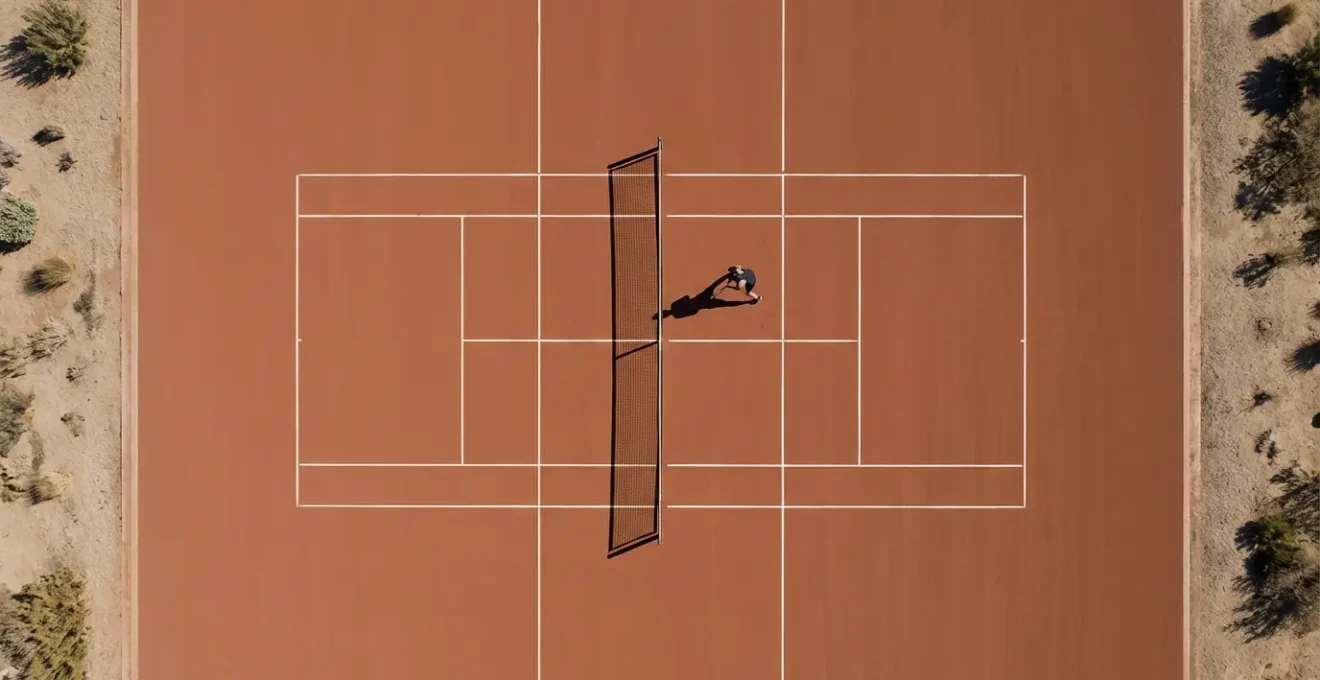
Think of it as covering the highest probability outcomes. Your goal is not to stand where you can cover every inch of the court—that’s impossible. Your goal is to position yourself where you can cut off the opponent’s easiest replies, forcing them to attempt a much more difficult, lower-percentage shot. This turns your follow-up volley from a desperate lunge into a controlled, point-ending put-away. It’s a mental shift from reacting to the ball to controlling the space.
Case Study: The Angle Bisector in Action
Imagine you’ve hit a drop shot that pulls your right-handed opponent wide to their forehand side. Their easiest returns are a sharp cross-court flick or a risky forehand down the line. Running to the center T of the service box leaves both options open. The correct “Angle Bisector” position would be a few steps to the left of the T, directly in the path of the cross-court reply. This positioning dares them to attempt the much more difficult down-the-line pass, significantly reducing their chances of success.
When to practice touch shots in a tired state to mimic match endings?
How many times has this happened? You can hit perfect drop shots and volleys in practice, but in the third set, at 4-4, 30-30, they desert you. The reason is simple: you haven’t practiced them under the right conditions. Fine motor skills, which govern touch and feel, are the first things to deteriorate under physical fatigue and mental pressure. When your heart rate is high, your breathing is shallow, and your legs are heavy, your brain reverts to gross motor skills—big, simple muscle movements. Hitting with power becomes easier than hitting with finesse. Therefore, practicing touch shots only when you are fresh is preparing you for a match scenario that rarely exists when points matter most.
To make your touch reliable, you must practice it in a fatigued state. This trains your nervous system to execute delicate movements even when your body is screaming for oxygen. The goal is to simulate the physiological conditions of a high-pressure, late-match moment. A 2021 study found that practicing drop shots at heart rates above 160 bpm (Zone 4/5) significantly improves a player’s ability to execute them successfully under actual match pressure. This isn’t just about hitting more balls; it’s about hitting the right balls at the right time in your practice session.
Integrate touch drills at the *end* of your practice, not the beginning. When your legs are tired and your focus is starting to wane, that is the perfect time to demand precision from your hands. This teaches your body and mind that even in a state of duress, finesse is a non-negotiable tool. By repeatedly performing these actions under stress, you build new, more resilient neural pathways.
Action Plan: Simulating Match-End Fatigue
- Heart Rate Zone Drill: Complete a series of intense court sprints (suicides) to elevate your heart rate to 160+ bpm. Immediately after, have a partner feed you balls to execute 10 consecutive drop shots or volleys.
- Cognitive Load Training: While practicing touch shots from a ball machine or partner, have someone ask you to solve simple math problems or spell words backward. This added mental stress simulates match pressure.
- Final Set Simulation: After a long practice of at least 90 minutes, play a 10-point tiebreak. Award yourself bonus points for every successfully executed drop shot or winning volley to incentivize their use when tired.
- Negative Trigger Practice: Start drills from disadvantageous scores, like 15-40 or facing a break point. The drill requires you to use a touch shot (drop shot or slice) within the first two strokes of the point.
Why top-spin capability is non-negotiable for modern training machines?
In the modern game, played with powerful rackets and polyester strings, the rally ball is rarely flat. The vast majority of shots from competitive players are loaded with heavy topspin. This spin makes the ball dip sharply, bounce high and fast, and kick off the court. A training machine that only feeds flat, predictable balls is therefore preparing you for a version of tennis that no longer exists. It’s like a flight simulator that only teaches you how to take off but not how to land in turbulence.
The ability to handle and redirect a heavy, high-bouncing, topspin ball is a fundamental requirement. This is where a machine’s topspin capability becomes non-negotiable. Practicing against a ball with realistic topspin allows you to groove the correct footwork (moving back to let the ball drop), racket preparation (a higher take-back), and swing path (hitting up and through the ball) needed to neutralize your opponent’s primary weapon. More importantly, it is the key to developing rhythm disruption. Learning to knife a low slice or block a soft volley off a heavy topspin feed is an advanced skill that can completely dismantle a powerful baseliner’s game. You cannot develop this feel by practicing against flat balls.
Case Study: The TopspinPro Training Philosophy
The success of training aids like the TopspinPro, used by over 500,000 players, highlights this principle. The device focuses exclusively on forcing the player to execute the correct “brushing” motion of a topspin groundstroke. Their data shows that players can feel the correct mechanics within minutes and show measurable improvement in control within weeks. The lesson is that modern control isn’t about hitting flat; it’s about mastering spin. A ball machine must be able to replicate this environment. Advanced machines like the Spinfire Pro 2 offer up to 10 distinct levels of topspin, allowing a player to progressively increase the difficulty and truly simulate a modern opponent.
Without this feature, you are simply practicing how to hit a clean ball, not how to play tennis. A machine without topspin creates a false sense of confidence that shatters the moment you face a real opponent who uses spin as their primary weapon. It builds bad habits—hitting too flat, taking the ball too early on the rise without adjustment, and using an incorrect swing path—that are difficult to unlearn. Investing in a machine with robust spin capabilities is investing in your ability to compete in the modern game.
How to adjust your slide on clay to prevent groin strains?
Sliding on a clay court is a beautiful and effective part of the modern game, allowing players to cover more court and maintain balance while hitting shots on the run. However, it is also a high-risk movement that, if performed incorrectly, places immense eccentric load on the adductor (groin) muscles, leading to strains and chronic injuries. The key to sliding safely and effectively is not just about balance, but about understanding the biomechanics of deceleration and force dissipation.
The most common mistake is sliding into a wide, open stance and attempting to brake abruptly. This puts the adductor of the sliding leg under maximum stretch and tension, creating a high risk of injury. A safer, more controlled slide involves a different mechanical approach. As a leading biomechanics research team states, the stance is critical:
Sliding into a wide open stance puts maximum stress on the adductor muscles. Teaching drills for sliding into a closed stance shot provides better rotation and control while being more protective of the groin muscles.
– Sports Biomechanics Research Team, Journal of Sports Science Study on Tennis Serve Mechanics
Beyond stance, the technique of the “braking leg” is paramount. Instead of planting the foot flat, elite players roll onto the outside edge of their braking foot. This action dissipates the forward momentum over a longer period, acting like an ABS braking system for your body. It allows for a smoother, more controlled stop and significantly reduces the peak force absorbed by the groin and hip joints. This requires specific pre-habilitation and a progressive training approach to build the necessary strength and coordination.
To integrate safe sliding into your clay-court game, a structured biomechanical protocol is essential:
- Braking Leg Technique: Focus on rolling onto the outside edge of the braking foot to dissipate force over a longer duration, mimicking an ABS braking system rather than a sudden stop.
- Stance Selection: Whenever possible, prioritize sliding into a closed or neutral stance. This can reduce adductor stress by up to 40% compared to a wide open stance.
- Pre-habilitation Routine: Strengthen the adductor muscles specifically. Daily sets of Copenhagen Adduction Planks (3 sets of 30 seconds per side) are highly effective at building resilience.
- Progressive Training: Begin practicing slides on a slightly watered-down clay court. This reduces the friction and impact, allowing you to develop balance and control before moving to a dry, high-friction surface.
Key takeaways
- Touch is a controllable system of force management, not an innate or mystical talent.
- Your equipment (especially strings) and your court positioning (tactical geometry) are as crucial to your soft game as your swing technique.
- To make touch shots reliable, you must practice them under simulated match pressure and physiological fatigue, not just when you are fresh.
How to Use Minimax Strategy to Exploit Opponent Weaknesses?
At the highest levels, tennis is a game of probabilities and patterns. A powerful strategic tool borrowed from game theory is the Minimax strategy. The core principle is simple: make the play that minimizes your opponent’s maximum possible payoff. In tennis terms, it means choosing a shot or sequence of shots that puts your opponent in a lose-lose or lose-lesser situation. Instead of just trying to hit a winner, you are architecting a point structure where their best possible response is still a weak one that you can exploit on the next ball.
The drop shot is a perfect vehicle for the Minimax strategy, especially against powerful baseliners who camp out behind the baseline. By hitting a drop shot, you force them to do something they don’t want to do: run forward. Their “maximum payoff” (best case scenario) is to reach the ball and attempt a reply. However, because they are sprinting and off-balance, this reply is almost always a defensive flick or a pop-up. You have successfully minimized their best option, leaving yourself with an easy volley or overhead to win the point. Analysis confirms the high probability of this play; when executed properly, data shows that drop shots win the point 69.3% of the time.
The true genius of Minimax, however, is in the sequence. It’s not just about hitting one drop shot. It’s about establishing a pattern. By hitting several heavy, deep topspin shots that push your opponent back, you condition them to stay deep. Then, you introduce the drop shot. Now they are in a dilemma. If they stay back to counter your power, they lose to the drop shot. If they start cheating forward to anticipate the drop shot, you can hit a power shot past them. You have created a tactical prison from which there is no easy escape.
Case Study: Carlos Alcaraz’s Minimax Application
At Indian Wells 2024, Carlos Alcaraz showcased a perfect application of Minimax. Against deep-lying defensive players, he used the drop shot to “minimize their maximum payoff.” Even when opponents managed to reach his drop shots, their weak, off-balance replies gave Alcaraz complete control of the follow-up shot. His strategic sequencing of heavy topspin followed by unexpected drop shots created constant lose-lose scenarios for his opponents, a tactical masterclass that generated a significant statistical advantage over the course of the tournament.
Begin today by applying these principles of force management and tactical geometry to transform your touch from a liability into your greatest strategic weapon.