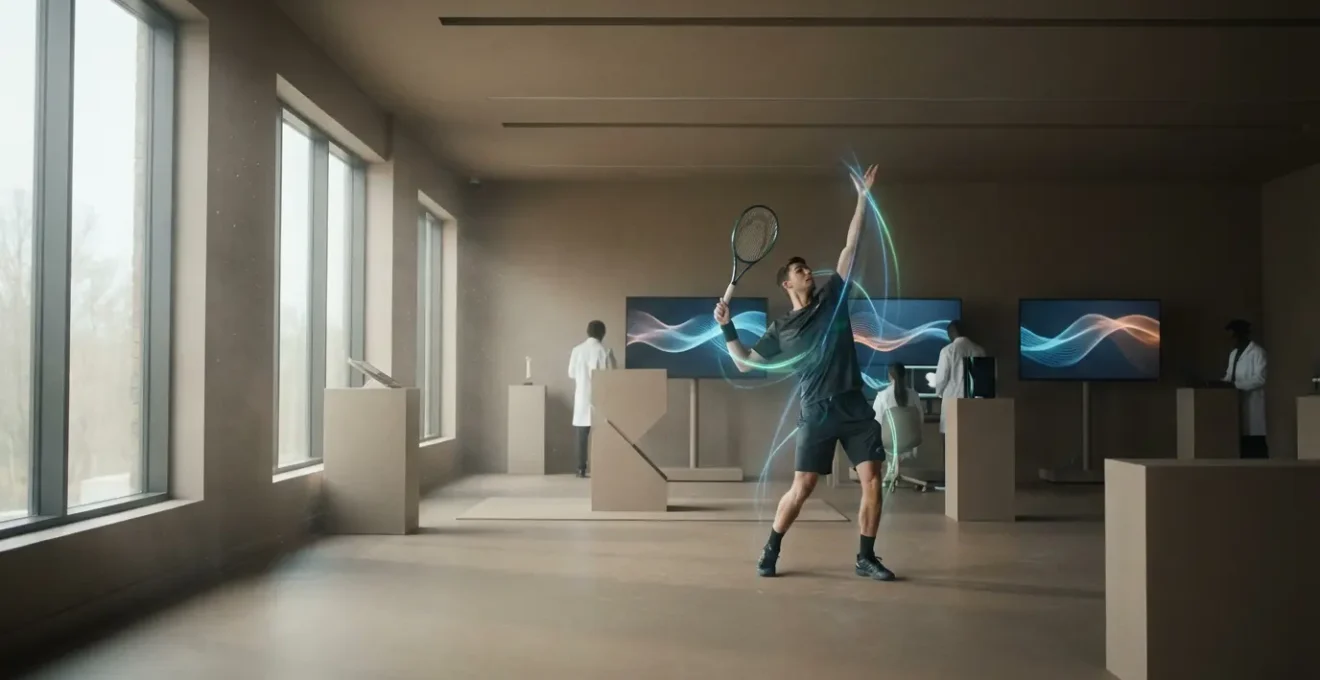
The frustrating performance plateau you’re experiencing isn’t a lack of effort; it’s a limitation of human perception. Your brain is neurologically wired to overlook the very micro-errors that digital analysis is designed to detect.
- Kinetic chain failures often occur in milliseconds, far too fast for the naked eye or standard video to capture, making them effectively invisible.
- High-precision technologies like 3D motion capture and high-speed cameras transform these invisible “blurs” into distinct, analyzable phases of movement.
Recommendation: Shift from trying to “see” your mistakes to using data to retrain your physical “feel.” The goal is to build a data-driven proprioception where the correct movement becomes automatic.
You feel it before you can see it. A nagging inconsistency in your golf swing, a recurring strain after your tennis serve, a vertical jump that has hit a glass ceiling. You’ve watched countless hours of video playback, followed the advice of coaches, and drilled the fundamentals, yet the flaw remains elusive. You are not alone. This plateau is a common barrier for dedicated, tech-savvy athletes who suspect a deeper technical issue is at play.
The conventional wisdom is to simply record yourself more or get another opinion. But this approach operates on a flawed premise: that the critical error is visible in the first place. What if the root cause of your performance bottleneck isn’t something you can see on a standard 60-frames-per-second video? What if it’s a micro-deviation in your kinetic chain, a fractional delay in muscle activation, or a subtle rotational asymmetry that is physically invisible to the human eye?
This is where the paradigm shifts from observation to diagnosis. The true frontier of performance enhancement lies in a realm of data imperceptible to our senses. This article moves beyond generic advice and delves into the precise mechanics of how digital analysis technologies make the invisible visible. We will explore not just *that* they work, but *why* they are the only tools capable of diagnosing the sub-millimeter, millisecond-level errors that separate good athletes from elite performers. It’s time to stop looking for errors and start measuring them.
This guide provides a clinical look into the technology and methodology that power modern biomechanical diagnostics. We will dissect the capabilities of different analytical tools and provide a framework for translating their complex data into tangible performance gains.
Summary: The Definitive Guide to Diagnosing Invisible Biomechanical Flaws
- Why you cannot see your own kinetic chain errors on video?
- Why frame-by-frame analysis reveals the true cause of tennis elbow?
- Why High-Speed Footage is Essential for Fixing Serve Mechanics?
- How to interpret angular velocity graphs without a PhD?
- How to position IMUs (Inertial Measurement Units) for accurate jump height data?
- Smartphone Apps vs. 3D Motion Capture: Is the $500 session worth it?
- Paralysis by Analysis: The risk of checking your swing after every shot
- How to give feedback based on data without overwhelming the student?
Why you cannot see your own kinetic chain errors on video?
The fundamental limitation is not in the camera, but in your brain. When you watch a video of your own performance, you are subject to a powerful cognitive bias. As one biomechanics analysis study notes, “Your brain knows the movement you intended to make. When you watch the video, you are neurologically primed to see the movement you intended, not the one you actually performed.” This proprioceptive deception means your brain subconsciously filters out the micro-deviations that don’t align with your internal model of the movement. You see what you *believe* you did.
The second barrier is speed. A complex athletic movement is a sequence of events—a kinetic chain. The difference between a flawless execution and a flawed one often comes down to timing. In fact, research demonstrates that kinetic chain alterations causing injury often involve millisecond-level timing differences in sequential segment activation. These are not just fast; they are orders of magnitude faster than what the human eye can process, even on slow-motion playback from a standard camera.

This visualization represents how each body segment’s movement builds upon the last, like a series of falling dominoes. A fractional delay or misalignment in the first “domino” (e.g., foot placement) creates a compounding error that results in a catastrophic failure at the end of the chain (e.g., an errant shot or injury). You may only notice the final outcome, but the true error occurred invisibly at the beginning of the sequence. Without the right tools, you are trying to diagnose a problem with an instrument that is simply not sensitive enough to detect it.
Why frame-by-frame analysis reveals the true cause of tennis elbow?
Lateral epicondylitis, or “tennis elbow,” is commonly dismissed as an overuse injury. While repetition is a factor, the root cause is often a specific, repeated biomechanical flaw—a breakdown in the kinetic chain that overloads the elbow joint. This is a classic case where the site of the pain is the victim, not the culprit. The actual error might be happening in the shoulder rotation, the wrist snap, or even the footwork, but at normal speed, these are impossible to isolate. The elbow simply bears the brunt of this inefficient energy transfer.
Frame-by-frame analysis transforms this diagnostic challenge. By breaking a movement that lasts less than a second into dozens of still images, it exposes the sequence of events. Coaches can pinpoint the exact moment a defensive misalignment occurs or a subtle positional error initiates a chain reaction. This technology allows us to move beyond treating the symptom (the sore elbow) and directly address the cause (the flawed movement pattern).
For instance, an analysis might reveal that a player’s shoulder is rotating 0.05 seconds too early, forcing the wrist and elbow to compensate with a “snapping” motion to get the racquet on the ball. To the naked eye, it just looks like a fast, aggressive swing. But frame-by-frame, it’s a clear mechanical error. As one analysis confirms, these seemingly insignificant factors can have a profound impact, separating champions from also-rans. By identifying and correcting these hidden micro-movements, athletes can not only alleviate chronic pain but also unlock a more efficient and powerful technique.
Why High-Speed Footage is Essential for Fixing Serve Mechanics?
In the world of biomechanics, “fast” is a relative term. For a tennis serve, where the arm can reach peak velocities exceeding 1,100 degrees per second, a standard smartphone camera shooting at 30 or 60 frames per second (FPS) is functionally blind. At that speed, crucial phases of the serve—such as forearm pronation, internal shoulder rotation, and the “racquet drop”—are not just quick, they are a complete blur. You cannot analyze what you cannot see.
High-speed footage, where technical specifications indicate 240 FPS and beyond is ideal, is the microscope for this type of motion. It transforms the blur into a series of distinct, analyzable events. This level of detail is not just academic; it’s directly linked to performance. Studies on tennis serves reveal significant differences in joint angles and angular velocities between players. High-performing players consistently exhibit greater external shoulder rotation and more flexion in the hips and knees during the late cocking phase, indicating a superior use of the kinetic chain for energy transfer.
Conversely, the same studies show lower-performing players often have reduced wrist flexion and thoracic lateral bending. This limits the “whip” effect of the serve, forcing them to “muscle” the ball with their arm and shoulder, leading to lower ball speed and a higher risk of injury. A coach might tell a player to “use their legs more,” but high-speed footage shows *precisely* when and how the legs should be contributing. It provides objective, measurable data to correct the intricate timing required for an elite serve, turning vague feedback into a precise surgical correction.
How to interpret angular velocity graphs without a PhD?
The moment a biomechanics lab presents you with a series of multi-colored lines on a graph, it’s easy to feel intimidated. Terms like “angular velocity” and “peak torque” can seem impenetrable. However, the key to interpreting this data is to shift your focus from the raw numbers to the overall shapes. It’s about pattern recognition, not advanced mathematics. Your goal is to identify the rhythm and flow of the movement, not to calculate the area under the curve.
Start by learning to identify a few key patterns that tell a story:
- Bell Curves: A smooth, symmetrical bell shape typically represents a healthy acceleration and deceleration. The peak of the curve shows the point of maximum velocity. A jagged or flat-topped curve can indicate an inefficient or uncontrolled movement.
- Plateaus: A flat section on the graph indicates a period of stable rotation or constant velocity. This can be desirable in some phases of a movement, but an unexpected plateau can signal a “stall” in the kinetic chain.
- Sharp Peaks: A rapid, sharp spike often represents an explosive, powerful movement. The timing of this peak is crucial—does it occur at the right moment in the sequence?
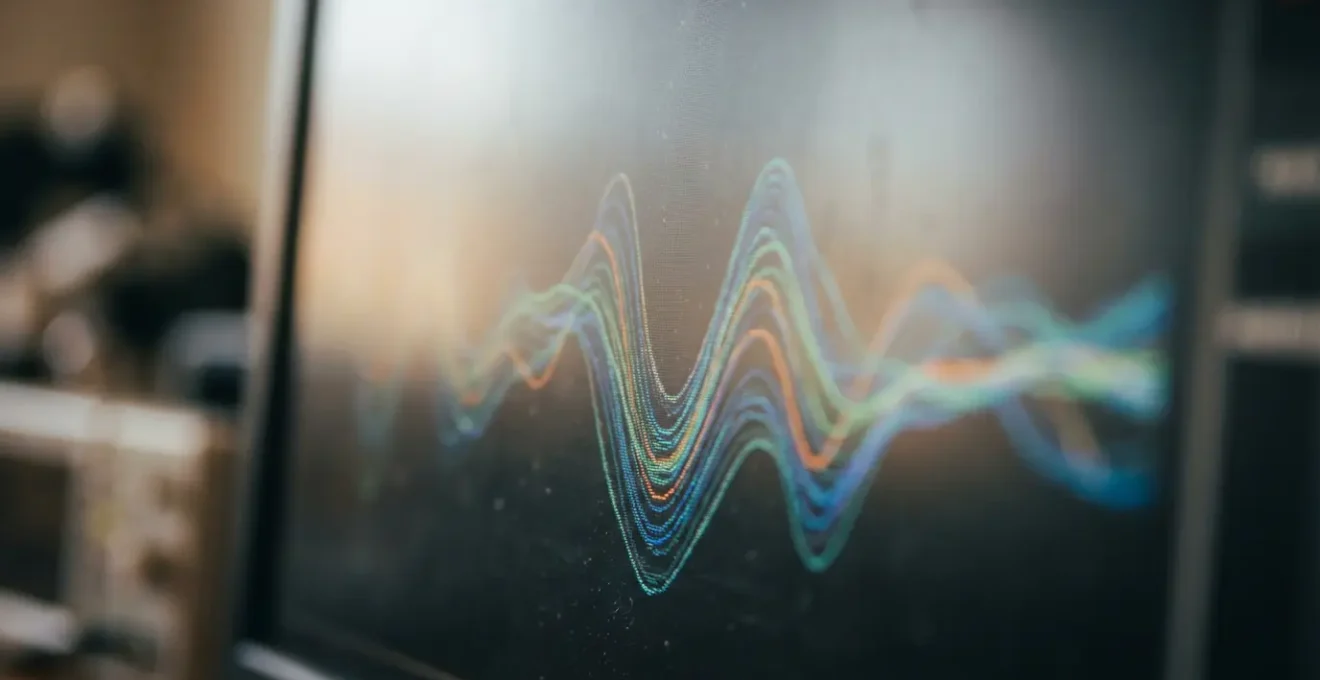
The most powerful technique is comparative analysis. By overlaying the graph of a “good” repetition with a “bad” one, the differences become immediately apparent. You don’t need to know what the ideal degrees-per-second is; you just need to see that on your best shots, the hip rotation peak occurs *before* the shoulder rotation peak, and on your worst shots, that sequence is reversed. The data simply confirms the feeling, giving you a clear, visual target for improvement.
How to position IMUs (Inertial Measurement Units) for accurate jump height data?
While high-speed cameras analyze movement from the outside, Inertial Measurement Units (IMUs) provide a view from within. These small, wearable sensors, containing accelerometers and gyroscopes, attach directly to the body or equipment to measure forces, orientation, and gravitational forces. They are the technology behind everything from your phone’s screen orientation to the guidance systems in spacecraft. In sports, they offer an unprecedented level of detail on an athlete’s movement dynamics.
However, the accuracy of IMU data is critically dependent on one factor: placement. An IMU’s data is only as good as its reference point. For analyzing jump height, for example, placing a single sensor on the lower back (near the body’s center of mass) is a common and effective protocol. If the sensor is placed too high, too low, or off-center, it will introduce errors into the calculation, leading to inconsistent and unreliable jump height readings. The sensor must be secured tightly to prevent movement relative to the body, as any slippage will be misinterpreted as athletic movement.
The precision required might seem daunting, but it’s what guarantees data integrity. When protocols are followed correctly, the results are remarkably accurate. In fact, for temporal jump variables, validation studies show that AI-driven systems using IMUs achieve exceptional agreement when compared to “gold-standard” optical motion capture systems. This means that with proper setup, this portable technology can deliver lab-quality insights on metrics like ground contact time, flight time, and reactive strength—data points that are invisible to the eye but are direct indicators of explosive power.
Smartphone Apps vs. 3D Motion Capture: Is the $500 session worth it?
The biomechanics technology market is expanding rapidly, with the global 3D motion capture system market showing a projected 15% compound annual growth rate. For the tech-savvy athlete, this presents a confusing landscape of options. Can a free smartphone app truly compete with a professional lab session? The answer lies in understanding what each technology can and cannot see.
A smartphone provides a 2D, or planar, view of movement. It’s excellent for analyzing things that happen in a single plane, like the path of a golf club or the general timing of a baseball swing. However, it is blind to rotation and depth. It cannot accurately measure crucial out-of-plane movements like hip-shoulder separation (the “X-factor” in a golf swing) or asymmetrical weight shifts during a jump. This is where 3D motion capture, whether markerless or optical, becomes essential.
The following table breaks down the fundamental trade-offs between cost, accuracy, and application for these different tiers of technology.
| Technology | Cost Range | Accuracy | Best Use Cases | Limitations |
|---|---|---|---|---|
| Smartphone Apps (2D) | $0-200 | Good for planar movements | Swing path, timing analysis, beginner corrections | Misses asymmetrical weight shifts, out-of-plane movements |
| Multi-camera markerless | $5,000-20,000 | High for 3D movements | Team analysis, advanced technique | Setup complexity, processing time |
| 3D Motion Capture (Optical) | $50,000-200,000+ | Sub-millimeter precision | Research, injury prevention, subtle rotations | Lab environment required, marker placement critical |
So, is the professional session worth it? If your issue is a simple planar flaw, a smartphone app may be sufficient. But if you’re a dedicated athlete who has plateaued, it’s highly likely your error is rotational or asymmetrical—invisible to 2D analysis. The value of a professional session is its ability to diagnose these 3D errors with sub-millimeter precision. The gap is closing, however. Systems like Stanford’s OpenCap are democratizing the science by using two synchronized smartphones to generate 3D biomechanical data at a fraction of the traditional cost, but it still represents a significant step up from a single-camera app.
Key Takeaways
- Human perception is the primary bottleneck; your brain is neurologically primed to miss your own micro-errors on video.
- Critical performance flaws often occur at a millisecond level, a speed that makes them invisible without high-speed cameras or sensor technology.
- The goal of data analysis is not just to correct form, but to retrain your physical feel, creating a “data-driven proprioception.”
Paralysis by Analysis: The risk of checking your swing after every shot
The power of digital analysis comes with a significant risk: information overload. The temptation to check the data after every single repetition is immense, but this behavior can be deeply counterproductive. It traps the athlete in a state of constant conscious correction, preventing the movement from ever becoming fluid and automatic. This condition is known as paralysis by analysis.
The core of the problem lies in how the brain learns motor skills. There are two primary modes of learning: implicit (learning by feel and repetition) and explicit (consciously thinking about body parts and movements). Effective performance relies on the implicit system. As sports scientist Philip Graham explains, constant data-checking disrupts this natural process.
Data analysis forces the brain into explicit mode (consciously thinking about body parts), which disrupts the fluid, automated execution learned via implicit mode (feel and repetition). Over-analysis prevents the skill from becoming automatic.
– Philip Graham, Sportsmith – How to use video analysis effectively
The goal of technology is not to replace proprioception but to refine it. Data should be used to link an objective insight to a physical sensation that the athlete can then reproduce without the need for constant monitoring. To achieve this, a structured feedback protocol is essential.
Action Plan: Feedback Protocols to Prevent Analysis Paralysis
- Implement the ‘1-in-5 Rule’: Perform five repetitions but only analyze the video or data for one. Use that single data point to inform the physical *feeling* you will try to replicate for the next four repetitions.
- Shift from Internal to External Focus Cues: Instead of telling yourself “rotate your hips 10 degrees more” (internal), use a data-informed external cue like “push the ground away more forcefully with your right foot.” External cues are proven to be more effective for motor learning.
- Link Data to Sensation: After reviewing a data point (e.g., “your hand speed was 5 mph faster”), immediately perform a practice swing and ask, “What did that *feel* like?” The objective is to anchor the successful number to a physical sensation.
- Schedule ‘Data-Free’ Sessions: Dedicate entire practice sessions where no technology is used. This forces the brain to rely on the newly refined implicit system, consolidating the learning.
- Define a Single KPI per Session: Do not try to fix everything at once. Dedicate each session to improving one single Key Performance Indicator (KPI), such as club head velocity or ground contact time.
How to give feedback based on data without overwhelming the student?
Collecting precise data is only half the battle. The final, and arguably most critical, step is translating that data into simple, actionable feedback that an athlete can absorb and implement without feeling overwhelmed. A screen full of graphs and numbers is more likely to cause confusion than improvement. The key is a disciplined approach to communication that prioritizes clarity over comprehensiveness.
One of the most effective methods is the “Digital Feedback Sandwich.” It structures the conversation to be positive, focused, and motivational. The process is simple:
- Start with a positive, data-proven fact. Find a metric that has improved, no matter how small. (“Your peak bat speed is up 2 mph since last week.”) This builds confidence and makes the athlete receptive to feedback.
- Provide ONE single, actionable correction linked to specific data. This is the most important rule. Resist the urge to point out multiple flaws. (“The graph shows your hips are firing 0.1s after your hands. For this next set, let’s focus *only* on making the hips initiate the swing.”)
- End with an encouraging, tangible outcome. Connect the specific correction to a desired result. (“Nailing this hip timing is what will stop you from pulling the ball foul.”)
This “less is more” philosophy extends beyond verbal feedback to the design of the technology itself. The most effective systems use tiered information delivery to avoid distracting the athlete.
Case Study: Tiered Data Dashboard Implementation
Leading sports video analysis platforms are now integrating directly with player tracking systems like Catapult. This creates a holistic view, blending visual footage with quantitative data. Successful implementations of this technology rarely show the athlete the full, complex dashboard available to the coach. Instead, they utilize a tiered system. The coach’s dashboard displays comprehensive data for deep analysis, while the athlete’s view is simplified to show only two or three KPIs relevant to their current developmental goals. As the athlete masters a skill, their KPIs are updated. This prevents them from being distracted by metrics that are not relevant to their immediate focus, ensuring the data serves as a guide, not a distraction.
By moving from raw data to focused, actionable insights, you close the loop, turning invisible errors into visible, repeatable improvements. The future of athletic development is not about more data, but more intelligent feedback.