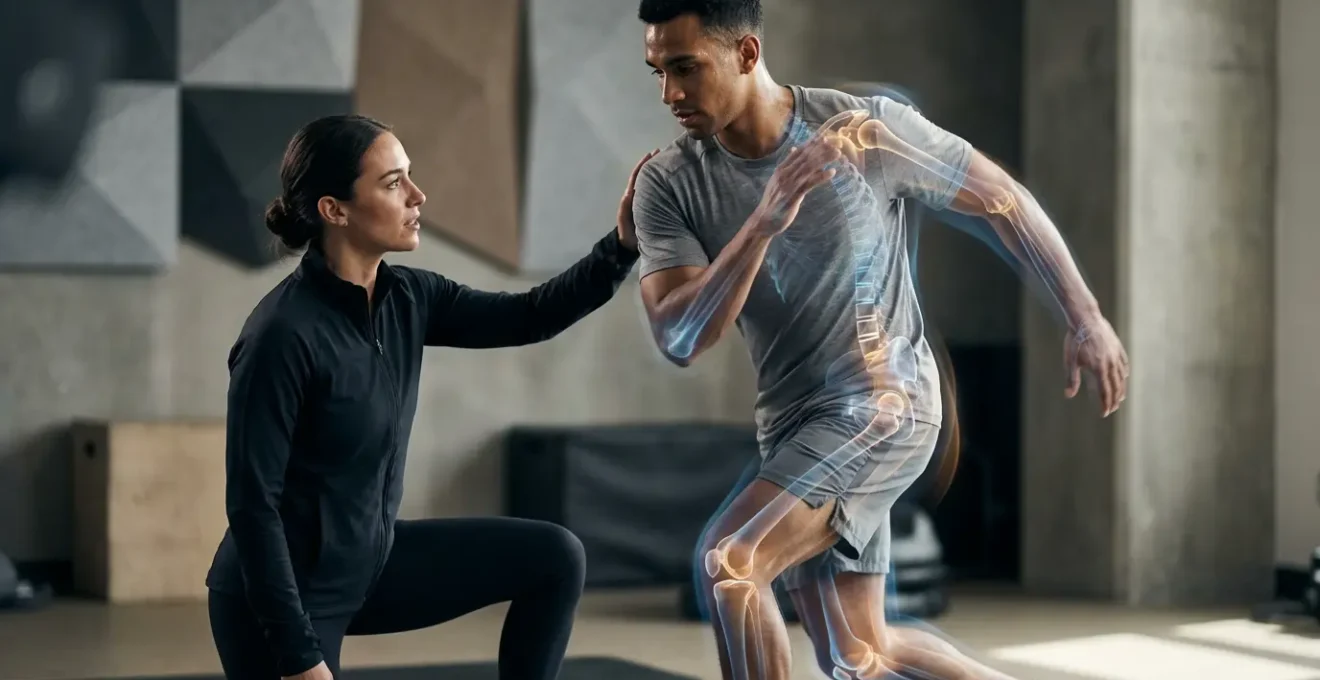
The hard truth: you cannot see your own biggest flaws. Filming yourself is a step, but your brain is wired to miss the critical kinetic chain errors that a certified coach spots instantly.
- Self-teaching often builds “technical debt”—bad habits that are harder and more expensive to fix later.
- Following unqualified social media “gurus” is a direct path to chronic injury, not elite performance.
Recommendation: Stop gambling with free but flawed advice. Investing in a qualified coach is the most efficient and cost-effective path to unlocking your real potential and avoiding the surgeon’s table.
You’re standing at a crossroads. In one hand, you have your smartphone, a gateway to an infinite library of free YouTube tutorials, Instagram drills, and blog posts promising to fix your form. In the other, a potential invoice for a certified coach that feels like a serious chunk of your budget. For the budget-conscious amateur, the choice seems obvious: why pay for something you can get for free? You’re dedicated, you can film yourself, and you’re willing to put in the work. That’s enough, right?
Let’s be blunt. That thinking, while logical, is the very reason so many promising athletes hit a permanent plateau or end up with a nagging, chronic injury. The common advice is to “be consistent” or “analyze your videos,” but this overlooks a fundamental, biological blind spot. The issue isn’t your work ethic; it’s that your brain and eyes are physically incapable of providing the feedback you actually need to improve complex motor skills. You’re trying to perform surgery on yourself by looking in a mirror.
This isn’t about luxury or having someone to motivate you. This is about return on investment. The real question isn’t “Can I afford a coach?” but rather, “Can I afford the time, progress, and physical health I’ll lose by *not* hiring one?” This guide breaks down the non-negotiable value of expert coaching, showing you why it’s the fastest path to fixing technique, why self-analysis is an illusion, and how to ensure every dollar you spend on coaching delivers maximum returns.
To navigate this crucial decision, this article provides a clear roadmap. We will dissect the science behind movement, demystify the coaching landscape, and provide actionable strategies to maximize your athletic investment.
Summary: Certified Coach vs. Self-Taught: An Investment Analysis
- Why you cannot see your own kinetic chain errors on video?
- How to verify a coach’s certification and track record effectively?
- Technical vs. Tactical Coach: Who do you need right now?
- The injury risk of following Instagram fitness gurus for sport-specific training
- How to prepare for a lesson to get $200 of value out of $100?
- Why your trainer makes you lift heavy when you want to be fast?
- The illusion of “wrist snap” that ruins junior players’ wrists
- How a Trainer Scripts Your Peak Performance for Championship Month?
Why you cannot see your own kinetic chain errors on video?
The core illusion of self-teaching is the belief that video playback is a substitute for a coach’s eye. It isn’t. The problem is a combination of biomechanics and neurobiology. Your kinetic chain is a sequence of movements flowing through your body to produce an action, like a throw or a swing. A tiny error at the hip can cause a massive, injury-inducing compensation in the shoulder. When you watch yourself on video, you’re looking for the obvious error—the one at the end of the chain. A real coach is looking at the origin.
Furthermore, you have what are called “proprioceptive blind spots.” You can’t accurately feel what your body is doing in space during a fast, complex movement. You might *feel* like your back is straight or your hips are rotating, but the video shows something else. The issue is that you lack the trained eye to spot the subtle, milliseconds-long deviations that matter. A study of biomechanics confirms that there is often no single “correct” technique; a movement must be optimized for an individual’s unique body structure. A generic YouTube tutorial can’t do that; it provides a one-size-fits-all model that may be inefficient or even dangerous for you.
Ultimately, a coach’s value is in providing external, expert feedback. The process of improvement relies on a loop: perform, receive feedback, adjust, perform again. When you are your own coach, the feedback loop is corrupted. You are both the flawed performer and the unqualified judge. An expert provides the objective data point you are biologically incapable of generating on your own, as biomechanical analysis reveals that true improvement comes from observing and imitating optimal patterns with expert guidance.
How to verify a coach’s certification and track record effectively?
Once you accept the need for a coach, the next challenge is navigating a market flooded with self-proclaimed experts. A certification on a business card means nothing without verification. The difference between a true professional and a charlatan can be vast, as some certification depth varies significantly as some programs can be completed in a weekend, while others require months of rigorous study and practical exams.
Don’t be shy about performing due diligence. You are hiring a professional for a critical job. Treat it like a job interview, because it is. Ask for credentials and, more importantly, verify them. A legitimate coach will respect this process; a fraudulent one will be defensive. Your goal is to find someone with a deep, verifiable foundation in exercise science, biomechanics, and pedagogy.
To cut through the noise, follow a systematic process to vet a potential coach. This ensures you’re investing in genuine expertise, not just a charismatic personality with a good social media presence.
Your Action Plan: Verifying a Coach’s Credentials
- Check for Elite Certifications: For strength and conditioning, look for credentials like SCCC (Strength and Conditioning Coach Certified) or the NSCA-CSCS (Certified Strength and Conditioning Specialist). These are widely regarded as the gold standards.
- Verify National Governing Body Credentials: For sport-specific coaching, check for certifications from the official national governing body (e.g., USA Swimming, USTA). Aim for coaches with Level 4 or higher credentials.
- Request Proof of Continuing Education: Top-tier certifications require ongoing learning to remain valid. Ask to see proof that their knowledge is current, not based on a course they took a decade ago.
- Inquire About Teaching Experience: A background in teaching, especially at a vocational college or university level, often indicates a deeper understanding of how to transfer knowledge effectively.
- Talk to Past or Current Athletes: The best proof is in the results. Ask for references and speak to other athletes they have trained. Ask about progress, communication style, and their overall experience.
Technical vs. Tactical Coach: Who do you need right now?
Hiring a “coach” is too generic. To maximize your investment, you must first diagnose what you truly need. Coaching falls into two broad categories: technical and tactical. A technical coach is a biomechanics expert. They are obsessed with *how* you move. They rebuild your swing, your stride, or your lift from the ground up, focusing on efficiency, power production, and injury prevention. A tactical coach is a strategist. They are focused on *what* you do in a competitive situation. They teach game sense, decision-making under pressure, and how to exploit an opponent’s weaknesses.
For an amateur athlete hitting a wall, the problem is almost always technical. You can’t execute a strategy if your fundamental movements are flawed. Trying to learn advanced tactics with poor technique is like trying to write a novel when you can’t form proper sentences. You must fix the foundation first. This is a long-term investment in your athletic future, correcting the “technical debt” you’ve accumulated from self-teaching.
The following table breaks down the key differences to help you identify which type of expert will provide the highest return on your investment at your current stage.
| Aspect | Technical Coach | Tactical Coach |
|---|---|---|
| Primary Focus | Movement mechanics, form correction, biomechanics | Strategy, game planning, decision-making |
| Best For | Beginners to intermediates; athletes with form issues | Advanced athletes; competition preparation |
| Timeline | Long-term investment (months to years) | Short-term gains (weeks to months) |
| Key Goal | Build a durable, efficient movement pattern. | Win the next game or match. |

As the visual suggests, these two roles exist on a spectrum. An elite coach will have skills in both areas, but they will always have a primary specialty. For the budget-conscious athlete looking for the fastest fix, identifying your main bottleneck—technique or strategy—is the first step to ensuring your money is well spent.
The injury risk of following Instagram fitness gurus for sport-specific training
The “free” advice from social media fitness influencers comes with a hidden, and often exorbitant, cost: your physical health. These platforms reward visual flair and novelty, not sound biomechanical principles. A flashy, complex-looking drill gets more likes than a video on proper hip hinge mechanics, but the latter is infinitely more valuable. The result is a generation of athletes attempting advanced, often inappropriate exercises without the foundational strength or technique to perform them safely.
The statistics are alarming. In the US alone, emergency departments reported 564,845 injuries from exercise and exercise equipment in 2024, a significant increase from the previous year. This trend is not a coincidence. It directly correlates with the rise of fitness trends promoted by unqualified individuals. For example, one study highlighted a 144% increase in workout-related injuries that correlated with the explosion of High-Intensity Interval Training (HIIT) programs, often followed without proper supervision.
This is the “Guru Trap.” You follow someone with a great physique, assuming their methods are sound. But you don’t see their genetic advantages, their years of foundational training, or the fact that their program may be completely wrong for your sport or body type. A powerlifting influencer’s advice is likely detrimental for a tennis player who needs rotational power, not just brute strength. A certified coach understands sport specificity and prescribes work that directly enhances performance in *your* discipline, while actively mitigating injury risk. That is a service no Instagram feed can provide.
How to prepare for a lesson to get $200 of value out of $100?
Hiring a coach isn’t a passive transaction; it’s an active collaboration. The amount of value you extract from a session is directly proportional to the quality of your preparation. Showing up and saying “fix me” is a waste of time and money. To get a 2x return on your investment, you must arrive as an informed partner, ready to work.
As a scout, I can tell within five minutes which athletes respect their own investment. They come with notes, videos, and specific questions. They have done the homework. They treat their one-hour session like a high-stakes board meeting. The coach doesn’t have to waste the first 20 minutes on discovery; they can get straight to analysis and correction. This is the single biggest differentiator between athletes who make rapid progress and those who spin their wheels.
Tools like mirrors and slow-motion video provide invaluable feedback, helping athletes visually assess and correct their technique.
– Fitbudd Academy, Biomechanical Analysis Guide
The key, however, is that these tools are most powerful when used to prepare *for* a lesson. They help you gather the data that your coach will then interpret. Here is your pre-lesson checklist to transform an expensive hour into an invaluable investment:
- Document Your Issues: Don’t just say “my serve is off.” Write down exactly what it feels like. “When I serve, I feel a pinch in my shoulder, and the ball consistently goes into the net.” Be specific.
- Bring Video Evidence: Record yourself performing the problem movement from multiple angles (front, side, back). A 30-second clip is worth 10 minutes of verbal description. This allows the coach to see the fault immediately.
- Prepare Specific Questions: Go beyond “What am I doing wrong?” Ask “I noticed my left hip drops during this movement. Why is that happening and what’s the first step to fixing it?” This shows you’ve already engaged in the process.
- Set A Measurable Goal for the Session: Define what a successful lesson looks like. For example: “By the end of this hour, I want to be able to perform a bodyweight squat with correct form for 5 reps” or “I want to understand the main feeling I should have in my core during rotation.”
Why your trainer makes you lift heavy when you want to be fast?
It’s one of the most common complaints from athletes new to structured training: “Why are we lifting heavy, slow weights? I’m a sprinter/pitcher/fighter. I need to be fast and explosive!” This skepticism is understandable, but it’s based on a misunderstanding of how the human body generates power. A good coach knows that strength is the foundation of speed. Making you lift heavy isn’t a random decision; it’s a direct application of biomechanical law.
The principle at play is the force-velocity curve. This fundamental concept in kinesiology describes an inverse relationship: the faster a muscle contracts, the less force it can produce. Why? Because muscular force is generated by tiny protein structures called “cross-bridges” latching onto each other. The more time they have, the more connections they can make, and the greater the force. According to a deep dive into the force-velocity curve, slower-paced activities enable the formation of more cross-bridges, thus generating more force.

By lifting heavy (high force) at slow speeds, your coach is training your neuromuscular system to recruit a maximum number of muscle fibers and build as many cross-bridges as possible. This increases your absolute strength potential. Once you have built a higher ceiling for force production, the coach will then transition you to lighter, faster movements (power training) to teach your body how to apply that force *quickly*. Without the initial phase of heavy lifting, you simply have less force to apply. You can’t shoot a cannon from a canoe. Lifting heavy builds the cannon.
The illusion of “wrist snap” that ruins junior players’ wrists
One of the most dangerous cues in youth sports is “snap your wrist.” It’s taught in tennis, baseball, and countless other sports, and it’s a biomechanical catastrophe waiting to happen. It encourages athletes to generate power from a small, fragile joint at the very end of the kinetic chain. This not only leads to weak, inconsistent performance but is also a primary cause of chronic wrist and elbow injuries among young players. The numbers show that youth athletes face significant risks with 3.5 million sports injuries reported annually in the US for those under 17.
The “snap” an observer sees in an elite athlete is not the cause of power; it is the *effect*. It is the final, relaxed release of a whip-like motion that originates in the legs and hips. Power is generated from the ground up, transferred through the core, and channeled through the arm. As explained in an analysis of whip-like energy transfer, the hip joint acts like a hinge, slinging the limb forward by engaging the powerful glute and core muscles. The wrist and hand are just the tip of the whip.
A self-taught player, watching a pro on YouTube, tries to mimic the last thing they see—the wrist snap. They spend hours strengthening their forearm and trying to force that snapping motion, leading to tendonitis and instability. A certified coach does the opposite. They put the racket or bat down and spend the first session teaching the athlete how to perform a proper “medicine ball rotational throw.” They force the athlete to generate power from their core, teaching them the correct sequencing from the ground up. They fix the engine, not the tailpipe.
Key Takeaways
- Self-coaching is fundamentally flawed; you cannot be an objective observer of your own complex movements.
- The ROI of a certified coach is measured in faster progress, broken plateaus, and, most importantly, injury prevention.
- Verifying a coach’s credentials (CSCS, SCCC) is a non-negotiable step to protect your investment and your health.
How a Trainer Scripts Your Peak Performance for Championship Month?
Perhaps the most valuable, and least understood, service a coach provides is “performance scripting.” This is the art and science of periodization: the long-term, systematic planning of training to ensure an athlete reaches their absolute peak at a specific time, like a championship or a new season. This is the opposite of the random, “workout of the day” approach common among self-taught athletes. It’s a strategic roadmap to success.
A coach divides your year into distinct phases: a general preparation phase to build your base, a specific preparation phase to hone sport-specific skills, a pre-competition phase, a competition taper to maximize recovery and power, and a transition phase for active rest. Each phase has a specific goal, and the volume and intensity of training are meticulously manipulated to elicit the desired adaptation without causing burnout or injury. This level of long-term planning is what separates amateurs from professionals. It also helps justify the investment, as professional coaching represents a significant investment as shown by median wages in the field.
This “script” is tailored to you. It accounts for your goals, your recovery rate, your competition schedule, and your life outside of sport. It’s a living document that a coach adjusts based on your weekly progress and feedback. This is the ultimate service you’re paying for: a strategic partner who manages your most valuable athletic asset—your physical potential. You can’t download this level of personalization from the internet.
Stop gambling with your potential and your health. The evidence is clear: the fastest, safest, and most cost-effective way to improve is to partner with a professional. Evaluate your needs, do your due diligence using the framework provided, and invest in a certified coach. It’s the most important competitive decision you will make.