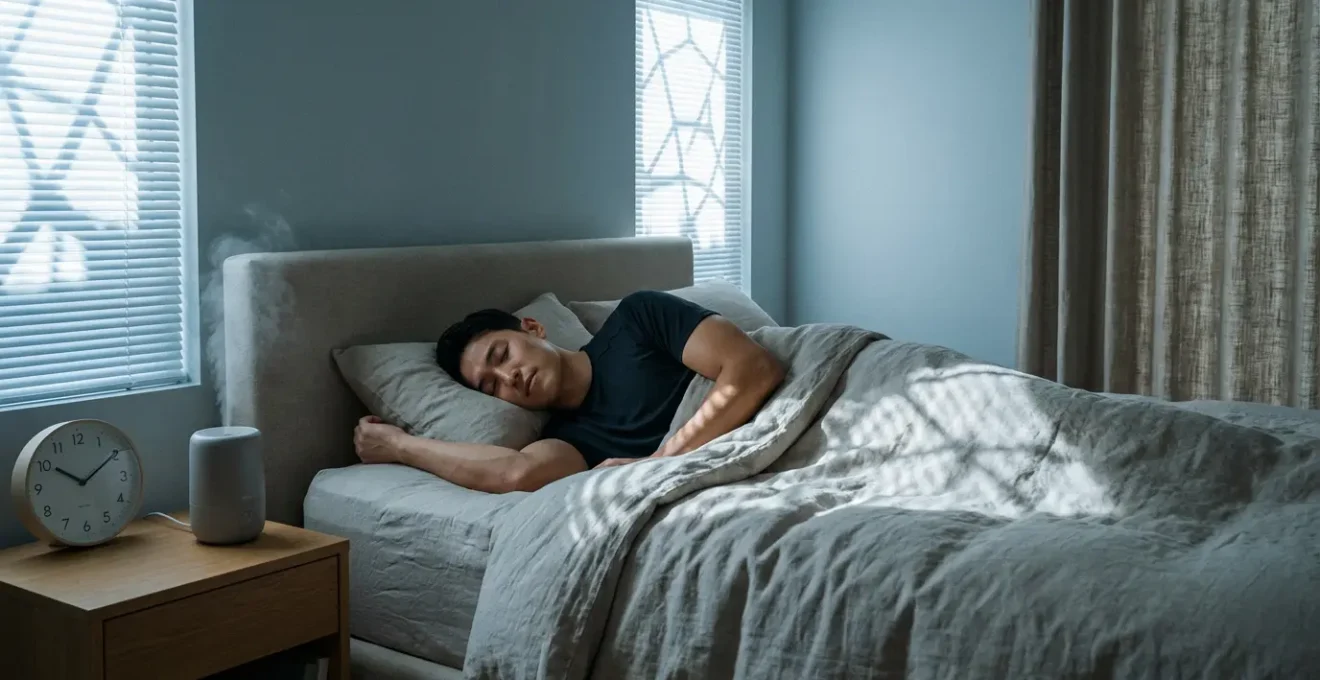
The key to faster reaction time isn’t just more sleep; it’s mastering your sleep architecture to maximize cellular repair.
- Deep sleep is for physical repair (muscle growth, waste clearance), while REM sleep refines motor skills and technique.
- Simple environmental triggers like bedroom temperature and light color have a dramatic, measurable impact on sleep quality and hormone release.
Recommendation: Instead of focusing on sleep duration, implement precise protocols to control your sleep environment and wind-down routine to architect the specific sleep stages you need for recovery.
You feel it after a grueling match or a double-day practice. The physical exhaustion is one thing, but the mental fog—the slight delay in your reaction off the blocks, the split-second hesitation on a pass—is what truly costs you. As a professional athlete, you’re told the answer is simple: get more sleep. But between a packed travel schedule, late-night competitions, and the pressure to perform, getting a full eight hours can feel like an impossible luxury.
The conventional wisdom to “sleep more” or “avoid caffeine before bed” is not wrong, but it is incomplete. It fails to address the unique physiology of an elite performer. The truth is, for an athlete, not all sleep is created equal. The difference between winning and losing can be found in the granular details of your sleep cycles, the very architecture of your nightly rest.
This is where we must shift the conversation. What if the key wasn’t simply a longer duration of unconsciousness, but a more strategic, targeted approach to sleep itself? This guide is built on a firm biological principle: you can learn to control the triggers that induce specific, high-value sleep stages. It’s not about adding hours to your night; it’s about adding quality, repair, and performance to the hours you have.
We will dissect the distinct roles of deep sleep and REM, explore how to manipulate your environment to enhance them, and provide concrete protocols to manage the hormonal aftermath of competition. This is your playbook for turning sleep into a precision tool for superior athletic performance.
Summary: Architecting Sleep for Peak Athletic Reaction Time
- Why “Deep Sleep” repairs muscles while “REM” repairs technique?
- How to set your bedroom thermostat to trigger hibernation mode?
- Magnesium vs. Melatonin: Which is safer for long-term athletic performance?
- The adrenaline mistake: Why you can’t sleep after a 9 PM match (and what to do)
- The “Nappuccino”: How to time caffeine and a nap for a PM energy peak?
- The lighting mistake in relaxation zones that disrupts melatonin production
- When does the body release the most growth hormone during sleep?
- Why Immersive Training Environments Reduce Perceived Exertion Levels?
Why “Deep Sleep” Repairs Muscles While “REM” Repairs Technique?
As an athlete, you need two distinct types of recovery every night: physical and neural. Your sleep is intelligently designed to handle both, but it delegates these tasks to different phases. Understanding this division is the first step in architecting your sleep for performance. Deep Sleep (Slow-Wave Sleep) is your body’s primary physical repair shop. During these crucial early-night hours, your body focuses on cellular regeneration, tissue repair, and muscle growth. This is also when your brain performs critical maintenance.
The brain’s glymphatic system, a network that clears out metabolic waste, becomes hyper-efficient during deep sleep. Groundbreaking research from Science journal shows a 60% increase in the interstitial space in the brain, allowing cerebrospinal fluid to flush out toxins like beta-amyloid, which can impair cognitive function and reaction time if they accumulate.

In contrast, REM (Rapid Eye Movement) sleep is your mental rehearsal studio. Occurring in cycles later in the night, this is when your brain consolidates procedural memories. The complex motor patterns you practiced during training—the subtle adjustment in your swing, the footwork of a new play—are encoded and refined during REM. While deep sleep rebuilds the hardware (your body), REM sleep upgrades the software (your technique). Prioritizing uninterrupted sleep in the first half of the night is therefore non-negotiable for physical recovery, while protecting the later hours ensures your hard-earned skills are locked in.
How to Set Your Bedroom Thermostat to Trigger Hibernation Mode?
Your body’s core temperature is a powerful, primal trigger for sleep. A slight drop in core temperature is one of the key signals your brain uses to initiate sleep. You can leverage this biological mechanism by turning your bedroom into a cool sanctuary that encourages the transition into deep, restorative sleep. The goal isn’t just comfort; it’s to create a thermal environment that actively promotes the most physically reparative sleep stages.
The ideal temperature range for sleep is surprisingly cool. For optimal deep sleep, you should aim for a room temperature between 60-67°F (15-19°C). Temperatures in this range facilitate the natural drop in core body temperature required to fall asleep and, more importantly, stay in the deeper stages of sleep where muscle repair and hormone release are maximized. A room that is too warm (above 72°F or 22°C) can lead to more frequent awakenings and fragmented sleep, robbing you of vital recovery time.
The performance benefits of this are not theoretical. A famous study with Stanford basketball players demonstrated the profound impact of sleep extension in a cool environment. By extending their sleep to 10 hours a night in a room kept between 60-67°F, players showed a remarkable 9% improvement in shooting accuracy and faster sprint times. This wasn’t just about getting more sleep; it was about getting more high-quality sleep, triggered by the right thermal cues.
Magnesium vs. Melatonin: Which Is Safer for Long-Term Athletic Performance?
In the quest for better sleep, many athletes turn to supplements. Melatonin and magnesium are the two most common, but they are not interchangeable. For long-term, sustainable performance, understanding their different mechanisms is crucial. Melatonin is a hormone that signals “nighttime” to your brain, helping to regulate your circadian rhythm. While effective for jet lag or occasional resets, long-term daily use of melatonin can be problematic for an athlete. It can downregulate your body’s own natural production and, more critically, may blunt the morning cortisol awakening response, leaving you groggy and affecting training readiness.
Magnesium, on the other hand, is a mineral that plays a different role. It doesn’t force a sleep signal but instead supports the body’s relaxation processes. It works by activating the parasympathetic nervous system (the “rest and digest” system) and regulating neurotransmitters that promote calm. It helps quiet the nervous system, preparing the body for sleep without directly interfering with your natural hormonal cycles.
For athletes, the form of magnesium matters. Magnesium Glycinate is the preferred choice due to its high bioavailability and because the glycine molecule itself has calming properties. It effectively supports sleep onset without the risk of dependency or disrupting the crucial hormonal balance needed for morning alertness and peak performance. A typical dose of 200-400mg taken 30-60 minutes before bed can significantly improve sleep quality by reducing nervous system excitability, making it a much safer and more sustainable tool in your recovery arsenal.
The Adrenaline Mistake: Why You Can’t Sleep After a 9 PM Match (and What to Do)
You know the feeling: the stadium lights are off, but your mind is still racing. Despite being physically exhausted after a late-night game, sleep feels impossible. This isn’t a failure of discipline; it’s a predictable biological reality. High-intensity competition floods your system with cortisol and adrenaline—the “fight or flight” hormones. Your body is physiologically wired for peak alertness, not for rest. Lying in bed and simply “trying” to sleep is a losing battle against your own biochemistry.
The mistake is waiting for the adrenaline to wear off on its own. You must actively signal to your body that the “threat” is over and it’s safe to power down. This requires a dedicated wind-down protocol designed to intentionally shift your nervous system from a sympathetic (alert) state to a parasympathetic (rest) state. According to the Sleep Foundation, this is critical, as their research shows that sleep-deprived athletes are 1.7 times more likely to suffer an injury. Your post-game routine is an essential part of injury prevention.
Instead of scrolling on your phone or replaying the game in your head, implement a non-negotiable, sensory-based wind-down. This isn’t about distraction; it’s about physiological intervention. The goal is to stimulate the vagus nerve, the main pathway of your parasympathetic nervous system, to manually apply the brakes on your stress response.
Your Action Plan: The 30-Minute Post-Game Wind-Down Protocol
- Minute 0-5: Physiological Sighing. Inhale fully through your nose, then take another short sip of air at the top. Exhale slowly and fully through your mouth. Repeat the 4-7-8 breathing pattern to activate the parasympathetic response.
- Minute 5-10: Cold Water Immersion. Immerse your face in a bowl of cold water (10-15°C or 50-60°F) for 30-second intervals. This powerful technique directly stimulates the vagus nerve.
- Minute 10-15: Low-Frequency Humming. The vibrations from humming or chanting create a gentle, internal massage for the vagus nerve, further enhancing a state of calm.
- Minute 15-20: Targeted Nutrition. Consume a small carbohydrate snack, such as a banana with a small glass of tart cherry juice, to help facilitate tryptophan uptake in the brain, a precursor to melatonin.
- Minute 20-30: Progressive Muscle Relaxation. In a cool, dark room, systematically tense and then release each muscle group, from your toes to your face, to discharge residual physical tension.
The “Nappuccino”: How to Time Caffeine and a Nap for a PM Energy Peak?
For an athlete with early morning and late afternoon training sessions, the midday energy slump is a significant performance barrier. The “Nappuccino” is a scientifically validated bio-hack to combat this. It combines the strategic use of caffeine and a short nap to create a powerful synergistic effect, providing a sharp peak in alertness and reaction time just when you need it for your second training block.
The mechanism is elegant. Caffeine works by blocking adenosine receptors in your brain. Adenosine is a compound that builds up throughout the day, causing feelings of sleepiness. A short nap naturally clears adenosine from the brain. By consuming caffeine right before a 20-minute nap, you get a double benefit: the nap clears out existing adenosine, and you wake up just as the caffeine is kicking in to block the receptors from any remaining adenosine. This results in a much more potent and clean feeling of alertness than either caffeine or a nap alone could provide.
The timing is everything. A study on elite swimmers showed that those who implemented strategic 20-minute naps before afternoon training had 17% faster reaction times off the diving blocks. To execute the perfect Nappuccino, follow this precise protocol:
- Check the Time: This technique must be used before 4 PM to avoid disrupting your nighttime sleep architecture, particularly your deep sleep.
- Consume Caffeine Quickly: Drink a cup of coffee or an equivalent of 100-150mg of caffeine rapidly.
- Set a Strict Alarm: Set your alarm for exactly 20-25 minutes. Do not exceed 30 minutes, as this risks entering deep sleep and waking up with sleep inertia (grogginess).
- Nap Immediately: Lie down in a cool, dark, quiet space as soon as you finish your coffee.
- Wake and Expose to Light: When the alarm goes off, get up immediately and expose yourself to bright light for a few minutes to signal to your brain that the nap is over.
The Lighting Mistake in Relaxation Zones That Disrupts Melatonin Production
You’ve meticulously designed your training and nutrition, but you may be sabotaging your recovery with a single, overlooked factor: the light in your environment after sundown. Your brain’s production of melatonin, the hormone that orchestrates sleep, is exquisitely sensitive to light—not just its brightness, but also its color. The bright, blue-spectrum light emitted by standard overhead lighting and all electronic screens is a powerful suppressor of melatonin.
Being in a brightly lit environment in the hours before bed sends a strong “daytime” signal to your brain, effectively slamming the brakes on melatonin production. This delays sleep onset, reduces sleep quality, and impairs the crucial repair processes that are supposed to happen overnight. The performance impact is severe; research shows tennis players can experience a 53% drop in serve accuracy after just one night of restricted, poor-quality sleep. Your relaxation zone, if lit improperly, can become a zone of hormonal disruption.
The solution is to create a “virtual sunset” in your home. In the 2-3 hours before your intended bedtime, you must transition to light that is both dim and warm in color (more red/orange, less blue/white). This mimics the natural light environment of dusk, allowing melatonin to rise naturally and prepare your body for deep sleep. The difference between light sources is not subtle; it is a powerful biological signal.
This table illustrates just how dramatically different light environments affect your physiology.
| Light Condition | Lux Level | Color Temperature | Melatonin Suppression |
|---|---|---|---|
| Overhead bright white | 100+ lux | 5000K+ | 90% suppression |
| Warm ceiling light | 50-100 lux | 3000K | 50% suppression |
| Low-level lamp | 10-50 lux | 2700K | 20% suppression |
| Candlelight equivalent | <10 lux | <2200K | Minimal impact |
When Does the Body Release the Most Growth Hormone During Sleep?
Human Growth Hormone (HGH) is one of the most powerful restorative substances your body produces. For an athlete, it is the master key to muscle repair, bone density, and overall recovery. While HGH is released in pulses throughout the day, the single largest and most significant release happens during one specific phase of your nightly sleep. Understanding when this occurs allows you to structure your sleep and pre-sleep routine to maximize this crucial hormonal event.
The vast majority of HGH secretion is tied directly to your first major cycle of deep sleep. In fact, sports neurology research indicates that up to 75% of your total daily HGH is released during this initial 90-minute deep sleep phase, which typically occurs within the first 1-2 hours after falling asleep. This means that the quality of the very beginning of your night is disproportionately important for physical recovery. Any disruption during this window—a notification, a noise, a room that’s too warm—can blunt this critical HGH pulse and compromise your body’s ability to repair itself.
Therefore, your entire pre-bed routine should be reverse-engineered to protect this sacred 90-minute window. Your goal is to create the ideal physiological conditions that facilitate a quick descent into, and an uninterrupted stay within, that first deep sleep cycle. This involves managing insulin levels, core body temperature, and environmental disturbances.
Your Checklist: Sleep Architecture Optimization for Maximum HGH
- Final Meal Timing: Finish your last meal 3-4 hours before bedtime. This allows insulin levels to drop, as high insulin can inhibit HGH release.
- Temperature Drop Protocol: Take a warm (not hot) shower or bath 90 minutes before bed. This brings blood to the surface of your skin, and the subsequent rapid cooling as you get out of the shower helps lower your core body temperature, signaling sleep.
- Protect the First 90 Minutes: Put your phone on airplane mode and ensure your sleep environment is completely dark, cool, and quiet. This first cycle is non-negotiable.
- Maintain Cool Temperatures: Keep the room temperature consistently between 60-67°F (15-19°C) all night to prevent awakenings that could pull you out of deep sleep.
- Consider Fasting Windows: Practicing a 14-16 hour intermittent fasting window can further enhance HGH secretion during both waking and sleeping hours.
Key Takeaways
- Sleep is not monolithic; deep sleep repairs the body physically, while REM sleep refines motor skills and technique.
- Your environment is a powerful tool. A cool room (60-67°F) and dim, warm light in the evening are non-negotiable biological triggers for high-quality sleep.
- The first 90 minutes of sleep are the most critical for physical recovery, as this is when the majority of your daily Human Growth Hormone (HGH) is released.
Why Immersive Training Environments Reduce Perceived Exertion Levels?
The link between your training and your sleep is a two-way street. While we’ve focused on how sleep impacts performance, the nature of your training also directly impacts your ability to recover. One of the most fascinating new frontiers in sports science is the use of immersive training environments, like virtual reality (VR), and its surprising effect on sleep quality. The key lies in the concept of Perceived Exertion (RPE).
Immersive environments can make a physically demanding workout feel psychologically easier. When an athlete is engaged in a stimulating virtual world, their focus is shifted away from the physical sensations of fatigue and strain. A recent study on athletes using VR training found they reported a 30% lower RPE for the exact same physical workload. This is significant because a lower RPE is directly linked to a lower physiological stress response—specifically, less cortisol production during and after the workout.
This reduction in cortisol is the bridge to better sleep. High cortisol levels from a strenuous workout can linger for hours, directly inhibiting the evening rise of melatonin. As sports neurologist Dr. Vernon Williams explains, “Lower post-training cortisol makes it physiologically easier for the body to initiate the evening rise in melatonin.” By reducing the *perceived* difficulty of a workout, you reduce the hormonal stress, which in turn clears the path for a smoother transition to sleep. The VR training study confirmed this, showing athletes had a 25% improvement in sleep onset latency (they fell asleep faster) on days they used the immersive environment.
Your journey to faster reaction times and peak performance doesn’t end here. It begins with the consistent, disciplined application of these principles. Start tonight by transforming your bedroom into a cool, dark sanctuary and implementing the post-activity wind-down protocol. Mastering your sleep is the ultimate competitive advantage.
Frequently Asked Questions About Sleep Optimization for Athletes
Why is Magnesium Glycinate preferred for athletes?
Magnesium Glycinate has the highest bioavailability and doesn’t interfere with the natural cortisol awakening response, maintaining morning alertness crucial for training.
What are the risks of long-term melatonin use for athletes?
Extended melatonin use can downregulate natural production and potentially blunt the morning cortisol response, affecting training readiness and reaction times.
What’s the optimal magnesium dosage for sleep improvement?
200-400mg of Magnesium Glycinate taken 30-60 minutes before bed supports parasympathetic activation without morning grogginess.