Equip
The landscape of sports equipment has transformed dramatically in recent years. What was once a straightforward choice between different brands of balls, rackets, or shoes has evolved into a complex ecosystem of intelligent training systems, biomechanical sensors, and adaptive technologies. Whether you’re a weekend tennis player seeking to improve your serve or a cyclist tracking every watt of power output, today’s equipment does far more than simply facilitate play—it analyzes, adapts, and optimizes your performance in ways that were unimaginable just a decade ago.
This shift brings both exciting opportunities and genuine challenges. The promise of data-driven improvement is compelling, but the sheer variety of technologies available can feel overwhelming. Understanding how different categories of sports equipment work, what they actually measure, and how to integrate them meaningfully into your training routine is essential for making informed choices. This comprehensive overview explores the major equipment categories transforming athletic training, from automated practice machines to intelligent textiles, helping you navigate this evolving landscape with confidence.
Smart Training Machines and Automation
Automated training equipment represents one of the most significant innovations for athletes who practice solo. Ball machines, robotic trainers, and programmable resistance systems have evolved from simple repetition devices into sophisticated coaching tools capable of replicating complex game scenarios.
How Automation Enhances Solo Practice
Modern training machines excel at delivering high-volume, consistent repetitions—something no human practice partner can sustain indefinitely. A tennis ball machine, for instance, can fire hundreds of serves with precise spin variations, allowing you to groove your return stroke without fatigue on the other side of the net. The key advantage lies in controllable variability: you can program specific sequences that target your weaknesses, whether that’s backhand slice returns or low balls to your forehand side.
However, there’s a subtle trap many users encounter. The rhythmic predictability of machines can create false confidence. Your body begins anticipating the next shot based on timing rather than visual cues and opponent positioning. To counter this, advanced machines now incorporate randomization features—varying speed, spin, direction, and intervals between shots—to better simulate real competitive conditions.
Practical Considerations: Battery Life and Maintenance
When evaluating automated training equipment, portability and power sources matter significantly. Battery-powered units offer flexibility for outdoor court use, but runtime typically ranges from two to four hours before requiring recharge. Corded models provide unlimited operation but restrict positioning. Beyond power concerns, regular maintenance extends longevity considerably:
- Clean ball feeding mechanisms after every fifth session to prevent jamming
- Inspect and replace worn wheels or throwing arms annually
- Store machines in climate-controlled environments when possible to protect electronic components
- Lubricate moving parts according to manufacturer specifications
Quality training machines represent a substantial investment, often ranging from several hundred to several thousand dollars. Proper care ensures years of consistent performance and protects that investment.
Biomechanical Analysis Technology
Perhaps the most profound change in sports equipment involves tools that measure and analyze movement itself. Force plates, swing analyzers, and motion capture systems reveal biomechanical inefficiencies invisible to the naked eye—even to experienced coaches.
Uncovering Hidden Flaws in Technique
Consider a golfer whose swing looks smooth but produces inconsistent ball flight. Traditional video analysis might show nothing obviously wrong, but a sensor attached to the club shaft could reveal a subtle wrist rotation occurring 20 milliseconds too early, disrupting the clubface angle at impact. These devices measure physics of impact—clubhead speed, angle of attack, face orientation, and impact location—with precision impossible through observation alone.
Similarly, force plates used in jumping sports can identify asymmetries between left and right leg power output. An athlete might feel balanced, yet produce 15% more force through their dominant leg. Over time, this imbalance can lead to overuse injuries and performance plateaus. The technology makes the invisible visible, providing actionable targets for improvement.
The Risk of Over-Analysis and Integration Challenges
Despite their power, biomechanical tools present a significant danger: paralysis by analysis. When athletes become obsessed with optimizing every measurable variable, they can lose the natural fluidity that characterizes great performance. A tennis player fixating on achieving the “perfect” kinetic chain sequence might develop a mechanical, hesitant stroke that crumbles under competitive pressure.
The most effective approach integrates technology into coaching rather than replacing human judgment. A skilled coach interprets biomechanical data within the context of an athlete’s individual strengths, competition schedule, and injury history. They determine which metrics actually matter for that specific person and filter out noise. The app-based software that typically accompanies these devices offers convenience and immediate feedback, but it lacks the nuanced understanding that lab-grade analysis with expert interpretation provides.
Strength Training Equipment: Traditional vs. Adaptive
Strength development remains fundamental across virtually all sports, and equipment in this category has evolved beyond simple fixed weights.
Adaptive Resistance Technology Explained
Adaptive resistance systems use pneumatics, electromagnetics, or computer-controlled motors to adjust load in real-time based on your force output, speed, or position in the movement range. Unlike traditional free weights where resistance remains constant, these systems can provide variable resistance that matches your strength curve. For example, during a squat, you’re typically strongest in the middle range and weakest at the bottom. Adaptive equipment can reduce load at your weakest point and increase it where you’re strongest, allowing for more complete muscle activation throughout the entire range of motion.
The mechanism of action differs fundamentally from conventional training. With free weights, gravity provides the resistance—fixed and predictable. Adaptive systems create resistance through controlled opposition, which can be programmed for concentric-only work, eccentric overload, or accommodating resistance that responds to your fatigue level within a set.
Applications in Rehabilitation and Strength Building
These systems excel in rehabilitation contexts where safe, progressive loading is essential. Someone recovering from ACL surgery might use adaptive resistance that limits force during vulnerable knee angles while allowing full effort in safer positions. Traditional free weights can’t provide this specificity, potentially exposing healing tissues to excessive stress.
However, adaptive systems have limitations. They’re typically expensive, require electrical power, and lack the stabilization demands of free weights. A barbell squat requires you to balance the load and control it through three-dimensional space—developing crucial stabilizer muscles and coordination. Adaptive machines, while safer and more targeted, don’t replicate these real-world demands. User error is also more consequential; incorrect setup or programming can deliver inappropriate resistance that defeats the safety advantages. Most experts recommend a balanced approach: use adaptive resistance for specific weaknesses or rehabilitation, but maintain free weight training for general strength and functional movement patterns.
Digital Training Aids and Wearable Technology
The explosion of wearable sensors and digital training aids has made performance tracking accessible to athletes at every level. From heart rate monitors to GPS-enabled watches and specialized sport sensors, these devices promise measurable, data-driven improvement.
Types of Training Aids: Wearable vs. Static Systems
Wearable devices attach to your body—wrist-based activity trackers, chest strap heart rate monitors, smart insoles, or sensor-equipped compression garments. They offer the advantage of mobility, tracking performance during actual training and competition. Static systems, conversely, remain in fixed locations—treadmill-mounted lactate threshold analyzers, stationary bike power meters, or court-based speed gates. These typically provide higher accuracy but limit where and how you can train.
The choice depends on your priorities. A runner training for road races benefits most from a wearable GPS watch that tracks pace, heart rate, and cadence during actual outdoor runs. A cyclist focused on power-based training might prefer a static indoor trainer with precise wattage measurement for structured interval sessions, supplemented by a less accurate but portable power meter for outdoor rides.
Understanding Data Accuracy and Avoiding Interpretation Errors
Not all metrics are created equal. Heart rate monitoring is highly reliable with quality chest straps, while wrist-based optical sensors can show significant error during high-intensity intervals or cold weather. GPS distance measurements typically fall within 1-2% accuracy outdoors but become unreliable indoors or in dense urban environments with tall buildings.
Common interpretation errors include comparing data across different device brands (each uses proprietary algorithms), ignoring environmental factors (heat, altitude, humidity all affect performance metrics), and focusing on irrelevant numbers. A recreational runner doesn’t need to obsess over ground contact time or vertical oscillation—pace, heart rate, and weekly mileage provide sufficient guidance. The metric relevance varies dramatically based on your sport, competitive level, and specific training phase.
Perhaps the most critical consideration is obsolescence planning. Many digital training aids depend on smartphone apps, cloud services, or firmware updates. When manufacturers discontinue support—which often happens within three to five years—your device may lose functionality or become incompatible with newer phones. Before investing significantly, research the company’s track record for long-term support and whether the device stores data locally or requires cloud connectivity.
Performance Optimization Through Equipment Customization
Off-the-shelf equipment rarely provides optimal performance. Small adjustments to match your unique biomechanics can yield surprising improvements.
Customizing Swing Equipment
In racket and club sports, three primary variables affect how equipment responds: swing weight, balance point, and grip specifications. Swing weight—the perceived heaviness during the swing motion—differs from static weight. A racket might weigh 300 grams, but if that mass is concentrated in the head, it will feel much heavier in motion than the same weight distributed evenly.
Lead tape application allows precise swing weight adjustment. Adding a few grams to the racket head increases power and stability on off-center hits but requires more effort to maneuver. Applying weight to the handle improves maneuverability but reduces power. The ideal configuration depends on your swing speed, style, and physical strength. A player with a long, fast swing might add head weight for more mass behind the ball. A player with a compact, quick swing might prefer a head-light balance for better control in rapid exchanges.
Grip customization extends beyond size. Different materials, thicknesses, and tackiness levels affect comfort, vibration dampening, and moisture management. The balance point risk emerges when modifications shift the racket’s equilibrium significantly—your muscle memory for swing timing becomes disrupted, potentially causing more harm than good during the adjustment period. Seasonal adjustments matter too; many players prefer slightly different setups for hard courts versus clay, or for summer humidity versus winter dryness.
Footwear: Matching Mechanics to Surface
The interaction between foot mechanics and court surfaces dramatically affects both performance and injury risk. The anatomy of traction varies by sport and surface—tennis shoes for hard courts feature durable, flat outsoles with modified herringbone patterns; clay court shoes use full herringbone with tighter spacing to release clay particles; basketball shoes emphasize multidirectional grip on smooth hardwood.
Proper fitting protocol extends beyond simple size selection. Your foot expands during activity, so shoes should be fitted with approximately a thumb’s width between your longest toe and the shoe’s end. Width matters enormously—a shoe too narrow restricts natural foot splay during weight-bearing, reducing stability and causing discomfort. The ongoing debate between cushioning and responsiveness represents a legitimate tradeoff: softer midsoles absorb impact better, reducing joint stress, but they also absorb force that could otherwise contribute to propulsion. Court sport athletes often prioritize responsiveness for quick direction changes, while distance runners typically favor cushioning for repetitive impact absorption.
Analyzing your wear pattern reveals biomechanical tendencies. Excessive wear on the outer heel suggests supination; inner edge wear indicates overpronation. This information guides both shoe selection and potential need for orthotic support. Finally, respect the break-in period—new shoes, especially leather models, require gradual introduction before high-intensity use to avoid blisters and allow materials to conform to your foot shape.
Smart Apparel and Textile Engineering
Performance clothing has evolved far beyond simple cotton t-shirts. Modern sports apparel uses textile engineering to regulate body temperature, manage moisture, and even influence perceived effort.
Moisture management mechanics rely on fabric construction that wicks perspiration away from skin through capillary action, spreading it across a larger surface area for faster evaporation. This process keeps skin drier and more comfortable while preventing the cooling efficiency loss that occurs when sweat-saturated fabric clings to skin. Compression benefits remain somewhat debated, but research suggests graduated compression garments may improve venous return, reduce muscle oscillation during impact, and potentially accelerate recovery, though effects on actual performance during activity are modest.
Seam technology has advanced to flat-lock and bonded construction that eliminates chafing during repetitive motions—critical for endurance athletes. However, the UV protection trap catches many athletes unaware. Not all performance fabrics include UV-blocking properties; some moisture-wicking materials are actually quite porous and provide minimal sun protection despite covering skin. Check for UPF (Ultraviolet Protection Factor) ratings when training outdoors extensively.
Effective layering strategy follows a three-tier approach: a moisture-wicking base layer against skin, an insulating mid-layer for temperature regulation, and a weather-protective outer shell. The system allows you to adjust to changing conditions and activity intensity by adding or removing layers rather than relying on a single bulky garment.
Managing Your Sports Technology Ecosystem
As you accumulate different pieces of smart equipment, wearables, and digital tools, integration challenges emerge.
Load Management and Scheduling Software
Digital platforms that aggregate data from multiple sources promise comprehensive training oversight. They track workout volume, intensity, recovery time, and readiness to train—theoretically preventing overtraining and optimizing adaptation. The algorithm reliability depends heavily on the quality and quantity of data inputs. A system receiving accurate information about your sleep, nutrition, stress levels, training load, and performance can offer genuinely useful guidance. Feed it incomplete or inaccurate data, and it produces misleading recommendations.
Setting baselines requires several weeks of consistent tracking before the software understands your normal patterns. Many athletes grow frustrated when initial recommendations seem off-target, abandoning the system before it becomes truly useful. The subscription value proposition deserves scrutiny—monthly fees for these platforms can total hundreds of dollars annually. Evaluate whether the insights justify the cost compared to simpler, free alternatives or spreadsheet-based tracking.
Avoiding Data Dependency and Maintaining Flexibility
The most insidious risk is data dependency—becoming unable to train effectively without technology confirming every decision. Athletes who can no longer recognize when they’re genuinely fatigued without checking their heart rate variability score or who won’t attempt a workout unless their GPS watch is charged have lost touch with internal awareness that often provides more nuanced guidance than any device.
Syncing ecosystem compatibility matters when choosing new equipment. Devices from different manufacturers often don’t communicate seamlessly. You might record a cycling session on one platform, a run on another, and strength training on a third, with no unified view of total training load. Before purchasing, verify that new additions integrate with your existing technology stack—or be prepared to accept fragmented data. Some athletes solve this by deliberately limiting themselves to a single manufacturer’s ecosystem, sacrificing best-in-class individual products for seamless integration.
The most sustainable approach balances technological insight with embodied knowledge. Use equipment and data to reveal blind spots, track long-term trends, and validate intuitions—but maintain the ability to train, compete, and make sound decisions even when technology is unavailable. Your equipment should serve your athletic development, not define it.

Beyond the Dashboard: How Wearable Sensors Decode the Invisible Signatures of Fatigue
The common approach to athletic monitoring focuses on visible outputs like distance covered or speed. This is a fundamental error. The true future of performance optimization lies in decoding the invisible language of kinetic efficiency. This guide reveals how next-generation…
Read more
Can Cooling Fabrics Actually Lower Heart Rate in High Heat?
The claim that cooling fabrics lower heart rate is a simplification; in reality, they manage the body’s thermal dynamics to prevent the cardiovascular strain that *causes* heart rate to spike. Effective fabrics are not just “moisture-wicking” but part of an…
Read more
Which Outsole Pattern Prevents Ankle Sprains on Clay Courts?
Chronic ankle sprains on clay courts are not a matter of bad luck but of a clinical mismatch between your footwear’s design and your personal biomechanics. The key is a full herringbone outsole that allows controlled sliding, reducing dangerous rotational…
Read more
How Tuning Swing Weight Can Add 10 MPH to Your Serve
The key to a faster serve isn’t adding crude weight; it’s precisely engineering your racket’s dynamic properties to amplify your unique biomechanics. Static weight is a misleading metric; swing weight dictates how a racket accelerates and transfers momentum. Strategic lead…
Read more
Stop Guessing: How to Use Your Training App to Actually Prevent Overtraining
The key to preventing overtraining isn’t the app itself, but your ability to interpret its data through a structured decision-making framework. Generic “readiness scores” are often misleading; you must build a personal fatigue profile by correlating metrics with specific stressors….
Read more
Performance Gadgets for Amateurs: Which Ones Actually Improve Your Metrics?
The biggest mistake amateurs make with performance gadgets is trusting their expensive data blindly; the key is critical interpretation, not just collection. Device accuracy is highly context-dependent; a wrist-based heart rate monitor that’s fine for a steady run can be…
Read more
The Neuro-Aesthetic Effect: How Immersive Environments Reprogram Perceived Exertion in Athletes
The power of immersive training is not simply distraction; it is the precise neuro-aesthetic tuning of an environment to actively lower the body’s perceived rate of exertion (RPE). Specific light frequencies and temperatures (e.g., cool, blue-dominant light) directly manipulate hormonal…
Read more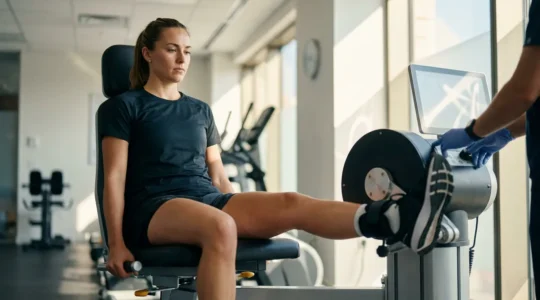
Kinetic Equipment vs. Free Weights: Which is Truly Safer for Joint Rehabilitation?
The true safety of kinetic equipment isn’t just about controlling speed; it’s about the machine’s ability to create “intelligent resistance” that actively adapts to your body’s limits in real-time. Unlike free weights that impose a constant, unforgiving load, kinetic systems…
Read more
Can Digital Analysis Spot Micro-Errors Invisible to the Naked Eye?
The frustrating performance plateau you’re experiencing isn’t a lack of effort; it’s a limitation of human perception. Your brain is neurologically wired to overlook the very micro-errors that digital analysis is designed to detect. Kinetic chain failures often occur in…
Read more
Programmable vs. Static Ball Machines: Which Truly Improves Reaction Time?
The critical difference isn’t features, but the training methodology: programmable machines enable ‘structured unpredictability’ that actively rewires your reaction cycle, while static machines primarily groove muscle memory. Programmable drills simulate the variable shot sequences of a real match, forcing the…
Read more