Explore
The setting where you train matters far more than most athletes realize. While climate-controlled gyms and synthetic tracks offer convenience and predictability, mounting evidence suggests that natural environments deliver unique physiological and psychological benefits that indoor spaces simply cannot replicate. From forest trails to coastal paths, outdoor training environments engage your sensory systems, challenge your proprioception, and activate ancient biological responses that enhance both performance and recovery.
This shift toward nature-based training isn’t merely a trend driven by aesthetic preference. The concept of biophilia—our innate human connection to natural environments—plays a measurable role in athletic performance, mental clarity, and long-term training sustainability. Understanding how to strategically incorporate natural terrain into your routine, select appropriate routes, and navigate the practical challenges of outdoor training can transform your relationship with physical activity while unlocking performance gains that structured indoor sessions often miss.
Whether you’re looking to break through a mental plateau, enhance your proprioceptive awareness, or simply find more joy in your training, the natural world offers a remarkably effective training partner. This exploration covers the science behind nature-based training, practical planning strategies, safety considerations, and the technical adjustments needed to train effectively outdoors.
Understanding Biophilia and Natural Training Environments
The biophilia hypothesis proposes that humans possess an evolutionary predisposition to seek connections with nature and other living systems. When applied to athletic training, this biological tendency translates into measurable performance benefits. Studies consistently show that individuals training in natural settings report lower perceived exertion at comparable intensity levels compared to indoor training, meaning the same workout feels easier outdoors.
This phenomenon occurs because natural environments engage your attention in a fundamentally different way than synthetic spaces. Rather than requiring focused concentration—which depletes mental resources—natural settings provide what researchers call “soft fascination.” The gentle movement of leaves, varying terrain textures, and dynamic lighting conditions capture your attention effortlessly, allowing your directed attention mechanisms to recover even while exercising.
Think of your attention capacity like a phone battery. Indoor training on a treadmill while staring at a screen rapidly drains this battery through constant forced focus. Outdoor training in natural environments, conversely, operates on a more efficient charging system, simultaneously using and replenishing your mental reserves. This is why many athletes report feeling mentally refreshed rather than depleted after nature runs, even following challenging sessions.
The Mental and Psychological Edge
The psychological advantages of training in natural environments extend well beyond simple preference. Natural settings provide a form of psychological restoration that synthetic environments cannot match, creating a compounding benefit for athletes who train frequently.
Visual and Auditory Restoration
Natural environments offer ever-changing visual complexity—patterns in bark, cloud formations, light filtering through canopy cover—that engages your visual system without overwhelming it. This stands in stark contrast to the visual monotony of indoor training facilities, where repetitive patterns and artificial lighting can contribute to mental fatigue. Similarly, the acoustic profile of natural settings, from rustling vegetation to flowing water, creates what acousticians call a “restorative soundscape” that reduces cortisol levels and promotes parasympathetic nervous system activation.
Mindful Movement and Present-Moment Awareness
Natural terrain demands continuous micro-adjustments in foot placement, stride length, and body position. This requirement naturally pulls your attention into the present moment, creating a form of moving meditation that many athletes find more accessible than formal mindfulness practices. Unlike the mental wandering that often accompanies treadmill running, trail training keeps your mind anchored to immediate sensory experience, which can improve both technique and mental clarity.
The Silence Comparison
Interestingly, the “silence” of natural environments isn’t actually silent—it’s filled with natural sounds that your nervous system perceives as non-threatening. Research comparing these natural soundscapes to the mechanical hum of gym equipment shows significantly different stress responses. Natural ambient sound correlates with decreased anxiety and improved mood states, while mechanical noise—even at lower decibel levels—can trigger low-level stress responses that accumulate over repeated training sessions.
Physical Benefits and Terrain Adaptation
Beyond psychological advantages, natural terrain provides distinct physical training benefits that flat, predictable surfaces cannot deliver. The primary advantage lies in proprioceptive development—your body’s ability to sense its position and movement in space.
Uneven natural surfaces require constant proprioceptive feedback and adjustment. Your ankles, knees, and hips must continuously adapt to changing angles and surfaces, strengthening the small stabilizer muscles and neural pathways that prevent injuries and improve overall coordination. This proprioceptive training creates resilience that transfers to all athletic activities. Athletes who regularly train on varied natural terrain typically demonstrate superior balance, improved reactive strength, and better movement efficiency compared to those who train exclusively on uniform surfaces.
Natural terrain also offers variable resistance that changes with conditions. Running uphill on soft trail requires different muscular recruitment than climbing stairs; descending on loose gravel challenges eccentric strength in ways that decline treadmill settings cannot replicate. This variability prevents the repetitive stress patterns that contribute to overuse injuries while simultaneously building a more comprehensive base fitness. The same route run in different seasons or weather conditions provides essentially different training stimuli, offering built-in periodization that indoor training requires deliberate programming to achieve.
Planning and Integrating Nature Runs
Successfully incorporating natural environment training requires thoughtful planning, particularly for athletes with structured training schedules. The key lies in understanding how different terrain types serve different training purposes.
Terrain Selection for Specific Training Goals
Not all natural environments suit all training objectives. Smooth, relatively flat trails with good footing work well for tempo runs and aerobic development where pace control matters. Technical terrain with rocks, roots, and elevation changes better serves recovery runs—counterintuitively, these challenging surfaces force slower paces and shorter strides that promote active recovery while maintaining proprioceptive engagement. Steep, sustained climbs offer excellent strength-endurance development, while long descents build eccentric strength and mental toughness.
Integration Strategies
For athletes with rigid training schedules, the most effective approach typically involves substituting one or two weekly sessions with outdoor equivalents rather than attempting wholesale schedule changes. A midweek recovery run and a long weekend session often convert most easily to nature-based training. The critical factor is recognizing that effort level matters more than pace when transitioning to natural terrain. A nine-minute-per-mile effort on technical trail might translate to a seven-and-a-half-minute pace on pavement, and that’s exactly as it should be.
Route Planning and Access
Practical access to quality natural training environments often presents the primary barrier. Effective route planning considers not only distance and terrain type but also trailhead access, parking availability, water sources, and emergency exit points. Many successful outdoor athletes maintain a mental catalog of routes categorized by time available, current fitness level, and weather suitability, allowing spontaneous decisions while maintaining training structure.
Safety Essentials for Uneven Terrain
Natural terrain’s variability—its primary benefit—also introduces injury risks that require specific prevention strategies. The most common injuries on natural terrain involve ankle sprains, falls on descents, and overuse issues from sudden volume increases on challenging surfaces.
Injury prevention starts with gradual adaptation. Athletes transitioning from road or track should initially limit natural terrain sessions to 20-30% of weekly volume, progressively increasing as proprioceptive strength develops. Running form also requires adjustment—shorter strides, increased cadence, and eyes focused two to three meters ahead rather than at your feet create the optimal balance between awareness and flow.
Seasonal hazards demand particular attention. Wet leaves create surprisingly slick surfaces in autumn, while spring mud can hide unstable footing. Winter ice and snow require entirely different movement patterns and potentially additional traction devices. Summer heat combined with limited shade and water access creates hydration challenges absent from climate-controlled facilities. Successful natural terrain athletes develop seasonal awareness, adjusting routes, pacing, and gear based on current conditions rather than attempting to maintain identical training patterns year-round.
Emergency preparedness takes on greater importance when training in remote natural areas. Carrying a charged phone, informing someone of your planned route and expected return time, and possessing basic first aid knowledge represent minimum safety standards for trail training.
Gear and Pacing Strategies
Shoe Selection for Natural Terrain
Footwear appropriate for natural terrain differs significantly from road running shoes. Trail-specific shoes typically feature aggressive outsole treads for traction, reinforced toe boxes for protection, and different cushioning profiles optimized for varied surfaces rather than repetitive pavement impact. The specific shoe characteristics you need depend on your typical terrain—rocky technical trails demand rock plates and protective uppers, while groomed forest paths may require only modest tread improvements over road shoes.
The Pacing Trap
Perhaps the most common mistake athletes make when transitioning to natural terrain involves attempting to maintain road paces. Natural terrain simply doesn’t allow consistent pacing—elevation changes, technical sections, and surface variations create inevitable pace fluctuations. Athletes who fight this variability by forcing specific paces often experience frustration and increased injury risk. The solution involves shifting focus from pace to effort level, using heart rate or perceived exertion as primary intensity metrics. This mental adjustment often proves more challenging than the physical adaptation but ultimately creates more sustainable and enjoyable training patterns.
Environmental Quality and Performance
An often-overlooked advantage of natural environment training involves air quality. Urban runners frequently train alongside vehicular traffic, inhaling elevated levels of particulate matter, nitrogen oxides, and other pollutants that can impair respiratory function and cardiovascular health. Natural environments—particularly forests and parks distanced from major roadways—offer significantly cleaner air, reducing inflammatory responses and allowing more efficient oxygen exchange.
Forest environments provide additional benefits through phytoncides, airborne compounds released by trees that research suggests may enhance immune function. While the performance impact of cleaner air and phytoncide exposure may seem subtle during any single session, the cumulative effects over months and years of training contribute to better respiratory health and potentially improved aerobic capacity. For athletes training in polluted urban environments, even occasional sessions in natural areas provide respiratory system recovery that supports long-term performance development.
Training in natural environments represents far more than a pleasant alternative to indoor facilities. The combination of psychological restoration, proprioceptive development, variable training stimuli, and environmental quality creates a comprehensive training approach that supports both immediate performance and long-term athletic sustainability. By understanding terrain selection, prioritizing safety, and adjusting pacing expectations, athletes at any level can harness these benefits while developing a more resilient and adaptable physical capacity. The natural world offers not just a place to train, but a sophisticated training partner that challenges, restores, and strengthens in equal measure.
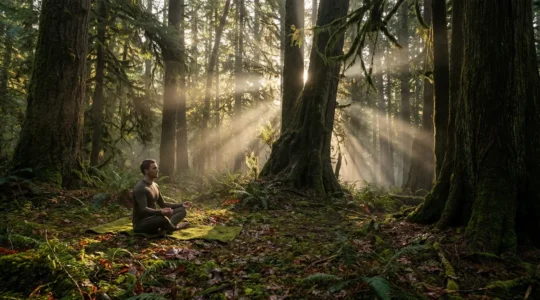
How “Forest Bathing” Lowers Cortisol in High-Stress Athletes
Contrary to common belief, reducing an athlete’s chronic stress isn’t about finding more distractions; it’s about engaging in an evidence-based, physiological reset that a forest environment is uniquely engineered to provide. Visual exposure to natural fractal patterns has been shown…
Read more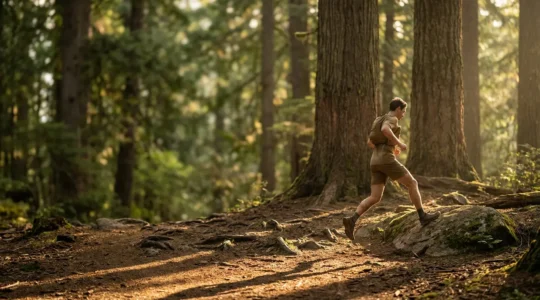
The Biomechanics of Trail Running: How Natural Terrain Reduces Impact Forces and Prevents Injury
Trail running reduces knee pain not just by being softer, but by fundamentally re-engineering your body’s biomechanics for dynamic force dissipation. Variable terrain activates constant proprioceptive feedback, strengthening the stabilizing muscles around your ankles and knees. Adopting an effort-based pace…
Read more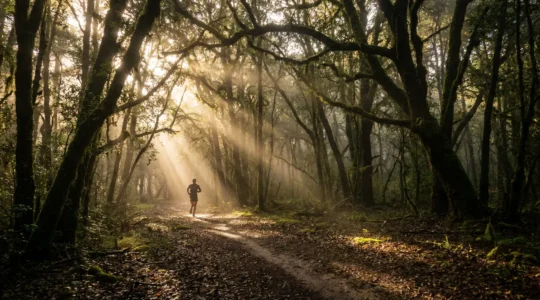
How Nature Exposure Reduces Cortisol by Over 20% and Reshapes Athletic Performance
Contrary to the belief that peak performance is forged solely in sterile gyms and on synthetic tracks, the most significant competitive gains are now being found in natural environments. Training in nature isn’t just relaxation; it’s a form of ‘neurological…
Read more