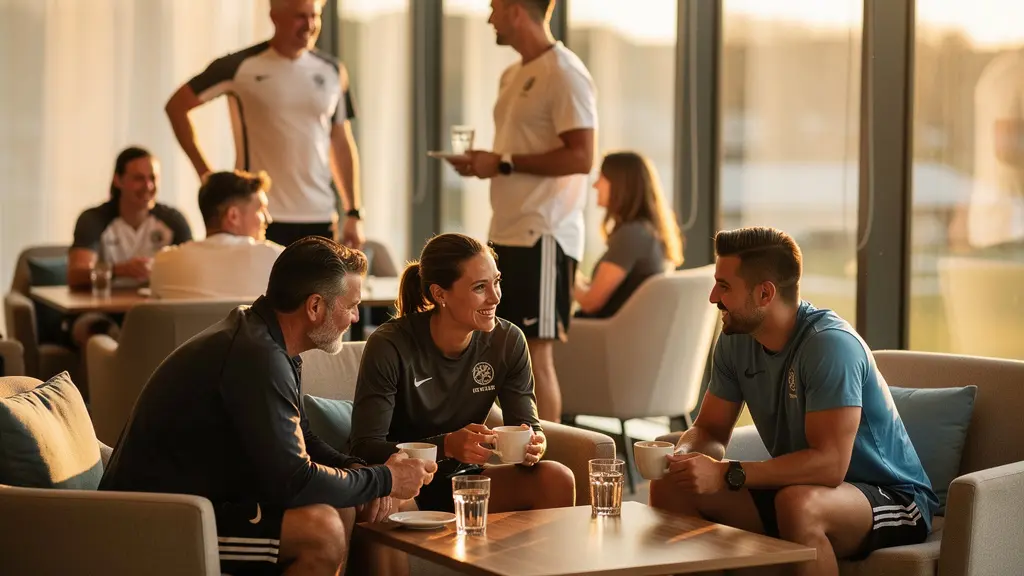
Contrary to popular belief, member attrition isn’t solved with better equipment or lower fees; it’s solved by transforming your club into a genuine ‘Third Place’ where human connection is engineered.
- The biggest mistake is leaving new member integration to chance, leading to a “Week 4 to 8 Danger Zone” where most dropouts occur.
- Inclusive club models that foster ‘Belonging Loyalty’ consistently outperform exclusive models, aiming for an 80-85% retention rate.
Recommendation: Stop just hosting events and start designing a structured ‘Integration Pathway’ for every new member, from their first day to their 90th.
Why do members leave a sports club? The easy answers are often about price, schedules, or facilities. Many managers focus on these transactional elements, believing a better service offering is the silver bullet for retention. They organize generic “social events,” send out newsletters, and wonder why the revolving door keeps spinning. This approach, however, misses the fundamental reason people seek out groups: a deep, human need for belonging.
The truth is, your biggest competitor isn’t the club across town; it’s the inertia of staying home. In a world of remote work and digital isolation, people are starved for genuine connection. A sports club has the unique potential to be more than just a place to work out. It can become a vital “Third Place”—a term coined by sociologist Ray Oldenburg to describe the crucial social environments separate from the two primary ones of home and work. This is where community is forged and where true loyalty is born.
But this transformation doesn’t happen by accident. It requires a deliberate shift in mindset, from service provider to community architect. It involves designing intentional pathways for connection, breaking down social barriers, and creating a shared sense of purpose. This guide moves beyond the platitudes and explores the strategic frameworks and psychological principles that turn a loose collection of members into a thriving, resilient community that people can’t imagine leaving.
This article will guide you through the essential strategies to build this powerful sense of community. We’ll explore the core concept of the ‘Third Place,’ learn how to design events that truly mix people, and understand the critical first 90 days of a new member’s journey.
Summary: Building a Community That Lasts, Slashing Attrition
- Why people need a space between home and work to thrive?
- How to organize a “mixer” tournament that actually mixes levels?
- Exclusive vs. Inclusive: Which club model breeds better long-term loyalty?
- The exclusion mistake that drives new members away within 3 months
- When to introduce a new member to the “regulars” for best integration?
- How to set up a “training pact” with a partner effectively?
- The mental error of needing a screen to run (and failing outdoors)
- How to Break the Monotony of Indoor Training During Winter?
Why people need a space between home and work to thrive?
The first step in reducing attrition is understanding a fundamental human need. We operate in two main spheres: home (our private life) and work (our professional obligations). But for a healthy civic life and personal well-being, we need a “Third Place.” This is the realm of informal public life, the anchor of community. Think of the classic English pub, the French café, or the American general store. These aren’t just places of commerce; they are environments where conversations are easy, relationships are formed, and a sense of belonging is cultivated. As sociologist Ray Oldenburg, who pioneered the concept, famously stated, “Third places are important for democracy, civic engagement, and a sense of place”.
Your sports club is perfectly positioned to become this modern-day Third Place. It’s a space where people with a shared interest can gather. However, simply having a facility isn’t enough. You must intentionally design for social interaction. This means creating an atmosphere where members feel comfortable lingering before and after their activity. It’s about shifting the focus from a purely athletic function to a social one.
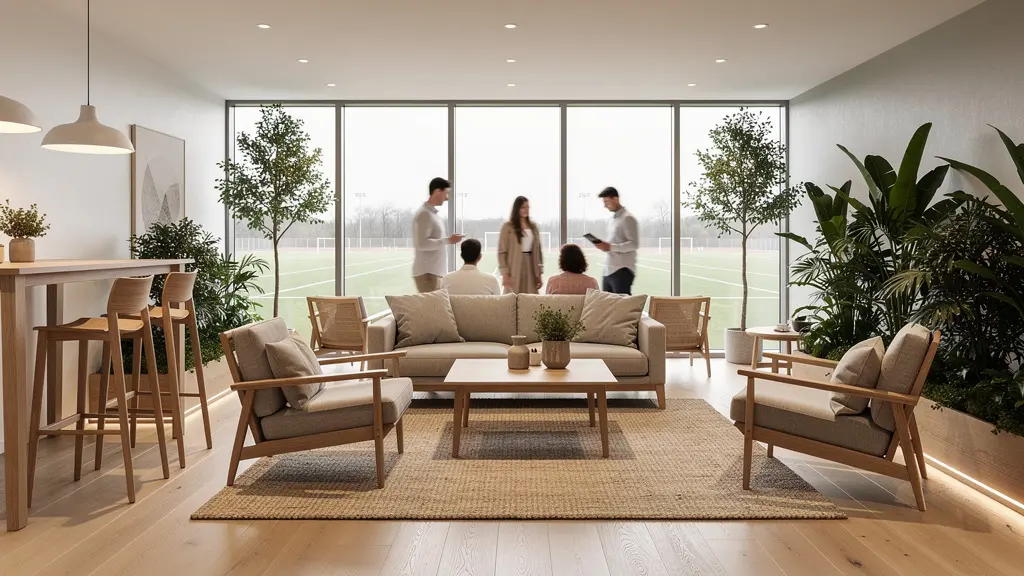
Look at the space in your club. Does it encourage people to stay? Or is it purely functional, pushing them out the door once their session is over? Creating comfortable lounge areas, offering coffee, and establishing post-training rituals are not frivolous expenses; they are investments in your social fabric. When a member feels like they are part of a community—not just a customer—their loyalty transcends the transactional. They are no longer just paying for access to a court or a machine; they are investing in their social well-being.
How to organize a “mixer” tournament that actually mixes levels?
One of the biggest barriers to community is the formation of cliques. While natural, they can make a club feel impenetrable to newcomers or lower-level players. The generic “mixer” event often fails because people naturally gravitate to those they already know. To truly foster connection, you need to engineer events for interaction. A mixer tournament’s primary goal isn’t to find the best player; it’s to create the most new connections. This shift in purpose is critical. It’s about prioritizing enjoyment and personal relevance over pure competition.
Research powerfully supports this approach. A major study of over 7,000 Danish athletes found that clubs focusing on enjoyment and intrinsic motivation saw dramatically higher retention. These clubs had dropout rates of just 7.1%, compared to the 19.8% of members who simply switched clubs, likely seeking a better social fit. The key is to design formats where mixing is not optional, but built into the rules of the game. Instead of random pairings that can lead to frustratingly lopsided matches, use structured formats that balance competition and social interaction.
This table compares different formats based on their effectiveness at mixing skill levels and ensuring beginner comfort, a crucial factor for integrating new members.
| Format | How It Works | Mixing Effectiveness | Beginner Comfort |
|---|---|---|---|
| Ladder Scramble | Winners split and pair with lower-ranked players each round | High | High |
| King of Court Twist | Winners must rotate partners from different skill pools | Very High | Medium |
| Random Rotation | Computer-generated pairings every 15 minutes | Medium | Low |
| Handicap Teams | Point advantages given based on combined team ratings | High | Very High |
Choosing a format like a “Ladder Scramble” or “Handicap Teams” intentionally creates balanced, low-pressure situations. It allows a beginner to play with and learn from a veteran, and gives the veteran a chance to be a mentor. These are the micro-interactions that build club-wide camaraderie and break down invisible walls, making the community stronger and more welcoming for everyone.
Exclusive vs. Inclusive: Which club model breeds better long-term loyalty?
Every club faces a fundamental choice in its culture: is it a private sanctuary for the elite or an open hub for the community? The “exclusive” model, built on high barriers to entry and status, can create a powerful sense of prestige. However, it often fosters what can be called “Status Loyalty”—members are loyal to the rank it affords them, not necessarily to the people within the club. This type of loyalty can be fickle; if a more prestigious club opens up, these members may be the first to leave. This model also inherently limits growth and can create a cold atmosphere for aspiring members.
The “inclusive” model, on the other hand, focuses on building “Belonging Loyalty.” This is a much stickier, more resilient form of commitment. It arises when members feel they are part of a supportive community, regardless of their skill level. This model thrives on low barriers to entry and a focus on participation and shared experience. While it may seem less glamorous, it’s the bedrock of sustainable, long-term success. The industry benchmark is clear: successful sports clubs maintain an annual member retention rate of 80-85%, a figure incredibly difficult to achieve with a purely exclusive model that constantly churns through those who don’t make the cut.
The most effective strategy is often a hybrid. This involves creating a broad, inclusive base where everyone is welcome, while also offering aspirational pathways for those who seek higher levels of competition. This “Tiered Inclusivity” model offers the best of both worlds. You can have a general membership focused on social play and fitness, alongside a competitive team squad. This allows you to recognize both participation and achievement, creating nested identity opportunities—a member can feel proud to belong to the club in general, and also to their specific training group or team. This balance ensures the club feels both accessible and aspirational, maximizing its appeal and retaining members for the long haul.
The exclusion mistake that drives new members away within 3 months
The first 90 days of a membership are the most critical period for long-term retention. This is when a newcomer decides if they fit in or if they’ve made a mistake. The single biggest error a club can make is a failure of integration. A new member left to fend for themselves will quickly feel invisible and isolated. They will see established groups of friends, hear in-jokes they don’t understand, and feel like an outsider looking in. The novelty of the new activity wears off around week four, but the social habits that ensure continued participation haven’t formed yet. This creates the “Week 4 to 8 Danger Zone,” where attrition is highest. The cost of this failure is immense, as studies show that acquiring new members costs up to 5 times more expensive than retaining existing ones.
Failing to address this early integration period is like trying to fill a leaky bucket. You can pour new members in at the top, but they will drain away from the bottom just as quickly. The solution isn’t a single “welcome” email; it’s a structured 90-day onboarding journey. This is a deliberate, proactive process designed to connect the new member to the club’s community fabric. According to one fitness studio study, even a single proactive interaction with an at-risk member can reduce their likelihood of dropping out by nearly 10%.
The 90-Day Integration Journey
Fitness studios that have successfully navigated this challenge implement structured onboarding programs that go far beyond a simple gym tour. They assign designated “Club Ambassadors” (experienced, friendly members) to newcomers. They run special 6-week clinics designed specifically for new members to learn skills and meet peers at the same level. Crucially, by the third month, they provide “micro-responsibilities”—like asking a member to help set up a small event or welcome the next wave of newcomers. This process systematically moves a person from outsider to participant to contributor, solidifying their place in the community during the critical ‘Week 4 to 8 Danger Zone’ and dramatically reducing early attrition.
This process transforms the new member experience from one of intimidation to one of guided discovery. It shows them, through actions and not just words, that they are valued and that there is a place for them. It’s the difference between someone saying, “I go to that club,” and someone saying, “I am a member of that club.”
When to introduce a new member to the “regulars” for best integration?
Throwing a new member into a large group of seasoned “regulars” can be incredibly intimidating. It’s the social equivalent of learning to swim by being pushed into the deep end. A far more effective approach is a staggered, deliberate integration protocol. The goal is to build a new member’s social confidence and connections step-by-step, ensuring they feel secure and welcome at every stage. This isn’t about sheltering them; it’s about strategically scaffolding their social experience. The process should begin with low-pressure, one-on-one interactions and gradually expand to larger group settings.
The first week should be a “soft launch.” The new member should interact primarily with a coach or a designated, trained “buddy” or “Gateway Regular.” This person’s role is to be a friendly face, answer questions, and make the initial experience feel personal and manageable. In the following weeks, this Gateway Regular can facilitate introductions to one or two other members with whom the newcomer might share an interest or skill level. This creates a small, safe social pod. Only after this initial foundation of comfort is built, around week four or six, should the member be encouraged to join a low-pressure mixer event or a small group activity.
This methodical process ensures that by the time the new member enters the broader club community, they aren’t entering as a stranger. They arrive with a few friendly faces to count on, a basic understanding of the club’s social norms, and the confidence that comes from successful prior interactions. It turns a potentially terrifying experience into an exciting journey of discovery. This is community building in action: a deliberate, thoughtful process that values the individual’s experience.
Your Action Plan: Staggered Integration Protocol
- Week 1 (Soft Launch): Pair the new member exclusively with a coach or a designated “Gateway Regular” for all initial sessions to establish a primary point of contact.
- Weeks 2-3 (First Connections): The Gateway Regular facilitates a direct introduction to 1-2 other specific members, chosen based on shared interests or similar skill levels.
- Week 4 (Small Group): Invite the new member to a pre-arranged small group activity (e.g., a practice court of 4) with the members they’ve already met and one or two new faces.
- Week 6 (Low-Pressure Event): Encourage participation in a larger, structured mixer event, such as a “Handicap Teams” tournament, where they know they will be thoughtfully paired.
- Ongoing (First 3 Months): The initial Gateway Regular continues to perform informal check-ins, ensuring the member feels seen and supported as they navigate the wider club community.
How to set up a ‘training pact’ with a partner effectively?
While building a large-scale community is the ultimate goal, fostering powerful connections can start at the micro-level. One of the most effective tools for accountability and retention is the “training pact”—a formal or informal agreement between two members. This creates a community of two, providing motivation and a sense of responsibility that is hard to replicate alone. Research on adolescent athletes who had dropped out of team sports showed that those who maintained training partnerships persisted in their sport for 2-3 years longer than those who trained alone. The key finding from the Swedish ice hockey partnership study was that successful pairs had pre-established rules for communication and feedback.
For a pact to be effective, it needs to be more than just a vague “let’s train together.” It requires clear, upfront communication about goals, expectations, and logistics. What is the primary purpose of the pact? Is it simply to ensure consistency (showing up)? Is it to push for performance (hitting specific metrics)? Or is it to work on skill development (mastering technique)? Clarifying the focus from the outset prevents future conflict and disappointment. A person focused on perfect form will be frustrated by a partner focused only on speed, and vice-versa.
Clubs can facilitate this process by providing templates or guidelines for members looking to partner up. This simple act of “social engineering” can formalize the process and increase its chances of success. The following table outlines three common types of training pacts.
| Pact Type | Primary Focus | Check-in Frequency | Key Metrics | Conflict Resolution |
|---|---|---|---|---|
| Consistency Pact | Showing up regularly | Daily text | Sessions attended | Flexible rescheduling allowed |
| Performance Pact | Hitting metrics | Weekly review | Specific benchmarks | Data-driven adjustments |
| Skill Development | Technique mastery | After each session | Form checkpoints | Video review for disputes |
By encouraging and structuring these micro-communities, you are weaving another strong thread into your club’s social fabric. Each successful partnership creates two members who are more engaged, more accountable, and significantly less likely to drop out.
The mental error of needing a screen to run (and failing outdoors)
In our hyper-connected world, a peculiar new challenge to community has emerged: screen dependency during physical activity. Many people feel they “need” a podcast, a playlist, or a virtual class on a screen to get through a workout. In fact, a staggering 65% of gym members now expect virtual options, highlighting a deep reliance on digital distraction. While these tools can be motivating, they create a significant mental error: they train us to tune out our surroundings and our own bodies. This creates an invisible bubble of isolation that prevents the spontaneous interactions that build community. A member with headphones on is sending a clear “do not disturb” signal, even if unintentional.
When this screen-dependent habit moves outdoors, it often fails. The unpredictable nature of the real world—uneven terrain, changing weather, traffic—clashes with the curated, predictable nature of a digital workout. More importantly, it prevents members from engaging with their environment and, crucially, with each other. Breaking this dependency is essential for fostering a more present and connected community. The key is not to ban devices, but to offer compelling, real-world alternatives through “analog gamification.”
Analog gamification uses game mechanics in the physical world to create engagement and fun, no screens required. This could involve organizing a “Sensory Run” where the goal is to notice and log sounds and sights, or a “GPS Art” challenge where teams work together to run a route that draws a shape on a map. These activities force members to be present, to communicate, and to work together. They replace the passive consumption of digital content with active, collaborative creation. Other ideas include scavenger hunts based on local landmarks or team-based distance challenges tracked on a large, physical chart in the club’s social area. By making the real world more interesting than the screen, you encourage members to unplug and connect with what matters most: each other.
Key takeaways
- True member loyalty is built on ‘Belonging,’ not ‘Status.’ An inclusive model with aspirational pathways is the most sustainable.
- The first 90 days are critical. A structured ‘Integration Pathway’ is non-negotiable to combat the ‘Week 4-8 Danger Zone.’
- Community doesn’t just happen; it must be ‘engineered’ through smart event design and by transforming your facility into a social ‘Third Place.’
How to Break the Monotony of Indoor Training During Winter?
The winter months are notoriously a high-attrition period for many clubs. The days are shorter, the weather is worse, and the motivation to leave the house plummets. For members who train indoors, the monotony of repeating the same workouts in the same space can become a significant drag. This is a critical time when community can make all the difference. When individual motivation wanes, collective purpose can take over. The key is to reframe the winter season not as a period to be endured, but as a unique opportunity for a shared mission.
Instead of leaving members to their own devices, clubs can implement large-scale, narrative-driven challenges. A multi-club study on “Winter Warrior Leagues” found this approach to be incredibly effective. By creating team-based challenges where members earned points for attendance, encouragement, and team spirit—not just raw performance—clubs saw retention rates stay above 75% through the winter. The narrative element is crucial. It’s not just “tracking miles”; it’s a “Race to the Pole” or a collective “Climb Everest” where every member’s contribution, no matter how small, helps the team achieve a grand, visible goal.
This approach transforms boring indoor training into an epic adventure. A 4-week training block can be themed around an “Arctic Expedition” or “Space Training,” with specific workouts and mini-challenges tied to the narrative. A large, visible progress tracker in the club’s social area becomes a focal point for conversation and camaraderie. You can also empower members by including “Member-Led Skill Pods,” where individuals can teach 15-minute workshops on a skill they’ve mastered. This creates a sense of shared ownership and expertise. By creating a compelling story and a common goal, you give members a powerful reason to show up—not just for themselves, but for their team.
By implementing these strategies, you are not just reducing attrition; you are building a resilient, vibrant community that becomes an indispensable part of your members’ lives. Start today by choosing one area—whether it’s designing your ‘Third Place’ or launching your first ‘Winter Warrior’ challenge—and begin the process of building a club people truly want to belong to.