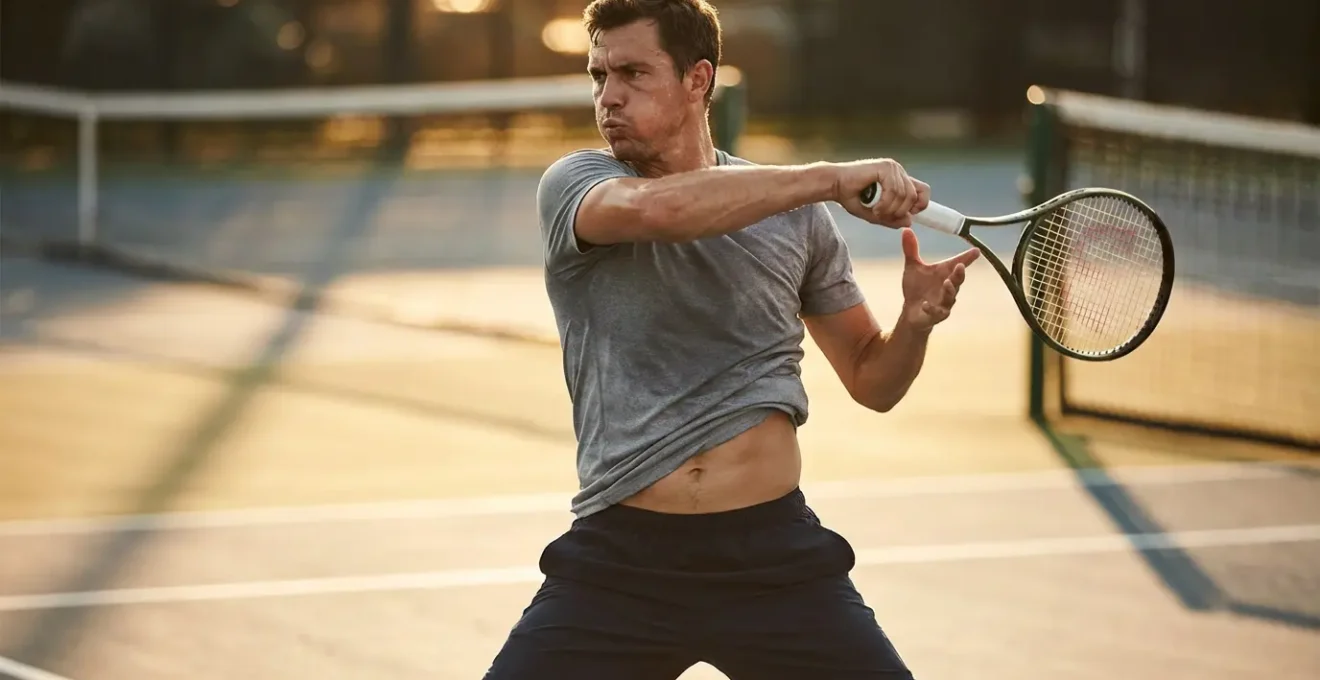
The solution to rotational-sport back pain isn’t stronger abs, but a smarter, more reactive core that resists unwanted movement.
- Surface muscles like the “six-pack” are for movement, not the deep spinal stability required to protect your lumbar spine during a swing or serve.
- True stability comes from training the core to act as a “braking system” (anti-rotation) and managing internal pressure through proper breathing.
Recommendation: Shift your focus from crunches and sit-ups to exercises that challenge your ability to stay rigid against rotational forces, like the Pallof Press and proper Bird-Dog form.
For any golfer or tennis player, that familiar, nagging ache in the lower back after a long match or a session at the driving range can feel like an inevitable part of the game. The common advice is predictable: “strengthen your core.” This usually conjures images of endless crunches and sit-ups, all in pursuit of a chiseled “six-pack.” But despite your efforts, the discomfort persists, perhaps even worsens. This frustrating cycle leads many athletes to believe that back pain is a permanent tax on their performance.
The conventional wisdom around core training is fundamentally flawed for high-rotation sports. It focuses on the muscles you can see—the rectus abdominis—which are primarily “movers,” not stabilizers. The real source of a pain-free, powerful swing lies much deeper, in a system of muscles designed to resist and control motion, not create it. These muscles function as a sophisticated neurological braking system, protecting your lumbar spine from the immense torque generated during a powerful forehand or golf swing.
What if the key wasn’t about building more abdominal strength, but about teaching your core to be smarter? This guide takes a clinical approach, moving beyond superficial aesthetics to explore the science of true spinal stability. We will dismantle the myths around core training and reveal how to build a resilient trunk that effectively transfers power from the ground up, turning your core into a protective corset rather than a source of pain.
This article will guide you through the biomechanics of a stable spine in a rotational context. We will explain why visible abs offer false security, provide diagnostic tools to assess your own stability, and detail the specific exercises and breathing techniques that translate directly to the court and the course. Prepare to rethink everything you thought you knew about core training.
Summary: A Clinical Guide to Rotational Core Stability
- Why “six-pack” abs don’t guarantee a stable spine?
- How to use the “Bird-Dog” exercise as a diagnostic tool?
- Plank vs. Pallof Press: Which transfers better to a forehand strike?
- The breathing error that destabilizes your spine during a serve
- When to do core work: Before or after the main cardio session?
- The core training error that exacerbates lower crossed syndrome
- Why hard courts increase micro-trauma in the lower back?
- Which Complementary Sports Improve Tennis Agility the Most?
Why “six-pack” abs don’t guarantee a stable spine?
The pursuit of a visible “six-pack” (rectus abdominis) is one of the most common yet misguided goals for athletes seeking to eliminate back pain. From a biomechanical standpoint, these superficial muscles are designed for spinal flexion—think of bending forward to tie your shoes. While important, they play a minimal role in providing the rotational control and segmental stability your lumbar spine desperately needs during a golf swing or tennis serve. The real protectors are the deep, unseen muscles: the transverse abdominis (your body’s natural corset) and the multifidus (tiny muscles that stabilize each vertebra).
True core stability is not about the ability to create movement, but the capacity to prevent unwanted movement. It’s a measure of how well your trunk can remain a rigid, force-transferring cylinder while your limbs move powerfully around it. Research on elite tennis players reveals they possess significantly more trunk rotational strength and, crucially, better symmetrical strength patterns than novices. This balance comes from deep muscle activation, not just surface-level “abs.” This is why an athlete can have impressive abdominal definition and still suffer from debilitating back pain; their “show” muscles are strong, but their “stabilizer” system is underdeveloped.
Focusing on exercises that build this deep stability has a measurable impact on pain. In fact, a comprehensive meta-analysis confirms that specific core stability exercises reduce pain by 29% more than general exercises for individuals with chronic low back pain. The goal, therefore, must shift from building aesthetically pleasing abs to cultivating a deep, responsive core that acts as an integrated unit to protect the spine.
How to use the “Bird-Dog” exercise as a diagnostic tool?
The Bird-Dog is often dismissed as a simple beginner exercise, but when executed with precision, it becomes a powerful diagnostic tool for assessing your core’s ability to resist rotation and extension. Its value lies in challenging your body to maintain a perfectly neutral spine while your limbs create destabilizing forces. This directly mimics the demands placed on your core during rotational sports, where the trunk must stay solid as the arms and hips generate power. By paying close attention to form, you can identify specific weaknesses in your kinetic chain.
To turn this exercise into a self-assessment, the goal is to observe any deviation from perfect stability. The “water cup test” is a classic method: place a small paper cup on your lower back (the sacrum). Your objective is to complete the movement without the cup tipping or spilling. This provides immediate, undeniable feedback on your control.
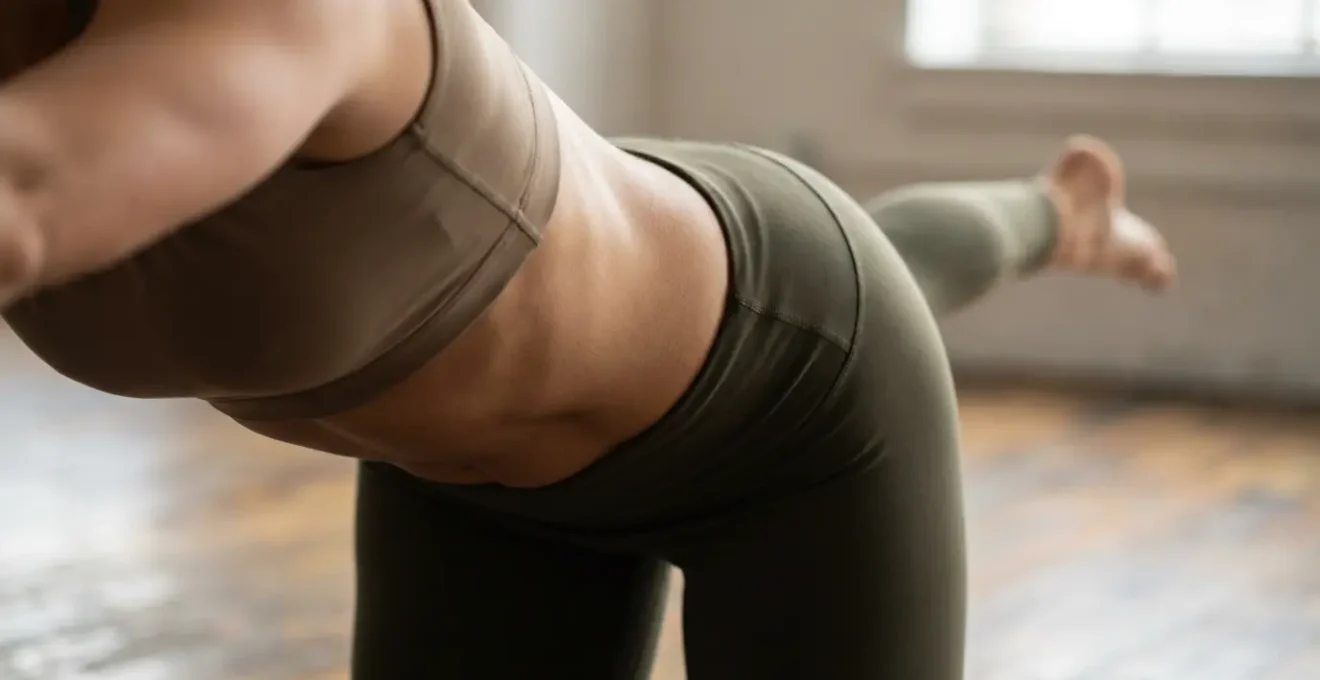
As the illustration demonstrates, maintaining a flat, table-top back is paramount. During this test, you should look for specific faults, as each one points to a different underlying weakness. These subtle errors are windows into your motor control patterns:
- Shaking or Trembling: This indicates a lack of endurance in your deep stabilizer muscles, like the multifidus and transverse abdominis.
- Hip Drop on the Lifted Leg Side: If your hip on the side of the raised leg dips toward the floor, it reveals a weak gluteus medius on the stance leg, a critical stabilizer for single-leg balance and power.
- Arching Lower Back: An increase in your lumbar curve as you extend your leg is a classic sign of poor transverse abdominis control and over-reliance on the hip flexors and back extensors.
- Rocking Shoulders: If your shoulders do not stay perfectly parallel to the floor, it shows a failure to control rotation through your thoracic spine and obliques.
Plank vs. Pallof Press: Which transfers better to a forehand strike?
When evaluating core exercises for rotational sports, the critical question is not “Which is harder?” but “Which one replicates the specific demands of the sport?” Both the Plank and the Pallof Press are excellent isometric exercises, but they train your core to resist different forces. Understanding this distinction is key to building a program that directly improves performance and reduces injury risk. The Plank primarily challenges your core to resist gravity—an anti-extension and anti-flexion exercise. It builds general trunk stiffness in the sagittal plane (front-to-back).
The Pallof Press, however, is an anti-rotation exercise. It challenges your core to resist a lateral force that is trying to twist your torso. This is profoundly more specific to the demands of a golf swing or a tennis stroke. During these movements, your hips rotate to generate power, but your lumbar spine must remain stable and resist excessive rotation to both protect itself and efficiently transfer that power to the upper body and implement. The Pallof Press trains this exact function: to keep the ribcage and pelvis locked together as a single unit against a rotational pull.
This table breaks down the core differences in how each exercise prepares you for sport-specific forces:
| Exercise | Force Vector | Sport Specificity | Primary Benefit |
|---|---|---|---|
| Plank | Vertical (gravity) | Sagittal plane stability | General trunk stiffness |
| Pallof Press | Horizontal (lateral pull) | Transverse plane anti-rotation | Sport-specific anti-rotation strength |
While the Plank builds a valuable foundation of trunk stiffness, the Pallof Press is superior in its direct transfer to rotational sports. It specifically strengthens the oblique and transverse abdominis muscles in the exact pattern needed to decelerate rotation and protect the lower back. Therefore, for an athlete hitting a forehand, the Pallof Press offers a more functional and protective training stimulus.
The breathing error that destabilizes your spine during a serve
Breathing is not just for oxygenation; it is the most fundamental tool for regulating core stability. The most common and detrimental breathing error in rotational sports is “letting all the air out” before or during the moment of impact. When you exhale completely, you lose Intra-Abdominal Pressure (IAP). IAP is the pressure created within your abdominal cavity when your diaphragm, pelvic floor, and deep core muscles co-contract. This pressure acts like an internal air bag, stiffening the entire trunk and providing a rigid cylinder that protects the spine from buckling under load.
Think of trying to crush an empty soda can versus a full, sealed one. The sealed can is incredibly strong due to its internal pressure. Your core works the same way. When serving in tennis or swinging a golf club, you generate immense rotational and compressive forces on your spine. A sharp, forceful exhalation timed *with* the moment of impact (often described as a “grunt” or “hiss”) is the key to maintaining IAP. This technique, known as the Valsalva maneuver in a controlled, dynamic context, allows you to create maximum trunk stiffness precisely when you need it most.
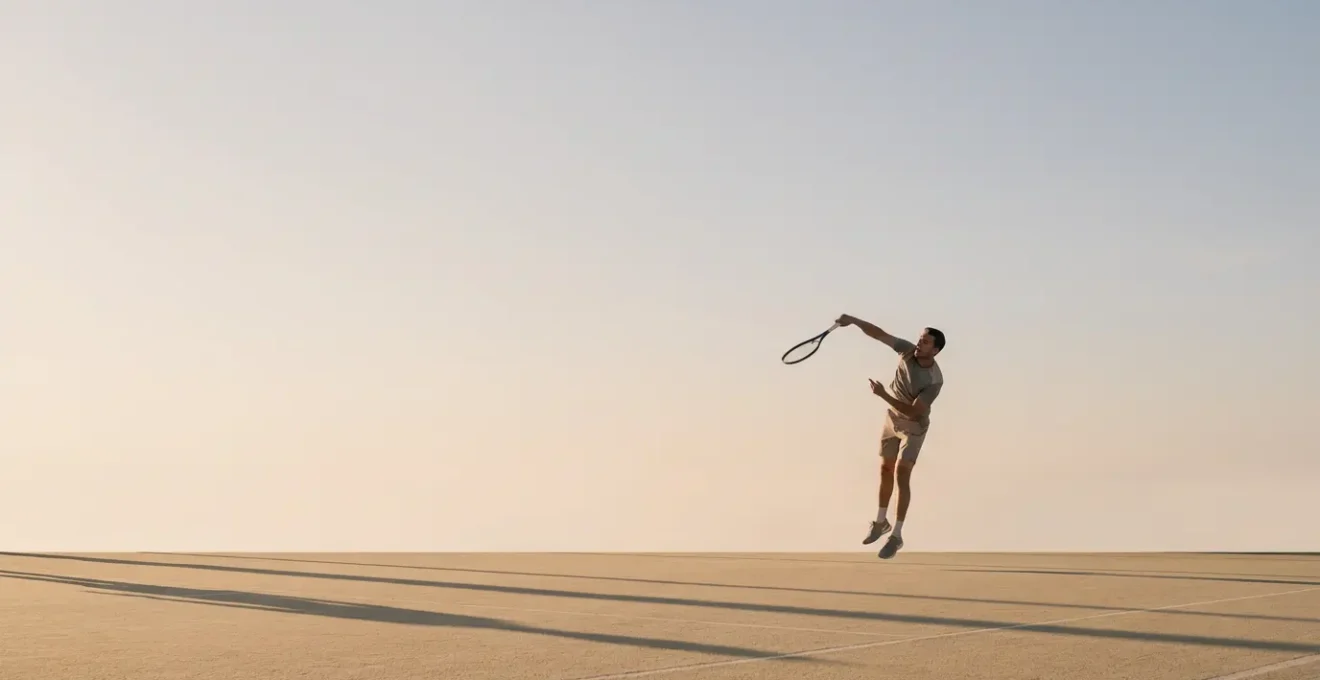
Conversely, exhaling too early or holding your breath passively causes the “can” to go soft. Without adequate IAP, the stability of your spine is compromised. The load is then transferred directly to the passive structures—your vertebrae, discs, and ligaments—instead of being absorbed and controlled by your musculature. Research on elite athletes confirms this link, showing that those who coordinate their breathing to maintain IAP at impact demonstrate superior power transfer and significantly lower rates of injury. Mastering this breathing technique is not a minor tweak; it’s a non-negotiable component of spinal hygiene for any rotational athlete.
When to do core work: Before or after the main cardio session?
The timing of your core training is as important as the exercises you choose. The common practice of tacking on a brutal core workout at the end of a long practice or cardio session is often counterproductive and can even be dangerous. Your core stabilizers are composed of endurance-based muscle fibers and are deeply integrated with your central nervous system (CNS). After a long, fatiguing session, your CNS is tired, and your ability to precisely control these muscles is diminished. Performing heavy or complex core exercises in this fatigued state can lead to poor form, reinforcing dysfunctional movement patterns and increasing injury risk.
A more effective, evidence-based approach is to periodize your core training based on its objective. Not all core work is the same. The optimal timing depends on whether you are activating, patterning, or strengthening.
- Before your workout (Activation): Perform light, non-fatiguing exercises like Bird-Dogs or Dead Bugs. The goal here is not to cause fatigue, but to “wake up” the mind-muscle connection with your deep stabilizers. This primes your core to function correctly during the main session.
- During your workout (Patterning): Incorporating a brief, sport-specific core exercise between sets (e.g., a Pallof Press hold between sets of swings) can help groove the motor pattern. This teaches your body to integrate core stiffness into the actual athletic movement.
- After your main session or on a separate day (Strengthening): This is the time for heavy, fatiguing core work that builds raw strength and endurance, such as weighted carries, cable rotations, or advanced plank variations. This should be done when your body is fresh enough to maintain perfect form, not immediately after an exhaustive 2-hour tennis match, which carries a high risk of CNS fatigue. Some athletes ask how long it takes to build core stability; consistency is key, and following a smart timing protocol ensures each session is productive, accelerating results over months, not years.
This strategic approach to timing not only reduces injury risk but also enhances performance. For example, studies on golf performance have demonstrated a 3.8% increase in club head speed with properly timed core training, compared to just 1.2% with general resistance training. This shows that *when* you train your core matters significantly. It is also important not to over-train; listening to your body and prioritizing recovery is essential to avoid burnout and injury.
The core training error that exacerbates lower crossed syndrome
Lower Crossed Syndrome (LCS) is an incredibly common postural imbalance in athletes and the general population, characterized by tight hip flexors and a tight lower back, paired with weak abdominals and weak glutes. This combination forces the pelvis into an anterior tilt, creating an exaggerated arch in the lumbar spine (lordosis), which places chronic stress on the vertebrae and discs. For a rotational athlete, this is a recipe for disaster. The biggest training error is performing exercises that reinforce this exact dysfunction, namely traditional sit-ups and leg raises.
These exercises primarily strengthen the hip flexors (iliopsoas), which are already tight and overactive in someone with LCS. Every sit-up you do further tightens these muscles, pulling your pelvis further into an anterior tilt and worsening the very problem you’re trying to solve. From a clinical perspective, this is like trying to put out a fire with gasoline. Research on patients with lower crossed syndrome confirms that these traditional exercises worsen the condition. Effective rehabilitation must focus on the opposite: strengthening the weak muscles (glutes and deep abs) while encouraging the tight muscles (hip flexors) to relax.
The solution lies in corrective exercise pairing that addresses both sides of the imbalance simultaneously. This involves choosing movements that activate the abdominals and glutes without significant hip flexor involvement. By strengthening the antagonists, you encourage the tight agonists to relax through a process called reciprocal inhibition. This rebalances the forces acting on the pelvis, gradually restoring a neutral spine position.
Action Plan: Correcting Lower Crossed Syndrome
- Identify Faulty Patterns: Notice if your default posture involves an arched lower back. Observe if you feel sit-ups more in your hips than your abs.
- Cease Harmful Exercises: Immediately stop performing traditional sit-ups, crunches, and leg raises, which reinforce the dysfunctional pattern.
- Activate Weak Muscles: Prioritize exercises that fire the glutes and deep abs together. Start with Glute Bridges, focusing on squeezing the glutes to lift the hips, not arching the back.
- Re-pattern Core Control: Integrate exercises like the Dead Bug, which teaches the core to stay braced while the limbs move, decoupling the abs from the hip flexors.
- Monitor and Progress: When performing planks, ensure your hips do not sag and your back remains flat. Progress only when you can maintain perfect form, avoiding the reinforcement of dysfunction.
Why hard courts increase micro-trauma in the lower back?
The playing surface is an often-overlooked variable that has a profound impact on an athlete’s body, particularly the lumbar spine. While all tennis involves high-impact movements, hard courts are significantly more punishing than clay or grass. The reason lies in physics: hard surfaces like asphalt or concrete have minimal energy absorption capacity. When you plant your foot to change direction or land from a serve, the surface returns almost all of that force back into your body. This is known as ground reaction force (GRF).
Biomechanical analysis reveals that hard courts can generate 40-60% higher ground reaction forces compared to the more forgiving surface of a clay court. On clay, a player can slide into a shot, which dissipates the braking forces over a longer period and distance, reducing the peak impact on the joints. On a hard court, the stop is abrupt and unforgiving. This shockwave travels up the kinetic chain—from the ankle, through the knee and hip, and culminates in the lower back. Your core musculature is the only thing that can absorb and control this jolt.
This constant, repetitive “braking” action requires an immense amount of work from your core stabilizers. Studies on the impact of court surfaces show that players on hard courts require 30-50% more anti-rotation and anti-flexion core contraction to stabilize the lumbar spine compared to their counterparts on clay. Over the course of a two-hour match, this adds up to thousands of high-impact repetitions, leading to an accumulation of micro-trauma in the muscles, ligaments, and discs of the lower back. Without a highly resilient and well-conditioned core, this micro-trauma eventually manifests as inflammation, stiffness, and chronic pain.
Key Takeaways
- True core stability is about preventing unwanted motion (anti-rotation), not creating it with exercises like sit-ups.
- Proper breathing to maintain intra-abdominal pressure is a non-negotiable tool for protecting the spine during powerful movements.
- The timing of core work is critical: activate before, pattern during, and strengthen after or on separate days for maximum benefit and safety.
Which Complementary Sports Improve Tennis Agility the Most?
To build a truly resilient and athletic core, training shouldn’t be confined to the gym. Engaging in complementary sports is an excellent way to develop core stability and agility in a more dynamic, reactive, and engaging environment. The key is to choose activities that challenge your core in ways that are different from, yet transferable to, the specific demands of tennis or golf. These sports force your body to stabilize against unpredictable, multi-directional forces, improving your proprioception and reactive strength in a way that pre-planned gym exercises often cannot.
As certified personal trainer Kate Meier states in a guide on anti-rotation exercises, ” For optimal core strength and stability, you need to perform exercises that use the transverse plane of motion.” Complementary sports naturally immerse you in this transverse plane, forcing you to constantly resist rotation. For instance, walking is a good baseline activity for general health, but sports that require 360-degree awareness and quick changes of direction provide a much higher level of stimulus for an athlete’s core.
Here is a comparison of how different sports challenge your core and how those benefits transfer to the tennis court:
| Sport | Core Stability Benefit | Transfer to Tennis |
|---|---|---|
| Soccer | Reactive 360-degree stability | Improved court coverage |
| Basketball | Vertical stability and deceleration | Better net play and jumps |
| Martial Arts | Resisting rotation under load | Enhanced stroke power |
| Rock Climbing | Isometric core strength and proprioception | Stability in awkward positions |
Engaging in these sports breaks the monotony of traditional training and builds a more well-rounded, injury-resistant athlete. By exposing your body to varied movements, you develop a more intuitive and robust “motor vocabulary,” allowing your core to react and stabilize more effectively when you’re back on the court or course.