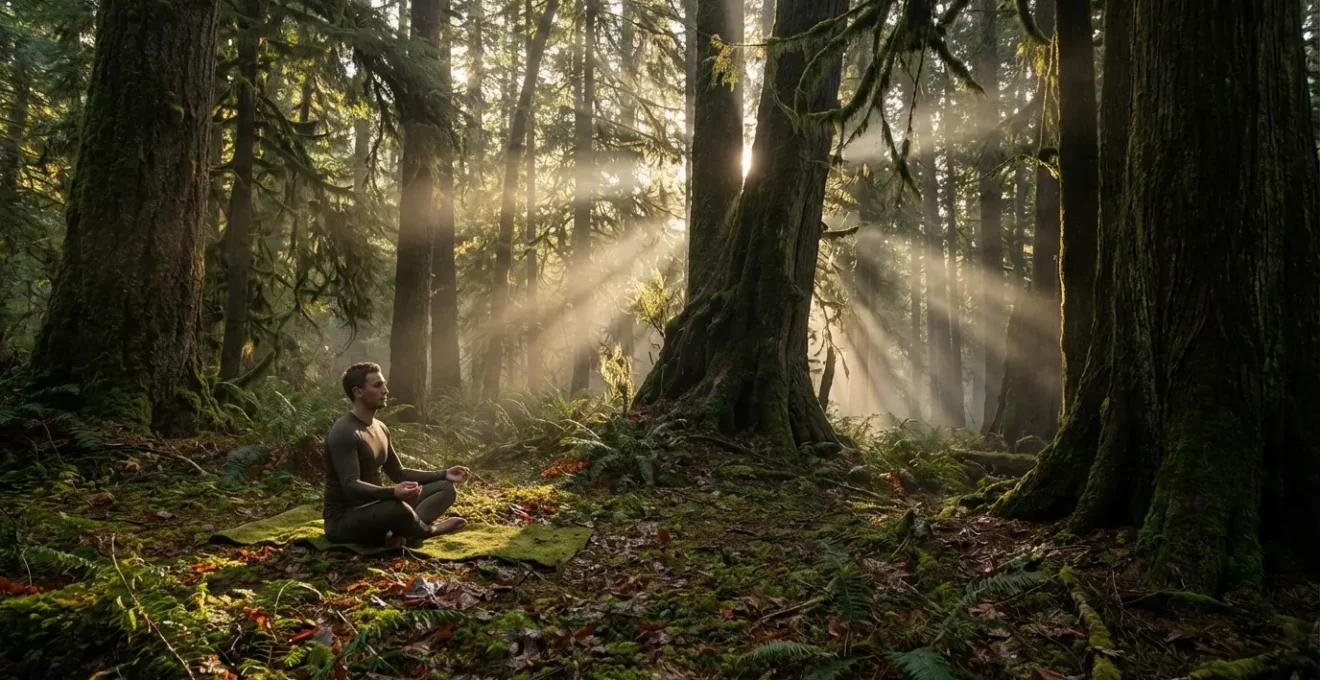
Contrary to common belief, reducing an athlete’s chronic stress isn’t about finding more distractions; it’s about engaging in an evidence-based, physiological reset that a forest environment is uniquely engineered to provide.
- Visual exposure to natural fractal patterns has been shown to reduce physiological stress by up to 60%.
- Inhaling airborne compounds from trees (phytoncides) directly boosts immune cell activity and lowers stress hormones.
Recommendation: Replace one high-tech recovery session per week with a structured, 40-minute restorative walk in a dense woodland to actively dismantle the cortisol cascade.
For the high-stress executive athlete, performance is a double-edged sword. The same drive that fuels success also feeds a relentless cycle of physical strain and mental pressure, leading to chronically elevated cortisol levels. This state, often misdiagnosed as simple fatigue or burnout, is a physiological red alert. The common prescription—unplug, rest, meditate—often feels abstract and ineffective against the deep-seated tension. We seek solutions with measurable impact, yet we overlook the most sophisticated recovery technology available: the natural world.
The solution is not merely “getting outside.” It’s a targeted intervention known as Shinrin-yoku, or forest bathing. This isn’t a leisurely stroll; it’s a form of environmental medicine. But if the key to unlocking profound mental restoration lies in the woods, the critical question is *how*? What specific mechanisms allow a forest to dismantle the physiological architecture of chronic stress in a way that urban environments or noise-canceling headphones cannot?
The answer lies beyond simple relaxation. It’s a process of biophilic engineering, where every element of the forest—from its visual geometry to its atmospheric chemistry—is calibrated to systematically calm the nervous system and rebalance the body’s stress response. This article deconstructs the science, moving beyond wellness platitudes to reveal the precise, evidence-based pathways through which forest bathing lowers cortisol and restores the high-performing mind. We will explore how visual patterns calm the brain, how inhaled compounds bolster immunity, and how to structure this practice for maximum restorative effect.
This guide breaks down the science and practice of forest bathing for peak performers. Follow along to understand the precise mechanisms at play and learn how to integrate this powerful recovery tool into your training regimen.
Summary: A Scientific Guide to Forest Bathing for Cortisol Reduction
- Why fractal patterns in trees calm the nervous system?
- How phytoncides (wood essential oils) boost immune function?
- Walking Meditation: How to structure a restorative walk in the woods?
- Natural Soundscapes vs. Noise-Canceling Headphones: Which restores focus better?
- When to visit the woods to maximize solitude and wildlife encounters?
- Why training near ancient woodlands improves focus retention?
- How chronic cortisol elevation mimics infection in the body?
- How to Decompress After a High-Stakes Loss Without Dwelling?
Why fractal patterns in trees calm the nervous system?
The restorative effect of a forest begins the moment you look at it. Your brain, especially when fatigued by urban environments filled with simple, Euclidean shapes (squares, rectangles), is hard-wired for a specific type of visual complexity. This complexity is found in fractal patterns—the repeating, self-similar shapes that define the structure of trees, ferns, and coastlines. From the way a large branch splits into smaller ones, to the intricate veins of a leaf, nature is a masterpiece of fractal geometry.
This isn’t just an aesthetic preference; it’s a neurological phenomenon. Our visual system has evolved to process these natural fractals with remarkable efficiency. This effortless processing induces a state of wakeful relaxation, characterized by an increase in alpha brainwave activity. Research using EEG has found that images with a mid-range fractal dimension—precisely the kind found in natural scenery—trigger this feel-good response. The result is a measurable calming of the nervous system. Indeed, research indicates that viewing mid-range fractals can reduce stress levels by up to 60%. This process, a form of neuro-aesthetic response, allows the brain to enter a state of recovery without conscious effort.

As you can see in the intricate texture of tree bark, these patterns repeat at different scales. This visual fluency is the opposite of the cognitive load imposed by chaotic or overly simplistic environments. For an athlete whose mind is constantly analyzing data and strategy, passively observing these patterns offers a profound and immediate form of mental decompression, shifting the brain from a state of high alert to one of quiet observation.
This shift allows the parasympathetic nervous system—the body’s “rest and digest” mode—to take over, beginning the crucial work of lowering cortisol.
How phytoncides (wood essential oils) boost immune function?
As you walk through a forest, the experience transcends the visual. The air itself is a form of atmospheric chemotherapy, rich in volatile organic compounds called phytoncides. These are the active components of wood essential oils, released by trees and plants as a defense mechanism against pests and disease. When we inhale these molecules, we are breathing in a powerful, natural medicine that directly interacts with our physiology.
The primary benefit for a stressed athlete is the impact on the immune system. Chronic stress and high cortisol levels suppress immune function, particularly the activity of Natural Killer (NK) cells. These are a type of white blood cell critical for fighting off viruses and nascent tumor cells. Research has conclusively shown that spending time in a forest environment significantly increases both the count and the activity of NK cells. This immune-boosting effect is not a byproduct of simple relaxation; it is a direct consequence of inhaling phytoncides like α-pinene and D-limonene.
Leading researcher Dr. Qing Li, in a study published in the International Journal of Immunopathology and Pharmacology, highlighted the direct connection between these natural aerosols and our body’s stress response:
Phytoncide exposure and decreased stress hormone levels may partially contribute to increased NK activity.
– Qing Li et al., International Journal of Immunopathology and Pharmacology
This means the forest air is actively working to counteract the immunosuppressive effects of chronic cortisol. For an athlete, whose body is constantly under strain and susceptible to illness, this boost is a critical component of sustainable performance and recovery.
Ultimately, breathing in the forest is not a passive act; it is an active exchange that fortifies the body’s defenses at a cellular level.
Walking Meditation: How to structure a restorative walk in the woods?
To fully harness the benefits of a forest, the approach must be intentional. Forest bathing is fundamentally different from hiking. Hiking is about reaching a destination; forest bathing is about sensory immersion with no goal other than being present. For an executive athlete accustomed to structured, goal-oriented activity, a clear protocol can transform a simple walk into a potent meditative practice.
The key is to systematically disengage the analytical, ruminating mind and awaken the senses. This process of sensory defragmentation allows the nervous system to reboot. A meta-analysis of studies on the practice confirms its efficacy, finding that salivary cortisol levels were significantly lower in forest groups compared to those walking in urban settings. A simple, three-phase structure can guide this experience, shifting from physical release to deep sensory and mental restoration.
This protocol isn’t about covering distance; it’s about shifting awareness. The aim is to move from the internal noise of performance analysis to the external symphony of the forest, allowing the environment to do its restorative work.
Action Plan: The Athlete’s Forest Bathing Protocol
- Phase 1 – Physical Unwinding (10 mins): Begin with a brisk walk. Use this time to consciously shed any lingering adrenaline from competition or work. Focus on your physical movement—the feeling of your feet on the ground, the rhythm of your breath.
- Phase 2 – Sensory Immersion (20 mins): Dramatically slow your pace to a wander. Deliberately engage one sense at a time. Spend five minutes just listening to the rustle of leaves and birdsong. Then, focus on touch by feeling the texture of tree bark. Finally, concentrate on smell—the scent of damp earth and pine.
- Phase 3 – Stillness & Reframing (10 mins): Find a comfortable, quiet place to sit. Don’t analyze your performance or plan your next move. Simply observe the environment around you without judgment. Let thoughts come and go like clouds.
- Duration & Frequency: While a 40-minute session is highly effective, studies show maximum immune benefits peak after 2-6 hours. Schedule these walks after major competitions to lower stress hormones and on rest days for nervous system restoration.
- Integration Check: Ensure your chosen location is distinct from your regular training venues. The goal is to create a psychological separation between performance and restoration.
This mindful engagement is what elevates a walk into a powerful form of walking meditation, capable of rewiring your stress response.
Natural Soundscapes vs. Noise-Canceling Headphones: Which restores focus better?
In the quest for focus and decompression, many athletes turn to technology, sealing themselves off with noise-canceling headphones. While this can block out distracting urban noise, it also starves the brain of the rich, restorative input of a natural soundscape. The sound of a forest—a complex tapestry of birdsong, wind through leaves, and running water—is not noise; it is information that the brain is exquisitely tuned to process.
Natural soundscapes are rich in the same fractal patterns we see with our eyes. The rhythm of a bird’s call or the ebb and flow of the wind have a complexity that is engaging but not demanding. This type of auditory stimulation helps to replenish our capacity for directed attention, a concept central to Attention Restoration Theory (ART). In contrast, the silence or monotonous sound delivered by headphones can lead to sensory deprivation, sometimes causing the mind to turn inward and amplify rumination—the exact opposite of the desired effect for a stressed athlete.

The physiological benefits are clear. A landmark Japanese study demonstrated that participants who walked in a forest experienced a 15.8% decrease in cortisol levels, alongside a slower heart rate and lower blood pressure, compared to their urban counterparts. This effect is significantly tied to the full sensory experience, with the auditory component playing a crucial role. Ditching the headphones allows the brain to engage with the environment, promoting a state of “soft fascination” that restores mental energy rather than consuming it.
For an athlete seeking to quiet the mind after a high-stakes event, the answer is not to block the world out, but to let the right kind of world in.
When to visit the woods to maximize solitude and wildlife encounters?
Like any training protocol, the effectiveness of forest bathing can be amplified by strategic timing. While any time spent in nature is beneficial, aligning your visits with natural cycles can significantly enhance the restorative experience, particularly for maximizing solitude and the therapeutic effects of the environment.
The first consideration is human traffic. To achieve the deep mental quiet required for restoration, avoiding peak times like weekend afternoons is crucial. Early mornings, especially on weekdays, offer the greatest chance for solitude and are also when wildlife is most active. An encounter with a deer or the chorus of the dawn birdsong provides a powerful anchor to the present moment, pulling the mind away from internal stressors.
The second factor is atmospheric. The concentration of beneficial phytoncides is not constant. It is influenced by temperature and humidity. As a general rule, these compounds are released in greater quantities on warm days. Furthermore, research indicates phytoncide concentrations increase in warm, humid conditions, particularly after rain. A walk after a light shower not only provides a richer dose of these immune-boosting aerosols but also engages the sense of smell through petrichor—the distinct, earthy scent of rain on dry soil—which has its own grounding and calming effects. Visiting during misty or foggy weather can also intensify forest aromas and create a profound sense of solitude and enchantment.
Finally, aligning your visit with your own body’s rhythm by walking in the mid-afternoon can coincide with a natural dip in cortisol, potentially amplifying the stress-reducing effects of the practice.
Why training near ancient woodlands improves focus retention?
The quality of the natural environment matters. While any green space is better than none, there is a distinct cognitive and physiological advantage to being in or near a mature, biodiverse ecosystem like an ancient woodland. These environments are not just collections of trees; they are complex, self-regulating systems that provide a superior level of restorative input, directly impacting an athlete’s ability to retain focus.
The primary mechanism at play is Attention Restoration Theory (ART). Our capacity for directed attention—the kind needed for intense training, strategic planning, and competition—is a finite resource. Urban environments, with their constant demands for focus (traffic, crowds, advertising), rapidly deplete it. Ancient woodlands, however, create an environment of “soft fascination.” The rich biodiversity, the variety in tree age and species, and the complex interplay of light and shadow engage the mind effortlessly. This allows the brain’s directed attention mechanisms to rest and replenish. As Harvard Health reports, decades of research show that forest bathing helps lower stress and improve focus.
Moreover, older forests have a more established and complex mycelial network and a richer soil biome, which contributes to a greater diversity and concentration of phytoncides and other airborne microbes. This “atmospheric biodiversity” provides a more potent chemical signal to our immune system. The concept of Shinrin-yoku was formally promoted by the Japanese government not just to de-stress its population, but also with the secondary goal of reconnecting people with their forests to encourage their protection—an acknowledgment of the irreplaceable value of these mature ecosystems.
For an athlete, training near such an environment provides a background state of restoration, helping to buffer against the cognitive drain of intense physical and mental effort.
How chronic cortisol elevation mimics infection in the body?
To fully grasp the necessity of an intervention like forest bathing, an athlete must understand the insidious nature of chronic stress. A short-term spike in cortisol is a vital performance tool—it sharpens focus, mobilizes energy, and readies the body for action. However, when high-stakes training, competition, and professional pressures make this state permanent, the body enters a dangerous phase where the cortisol cascade begins to mimic a low-grade, systemic infection.
Under chronic stress, the adrenal glands continuously pump out cortisol and other stress hormones like epinephrine and norepinephrine. This sustained hormonal flood has a profound impact on the immune system. Initially, it can trigger an inflammatory response. Over time, however, the body’s cells can become resistant to cortisol’s signal to regulate inflammation. This leads to a state of chronic, low-level inflammation, which is a hallmark of overtraining syndrome and is linked to a host of health issues, including increased susceptibility to illness, poor recovery, and mental fog.
This state is physiologically similar to the body’s response to a persistent infection. The immune system remains on high alert, consuming vast resources and creating by-products (cytokines) that contribute to feelings of fatigue, muscle soreness, and malaise. The athlete feels perpetually run-down, not because of a single workout, but because their internal alarm system is stuck in the “on” position. Interventions like forest bathing are critical because they work to break this cycle, with studies showing that forest bathing can significantly influence cortisol levels to reduce stress and its downstream inflammatory effects.
Forest bathing acts as a circuit-breaker, directly down-regulating the stress response and allowing the immune system to reset from a state of chronic alarm to one of healthy surveillance.
Key Takeaways
- The brain is hard-wired to relax when viewing the fractal patterns in nature, measurably reducing stress.
- Inhaling phytoncides (wood essential oils) actively boosts immune cell activity, counteracting the effects of stress.
- A structured walk focusing on sensory immersion is more effective than a destination-focused hike for mental restoration.
How to Decompress After a High-Stakes Loss Without Dwelling?
For a competitive athlete, one of the most acute moments of stress is the aftermath of a high-stakes loss. This is when the mind is most vulnerable to destructive rumination, replaying every mistake and feeding the cortisol cascade. A forest provides the ideal environment to process this experience constructively, moving from dwelling on the past to being grounded in the present. This is where all the principles of forest bathing converge into a powerful post-competition ritual.
The first step is to create a clear physical and psychological separation. Choosing a forest location that is entirely distinct from training venues helps signal to the brain that it is time for a different mode of being. Once there, the goal is not to suppress negative emotions, but to externalize them. A powerful technique is to assign feelings of frustration or disappointment to a natural element, such as the flowing water of a stream, and watch it carry them away. Another effective method is the 5-4-3-2-1 grounding exercise: name five things you can see, four you can touch, three you can hear, two you can smell, and one you can taste. This simple practice forces the brain out of the abstract world of analysis and into the concrete reality of the senses.
This process does more than just provide a temporary distraction; it initiates a lasting physiological shift. By engaging in slow, purposeful movement without technology, you allow the parasympathetic nervous system to take over, halting the production of stress hormones. The long-term benefits are significant; studies show the NK cell activity boost from forest bathing can last for up to one month post-exposure. This provides a sustained buffer of resilience against future stressors.
Ultimately, the forest offers a space not to forget a loss, but to reframe it, building mental and physiological resilience for the challenges ahead.