
The key to surviving winter training isn’t more willpower; it’s engineering a system that manages your brain’s dopamine economy to make consistency feel effortless.
- Shift from vague “outcome goals” to specific, daily “process goals” that provide immediate feedback and satisfaction.
- Create a dedicated training space—a “third place”—that removes physical and mental friction, making it easy to start.
Recommendation: Stop fighting the winter blues and start architecting your motivation. Focus on building disciplined systems around your environment, goals, and rewards.
The days get shorter, the air grows cold, and the trainer in the corner of the room begins to feel less like an opportunity and more like a sentence. For any athlete in the off-season, this is the familiar dread of the “winter blues.” The lack of races, the absence of group rides, and the sheer monotony of staring at a wall can drain the passion from even the most dedicated competitor. We’re often told to “just push through,” “find your motivation,” or “remember your goals.” But these platitudes fall flat when every pedal stroke feels like a chore.
The common advice to simply mix up your workouts or listen to louder music only papers over the cracks. It fails to address the fundamental mechanism that governs our drive: our brain’s internal reward system. But what if the solution wasn’t about finding some mythical source of inspiration, but about strategically managing your own neurochemistry? What if you could architect a training environment and goal structure that makes showing up the easiest, most logical choice you make all day? This is where we move beyond sheer willpower and into the realm of sustainable, long-term discipline.
This guide will deconstruct the psychology of winter training. We will explore why your current goals might be setting you up for failure, how to leverage social accountability, and how to use the science of dopamine to your advantage. It’s time to stop fighting a battle of attrition and start playing a smarter game.
For those who prefer a condensed visual format, the following video offers a complete workout routine that you can use to apply the principles of structured training discussed in this guide. It’s a perfect way to put these strategies into immediate action.
To help you navigate these strategies, this article is broken down into a clear, actionable framework. Each section builds upon the last, providing a comprehensive roadmap to transform your off-season from a period of survival into a launchpad for your strongest season yet.
Summary: Your Strategic Guide to Unlocking Winter Training Motivation
- Why “outcome goals” fail and “process goals” succeed in winter?
- How to set up a “training pact” with a partner effectively?
- New Routine vs. Old Faithful: Which restores dopamine levels?
- The “motivation myth”: Why you need discipline, not inspiration
- When to reward yourself: The timing that reinforces the habit loop
- Why people need a space between home and work to thrive?
- The danger of ignoring your body pain because the app says “Go”
- How a Trainer Scripts Your Peak Performance for Championship Month?
Why “outcome goals” fail and “process goals” succeed in winter?
The single biggest mistake athletes make in the off-season is setting the wrong kind of goals. We fixate on a distant “outcome”—a specific race weight, a target FTP, or a victory in July. While inspiring, these goals are too far away to fuel daily motivation. In the dark of a winter morning, the thought of a race six months from now provides little energy. This is because our brain’s reward system, driven by dopamine, thrives on proximity. It needs to see progress now, not later. This is why you must shift your focus to “process goals”: small, daily, controllable actions that build toward the larger outcome.
A process goal isn’t “get faster”; it’s “complete today’s 60-minute interval session at the prescribed power.” It’s not “lose 10 pounds”; it’s “hit my nutrition targets for this meal.” Each time you complete a process goal, you get a small dopamine hit, reinforcing the behavior. A study from Dominican University confirms this principle, finding that people are 33 percent more likely to complete their goals if they write them down and create a specific action plan. Process goals are that action plan, executed daily.
This strategy directly taps into what is known as Goal Proximity Theory. Research shows that dopamine availability is crucial for adherence to tasks, especially when the brain can sense that it is getting closer to achieving a goal. By breaking a huge outcome goal (a 100-mile ride in summer) into tiny process goals (this 20-minute interval), you are constantly feeding your brain a sense of accomplishment, making the entire journey more engaging and sustainable. You are architecting a system where success is inevitable simply by following the daily plan.
How to set up a “training pact” with a partner effectively?
While solo training builds mental fortitude, the off-season is the perfect time to forge a “training pact.” This goes beyond just having someone to chat with during a session; it’s about creating a system of mutual accountability and shared experience. When motivation wanes, knowing someone else is counting on you—or suffering alongside you—is a powerful psychological lever. The pact transforms a personal chore into a shared mission, dramatically increasing the likelihood that you’ll both show up, especially on the days you’d rather not.
An effective training pact is built on three pillars: shared goals, consistent communication, and mutual respect. Start by aligning on your objectives for the winter. Are you both building a base? Working on threshold power? Having a common target creates a unified purpose. Next, establish clear communication rules. Will you text each other before a workout? Do you have a shared calendar for scheduled sessions? This logistical framework removes ambiguity and strengthens commitment. Finally, the pact must be rooted in respect for each other’s schedules, energy levels, and off-days. It’s a partnership, not a dictatorship.
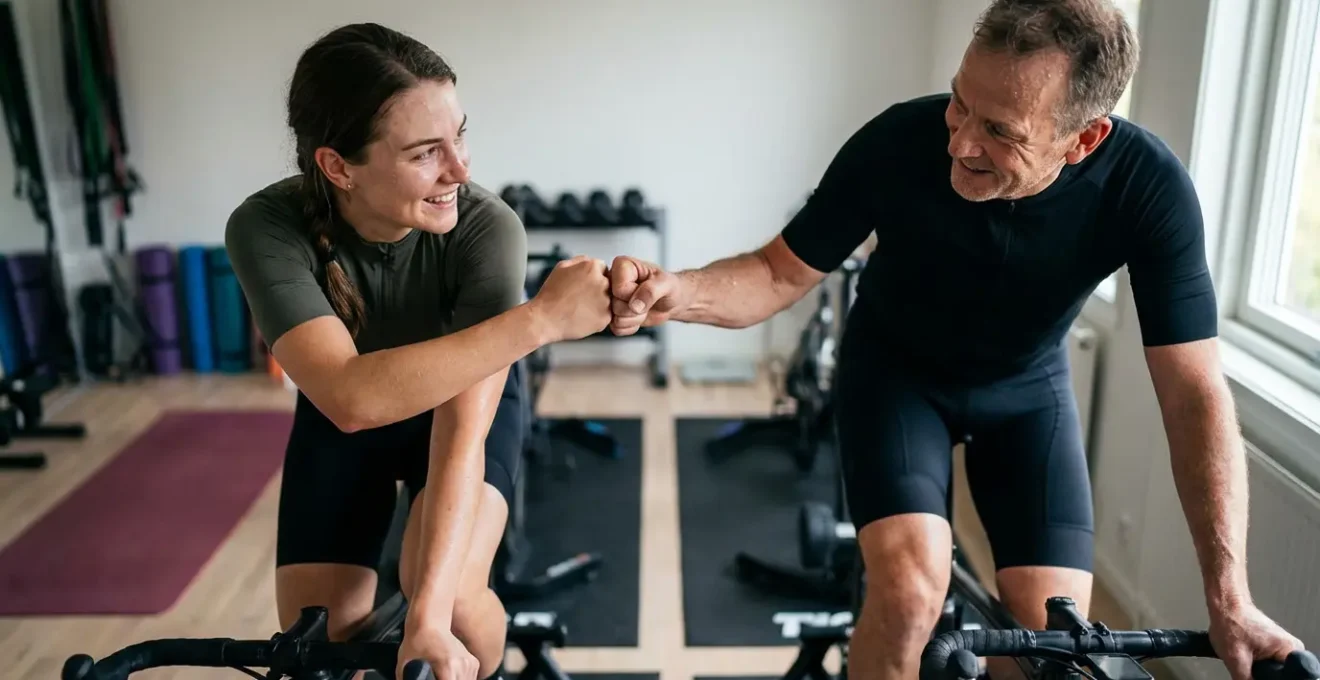
The emotional bond forged during these tough indoor sessions is a powerful reward in itself. The shared jokes, the encouragement during a tough interval, and the collective sigh of relief at the end build a unique camaraderie that outdoor riding sometimes masks. This social connection provides a different, potent stream of dopamine, one that rewards the act of showing up for someone else. It adds a crucial human element to the cold, data-driven world of indoor training, making the entire process more meaningful and sustainable.
New Routine vs. Old Faithful: Which restores dopamine levels?
The athlete’s brain is a complex machine, pulled in two directions. It craves the comfort and mastery of a familiar routine (“Old Faithful”), yet it also gets excited by new and unexpected challenges (“New Routine”). The key to maintaining your dopamine economy is not to choose one over the other, but to strategically blend both. Dopamine is not just a “reward” chemical; it’s also a “motivation” chemical. As experts in the field have noted, its role is multifaceted.
Dopamine transmission is crucial for creating a state of motivation to seek rewards and for establishing memories of cue-reward associations. DA release is critical for causing goals to become ‘wanted’ in the sense of motivating actions to achieve them.
– Bromberg-Martin et al., Dopamine in motivational control: rewarding, aversive, and alerting – PMC
This is supported by fascinating neuroscience. Research shows there are at least two types of dopamine neurons that encode different motivational signals. One type is excited by predictable rewards, reinforcing the value of sticking to your structured training plan and seeing your power numbers improve. The other is excited by novelty and salience—unexpected events, both good and bad. This explains why trying a new virtual route, joining a new group workout, or even just using a different playlist can suddenly make a stale routine feel fresh and engaging again.
The solution is a concept called “structured novelty.” This means keeping the core of your training plan—your “Old Faithful”—intact, but injecting small, planned doses of novelty around it. Successful athletes do this by integrating entertainment into their training environment. Listening to a new podcast, watching a new series on Netflix, or even playing a video game during a long endurance session can provide the novel stimulus your brain craves without compromising the physiological goals of the workout. You are satisfying both dopamine systems at once: the one that loves mastery and the one that loves discovery.
The “motivation myth”: Why you need discipline, not inspiration
Motivation is a fickle feeling. It comes and goes like the weather. Relying on it to get you on the trainer is a recipe for inconsistency. Inspiration is for amateurs; professionals rely on discipline. But discipline isn’t about being a drill sergeant with yourself. It’s about designing a system and an environment that makes doing the right thing the easiest option. Instead of waiting to *feel* like training, you create a structure where you train regardless of how you feel. You automate the decision.
One of the most overlooked aspects of this system is your physical environment. For indoor training, this is paramount. You might think your performance drops indoors because you lack motivation, but the reality is often much more tangible. For instance, research indicates that inadequate cooling is one of the biggest issues for indoor training performance. Your body overheats, your heart rate spikes, and perceived effort skyrockets. What feels like a “bad day” or a “lack of motivation” is actually a simple environmental failure. Setting up a powerful fan isn’t a luxury; it’s a core part of building a disciplined system.
Building discipline, therefore, is an act of engineering. It means leaving your cycling clothes out the night before. It means keeping your bike on the trainer, ready to go, instead of packing it away. It means ensuring your water bottles are filled and your tablet is charged. Every small barrier you remove decreases the “activation energy” required to start your workout. When the path of least resistance leads directly to the saddle, you no longer need to negotiate with yourself. The decision is already made. This is the essence of discipline: it’s not about forcing yourself to do hard things, but about making hard things easy.
When to reward yourself: The timing that reinforces the habit loop
The “habit loop” is a neurological pattern that governs our behaviors: Cue, Routine, Reward. For winter training, the cue might be your alarm clock, and the routine is getting on the trainer. But the reward is the most critical and misunderstood part of the equation. A reward isn’t just a treat; it’s the mechanism that tells your brain, “That routine was worth doing. Let’s do it again.” The timing and nature of this reward are crucial for hardwiring the habit.
Many people think the reward is the long-term fitness gain, but that’s too delayed. The brain needs something more immediate. Interestingly, science shows a significant reward happens *during* the activity itself. Using PET scans, scientists found that as participants cycled, their brains increased dopamine release, and this process was directly linked to improved reaction time during the exercise. This intrinsic reward is what makes an activity feel good in the moment. You can amplify this by focusing on the feeling of strength in your legs or the satisfying rhythm of your breathing.

In addition to the intrinsic reward, an immediate post-workout reward is essential to close the loop. This should happen within minutes of finishing. The most effective rewards are “congruent rewards”—those that align with your athletic identity. Instead of a cookie (which might conflict with your goals), the reward could be a delicious, high-quality recovery shake, five minutes with a massage gun, or simply tracking your completed workout in an app and seeing the green checkmark. This immediate, positive feedback solidifies the connection in your brain: workout = satisfaction. It’s not about bribery; it’s about smart neurological reinforcement.
Your Action Plan: Optimal Reward Timing
- Cue Creation: Set a consistent daily alarm or calendar event that signals the start of your training time.
- Intrinsic Focus: During your workout, actively focus on a positive sensation—the rhythm, the power, the feeling of getting stronger.
- Immediate Reward: Within 5 minutes of finishing, engage in a congruent reward (e.g., a favorite recovery drink, using a foam roller, or reviewing your workout data).
- Track Progress Visually: Use a training app or a physical calendar to mark off completed sessions. This visual proof of consistency is a powerful secondary reward.
- Align with Identity: Choose rewards that reinforce your identity as an athlete, such as investing in quality nutrition or a new piece of recovery gear.
Why people need a space between home and work to thrive?
In our lives, we have our “first place” (home) and our “second place” (work). But sociologists argue that for a healthy, balanced existence, we desperately need a “third place.” This is a social surrounding separate from the other two, a neutral ground where we can relax, connect, and pursue our interests. For many, the gym, the coffee shop, or the park serves this function. For an athlete, a dedicated training space can, and should, become their essential third place.
In sociology, the third place refers to social surroundings separate from home (‘first place’) and workplace (‘second place’). Examples include gyms. Ray Oldenburg argues that third places are important for democracy, civic engagement, and a sense of place.
– Ray Oldenburg, The Great Good Place
When your indoor trainer is crammed in the corner of your home office or bedroom, the lines between rest, work, and training become blurred. The space carries the psychological baggage of other activities, making it harder to mentally switch into “training mode.” Creating a dedicated area—even if it’s just a small, clearly defined corner—transforms it into a destination. It becomes a sanctuary for a specific purpose. This physical separation creates mental separation, signaling to your brain that it’s time to perform a different role: the role of the athlete.
To be effective, this third place must be comfortable and accessible. The environment can’t feel like a chore to enter. This means actively addressing obstacles like clutter, poor lighting, extreme temperatures, and noise. Is the space inviting? Is it easy to get on the bike and start? By curating your training zone to be a place you *want* to be, you are no longer just exercising in your house; you are “going to the gym.” This simple psychological shift makes the activity feel more intentional, more professional, and ultimately, more sustainable. It’s your personal stadium, and it deserves to be treated as such.
The danger of ignoring your body pain because the app says “Go”
In the age of smart trainers and adaptive training apps, it’s easy to outsource our intuition. We have algorithms telling us exactly what zones to hit and for how long. While this data is incredibly powerful, it creates a new danger: the temptation to listen to the app instead of your own body. Pain is a signal, not a weakness. Ignoring a sharp sensation in your knee or a dull ache in your lower back because the app says “Go” is a fast track to injury and burnout, not peak performance.
Your body is the ultimate source of truth. An app doesn’t know you slept poorly, are stressed from work, or are fighting off a cold. Your Rate of Perceived Exertion (RPE) is just as valid a metric as your power output. This is where you must learn to be a smart, self-aware athlete. For example, if you consistently feel knee pain, a common culprit might be a saddle that is too low. Conversely, a saddle that’s too high can often lead to lower back pain. Even with your regular bike, you may need to make small positional tweaks for stationary indoor training, as the lack of body movement can exacerbate fit issues.
This internal feedback loop is also crucial for managing intensity. While your plan might call for a threshold effort, if your body is screaming for a recovery day, the wisest and ultimately fastest choice is to listen. The brain’s reward circuitry is complex; new research provides evidence that dopamine acts on motivation and reinforcement through separate processes. Pushing through pain may satisfy the “motivation” to complete a workout, but it generates negative “reinforcement,” teaching your brain to associate training with injury and dread. True discipline isn’t about blindly following the plan; it’s about having the wisdom to adapt the plan to the reality of your body on any given day.
Key Takeaways
- Ditch distant outcome goals for daily, controllable process goals to fuel your brain’s reward system.
- Automate discipline by creating a frictionless training environment—your “third place”—where starting is the easiest option.
- Listen to your body’s signals (RPE, pain) as a primary data source, adapting your plan rather than blindly following an app.
How a Trainer Scripts Your Peak Performance for Championship Month?
The winter training season shouldn’t be a random collection of hard workouts. For a professional coach, it’s a carefully scripted three-act play, designed to build you up layer by layer, culminating in peak performance right when it matters. This process, known as periodization, transforms the off-season from a monotonous grind into a structured narrative with a clear beginning, middle, and end. Each phase has a specific purpose, both physically and mentally, ensuring you arrive at the start of the season not just fit, but also confident and resilient.
A coach scripts this journey by setting short-term, measurable objectives that act as signposts along the way. For example, when building toward a hilly spring classic, a coach might set a target for a specific threshold power improvement by the halfway mark of the winter block. These milestones provide constant feedback, confirming that the training is working and that you are moving in the right direction. This turns the long winter into a series of smaller, winnable challenges, keeping you engaged and focused.
This structured approach can be visualized as a three-act play, with each phase building on the last. The table below outlines a typical winter training structure, demonstrating how a coach methodically scripts your progression from foundational habits to race-ready fitness.
| Training Phase | Focus | Duration | Key Elements |
|---|---|---|---|
| Act 1 (Early Winter) | Foundation Building | 4-6 weeks | Habit formation, base endurance |
| Act 2 (Mid-Winter) | Peak Training Load | 6-8 weeks | Hardest blocks, mental resilience |
| Act 3 (Late Winter) | Crystallization | 3-4 weeks | Fitness consolidation, confidence building |
By adopting this scripted approach, you move from simply “exercising” to purposefully “training.” Every session has a place in the larger story. This narrative structure gives meaning to the monotony and provides the ultimate answer to the winter blues: the unwavering confidence that you are executing a plan designed for success.
Now that you have the strategic framework, the next step is to translate this knowledge into action. Begin today by reviewing your current goals and environment, and start architecting the disciplined system that will carry you to your strongest season ever.