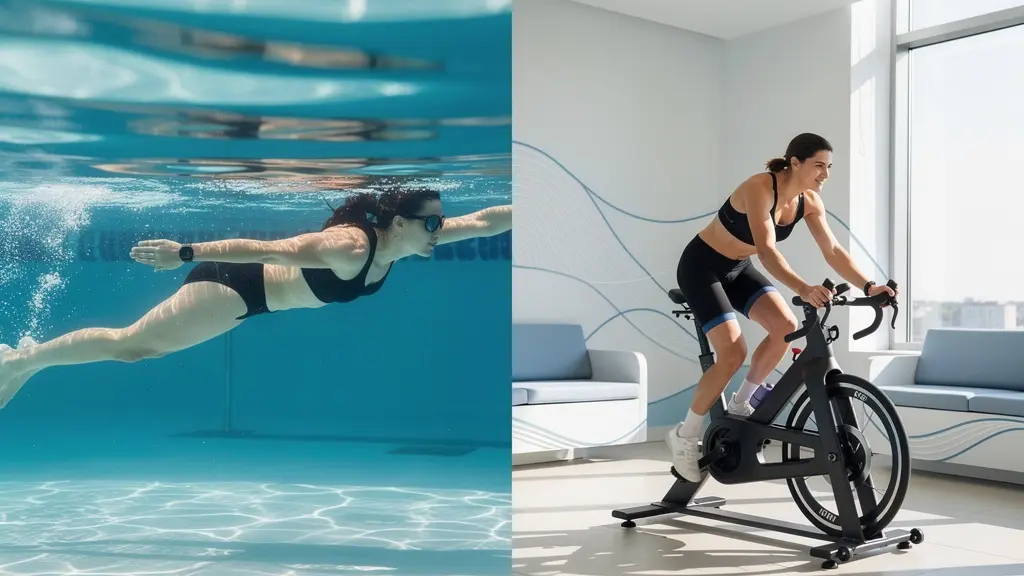
The key to long-term fitness is not just avoiding impact, but mastering high-intensity training that is completely decoupled from joint stress.
- Cardiovascular capacity (VO2 max) can be maintained or improved using zero-impact machines like ellipticals and rowers.
- Techniques like high-cadence (RPM) training allow you to spike your heart rate and metabolic load without adding mechanical wear and tear.
Recommendation: Shift your focus from “low-impact” as a compromise to “zero-impact intensity” as a strategic advantage for building a durable, high-performance body.
For any athlete, dedicated fitness enthusiast, or individual returning from injury, a familiar dilemma emerges: the drive to push your cardiovascular limits clashes with the stark reality of joint pain. The pounding of the pavement and the repetitive stress of high-impact sports can feel like a tax on your knees, hips, and ankles—a debt that compounds over time. Many believe the solution is to simply scale back, accepting a lower ceiling on their performance in exchange for joint preservation. This is a common, yet fundamentally flawed, compromise.
The conversation often revolves around generic advice like “switch to swimming” or “try cycling.” While sound, this barely scratches the surface. It fails to address the core question: how can you generate the high-level metabolic stress required to build a powerful cardiovascular engine without imposing a destructive mechanical load on your joints? The answer lies not in simply choosing low-impact activities, but in understanding the principles of what can be called “zero-impact intensity.”
This guide will dismantle the myth that low-impact means low-effort. We will explore a forward-looking, protective approach to training, treating your joints not as a limitation, but as a precious asset to be safeguarded for decades of high performance. Instead of just listing exercises, we will provide a blueprint for decoupling effort from impact, allowing you to train harder and smarter. We’ll delve into specific modalities, techniques, and technologies that build elite cardio while actively protecting your knees, setting you up for a lifetime of athletic longevity.
This comprehensive guide is structured to build your knowledge progressively, from foundational concepts to advanced applications. You will discover not only which exercises to choose, but precisely how to use them to achieve maximum benefit with minimal risk, ensuring your fitness journey is both ambitious and sustainable.
Summary: A Longevity Specialist’s Guide to Joint-Sparing Cardio
- Why elliptical training maintains VO2 max just as well as running?
- How to use RPM (Cadence) to spike heart rate without impact?
- Rower vs. Ski-Erg: Which provides the best full-body low-impact burn?
- The mistake of thinking “low impact” means “low effort”
- When to reintroduce impact exercises after a low-impact block?
- Cycling vs. Running: Which saves your knees while building heart health?
- How isokinetic machines adapt resistance to your fatigue level instantly?
- Why Hydro-Resistance Training Builds Strength Without Soreness?
Why elliptical training maintains VO2 max just as well as running?
For decades, running has been the gold standard for measuring and improving aerobic capacity, or VO2 max. This metric represents your body’s maximum ability to utilize oxygen during intense exercise and is a key indicator of cardiovascular health. The prevailing assumption has been that to improve it, you need the high intensity of impact-based exercise. However, this is where the elliptical trainer fundamentally changes the equation for joint preservation.
The elliptical’s genius lies in its ability to mimic the biomechanics of running without the damaging ground reaction forces. Your feet never leave the pedals, eliminating the jarring impact that travels up through your ankles, knees, and hips with every stride. This allows you to increase intensity through resistance and speed, driving your heart rate into the same training zones as a hard run, but without the associated mechanical cost. It’s the perfect example of decoupling metabolic load from mechanical load.
This isn’t just theory; it’s backed by science. For instance, research from Texas A&M University shows that when trained runners switched to either an elliptical or a running program for a period, VO2 max declined by a statistically insignificant 1.5% with the elliptical, compared to a 0.8% decline for the running group. This demonstrates that for maintaining a high level of aerobic fitness, the elliptical is a remarkably effective substitute, offering a powerful tool for injured athletes or those seeking athletic longevity.
How to use RPM (Cadence) to spike heart rate without impact?
One of the most powerful and often underutilized tools for generating intensity in low-impact cardio is manipulating your cadence, measured in revolutions per minute (RPM). Many people on a stationary bike or elliptical default to a slow, grinding pace with high resistance. While this builds muscular endurance, it’s not the most effective way to spike your heart rate and train your cardiovascular system. Shifting the focus to a higher RPM with moderate resistance is the key to unlocking true zero-impact intensity.
Think of it like gears on a car. A high gear (heavy resistance) at a low speed puts immense strain on the engine. A lower gear (lighter resistance) at a high speed allows the engine to rev freely and powerfully. By increasing your cadence, you force your neuromuscular system to fire more rapidly and demand more oxygen from your bloodstream. This elevates your heart rate significantly, pushing you into higher aerobic and even anaerobic training zones, all while keeping the force on your knee joints minimal.
A structured approach to cadence training can be incredibly effective. By using specific RPM ranges, you can target different physiological systems. For example, you can build a workout that moves through various zones:
- Zone 2 (Aerobic Base): A sustainable 80-90 RPM at a conversational pace, ideal for building endurance.
- Zone 3 (Tempo): Pushing to 90-100 RPM, this effort matches your lactate threshold and is “comfortably hard.”
- Zone 4 (VO2 Max): Short intervals at 100-110 RPM with just enough resistance to keep control, designed to maximize oxygen uptake.
- Zone 5 (Neuromuscular Power): All-out sprints at 110+ RPM for 15-20 seconds to train your brain-to-muscle connection speed.
This method allows you to create incredibly challenging workouts that leave your lungs burning but your joints feeling fresh. It’s a strategic way to build a powerful cardiovascular engine without paying the price in joint pain.
Rower vs. Ski-Erg: Which provides the best full-body low-impact burn?
When the goal is a comprehensive, full-body workout that spares the joints, the conversation quickly turns to two of the most effective machines in the modern gym: the indoor rower and the Ski-Erg. Both offer a phenomenal, low-impact cardiovascular challenge, but they do so by emphasizing different movement patterns and muscle groups. Choosing between them depends on your specific goals for building a durable, athletic body.
The rowing machine is often hailed as the ultimate all-in-one cardio tool. The movement is a powerful horizontal push-pull sequence, engaging approximately 60% legs and 40% upper body and core. It is exceptional for building leg drive and posterior chain strength (glutes, hamstrings, back) in a completely seated, non-weight-bearing position. Critically, for those concerned about maintaining elite fitness, research has shown the rowing machine is equally effective as a treadmill for achieving peak oxygen uptake (VO2 max).
The Ski-Erg, conversely, focuses on a vertical pulling motion. It brilliantly simulates the “poling” movement of Nordic skiing, making it a dominant workout for the lats, triceps, and core. The powerful hip hinge required with every pull provides an intense abdominal workout similar to an ab-wheel rollout, while the arms and back do the work of pulling the handles down. It is arguably one of the best tools for building upper-body endurance and a rock-solid core.
To help you decide which modality best fits your longevity blueprint, here is a direct comparison of their key features.
| Feature | Rowing Machine | Ski-Erg |
|---|---|---|
| Primary Movement | Horizontal push-pull | Vertical pull with hip hinge |
| Muscle Focus | Legs (60%), Back/Arms (40%) | Lats, Core, Triceps dominant |
| VO2 Max Effectiveness | Equal to treadmill running | Lower than rowing |
| Core Engagement | Transition stabilization | Continuous flexion (ab-wheel like) |
| Best For | Building leg drive power | Posterior chain development |
Ultimately, the choice isn’t about one being “better” but about which one complements your needs. For balanced, full-body conditioning, the rower has a slight edge. For targeted upper body and core development, the Ski-Erg is unparalleled. Integrating both into your routine offers a truly comprehensive approach to zero-impact fitness.
The mistake of thinking “low impact” means “low effort”
One of the most pervasive and damaging myths in fitness is the equation of “low impact” with “low intensity.” This misconception often leads athletes recovering from injury or older individuals to perform watered-down workouts that fail to stimulate meaningful cardiovascular or muscular adaptation. This mindset is a barrier to true progress and longevity. The goal of a protective training program is not to avoid effort; it is to channel that effort intelligently, creating high physiological stress without high mechanical stress.
This is the essence of zero-impact intensity. Imagine sprinting on a stationary bike with a high cadence, performing a maximal-effort interval on a rower, or engaging in deep-water running with a flotation belt. In each scenario, your heart rate can soar to its maximum, your lungs can burn for oxygen, and your muscles can work to the point of fatigue. You are operating at peak effort. Yet, the compressive force on your knees, hips, and spine is virtually nonexistent.
Embracing this principle is a critical paradigm shift. It means redefining what a “hard workout” looks like. It’s not about the pounding on the pavement but about the metabolic demand you place on your body. An athlete can achieve a VO2 max-level workout on a Ski-Erg that leaves them breathless, far surpassing the intensity of a slow, plodding jog that might be more damaging to their knees. This approach allows for consistent, high-level training day after day, as the body isn’t spending its recovery resources on repairing joint and tissue microtrauma from impact.
By separating effort from impact, you unlock the ability to build and maintain an elite cardiovascular engine indefinitely. You are no longer held back by joint pain or the fear of re-injury. You are simply choosing a smarter, more sustainable path to high performance. It’s a strategy that protects you today so you can still be a high-performing athlete decades from now.
When to reintroduce impact exercises after a low-impact block?
For many athletes, a block of low-impact training is a strategic phase—a time for recovery, rehabilitation, or simply giving the joints a rest. It is not necessarily a permanent state. The eventual goal is often to return to the sports and activities they love, which may include impact. However, the transition back to impact must be methodical, patient, and guided by objective milestones, not just by a date on the calendar or a feeling of being “ready.” An improper return is one of the fastest routes to re-injury.
The guiding principle for reintroducing impact is earning the right to progress. Before you even consider your first light jog, your body must demonstrate that it has the requisite strength, stability, and control to handle the forces involved. Running, for example, places a force of 2-3 times your body weight through your leg with every single step. Your muscles and connective tissues must be prepared to absorb and manage that load effectively.
A safe return-to-impact protocol is not based on guesswork. It should be built on a foundation of unilateral (single-leg) strength and stability. Your ability to control your body weight on one leg is a direct indicator of your readiness. If you cannot perform a single-leg squat or balance on one foot without your knee collapsing inward, you are not ready to absorb the dynamic, unpredictable forces of running.
The following checklist provides a clear, criteria-based progression. You should be able to complete each step without pain or subsequent swelling before even considering the next. This is your blueprint for a durable, successful return to impact.
Your Action Plan: Safely Reintroducing Impact
- Establish Foundational Strength: Can you complete multiple sets of 15-20 pain-free single-leg squats to a parallel depth? This confirms basic quadriceps and gluteal strength.
- Test Posterior Chain Control: Can you perform 20 single-leg glute bridges on each side without discomfort or cramping? This ensures your glutes and hamstrings are ready to stabilize the pelvis.
- Validate Load Tolerance: Have you been able to walk for at least 30 minutes daily for two consecutive weeks without any knee pain or swelling? This confirms your joint’s ability to handle basic, prolonged loading.
- Assess Proprioception & Stability: Can you pass a single-leg balance test, holding a steady position for 60 seconds with your eyes closed? This checks the feedback loop between your joint and your brain.
- Begin Gradual Impact Exposure: Only after mastering the above, start with a walk/run protocol. For example, begin with 1-minute light running intervals followed by 4-minute walking breaks, monitoring for any pain or swelling response over the next 48 hours before progressing.
Cycling vs. Running: Which saves your knees while building heart health?
The classic debate between cycling and running is a cornerstone of the conversation around cardio and joint health. For individuals with knee concerns, particularly those with conditions like osteoarthritis, the answer becomes remarkably clear. While both are excellent for cardiovascular fitness, their mechanical effects on the body are worlds apart. Running is a high-impact activity, while cycling is fundamentally low-impact, making it a superior choice for long-term knee preservation.
Every time a runner’s foot strikes the ground, a shockwave travels up the kinetic chain. This ground reaction force, while necessary for bone density to some extent, can be highly inflammatory for compromised knee joints. Cycling, on the other hand, is a “closed-chain” exercise. Because your feet are connected to the pedals and travel in a smooth, controlled circular motion, the jarring impact is completely eliminated. The load is placed on the musculature of the legs and glutes, not compressed through the knee joint itself.
This isn’t to say running is “bad,” but for a target audience focused on longevity and managing knee health, the evidence heavily favors lower-impact options. The sheer volume of evidence is compelling; a comprehensive BMJ study that analyzed 217 trials with 15,684 participants found that lower-impact aerobic exercises like cycling and walking were among the most effective non-pharmacological treatments for reducing pain and improving function in people with knee osteoarthritis.
Therefore, for an athlete looking to build or maintain heart health without exacerbating knee issues, cycling presents an almost perfect solution. It allows for high levels of intensity, from steady-state endurance rides to high-intensity interval training (HIIT), without the mechanical cost of running. It enables you to tax your heart and lungs to their limits while your knees are safely supported through a controlled range of motion.
How isokinetic machines adapt resistance to your fatigue level instantly?
In the world of advanced rehabilitation and strength training, isokinetic machines represent a pinnacle of safety and efficacy, especially for sensitive joints like the knee. Unlike traditional weights, where the resistance is constant, an isokinetic machine provides an “accommodating” resistance. This means the machine’s resistance perfectly matches the force you apply to it at every single point throughout the range of motion, while keeping the speed of movement constant.
This concept is revolutionary for joint-centric training. If you push or pull with maximal force, the machine resists with maximal force. If you experience a moment of pain or fatigue and your force output drops, the machine’s resistance instantly drops to match it. This creates a controlled and safe environment for strengthening muscles around a joint without the risk of overloading it. There’s no danger of a weight becoming too heavy mid-repetition or pushing through a painful point, as the resistance is entirely dictated by the user’s effort.
This adaptive resistance is a powerful tool for post-injury recovery. As Chen et al. noted in a 2023 article for Nature Communications, this technology has an inherent safety mechanism.
This constant speed characteristic naturally integrates a safety mechanism that reduces resistance if the patient experiences pain or discomfort.
– Chen et al., Nature Communications, 2023
The effectiveness of this approach is well-documented. For instance, research from the University of Novi Sad demonstrates that 92.2% of patients recovering from knee surgery achieved the highest recovery classification when isokinetic training was part of their protocol. By allowing for maximal muscle contraction at every angle of a joint’s movement in a safe, controlled manner, isokinetic machines can accelerate strength gains and functional recovery far more efficiently than traditional methods.
Key Takeaways
- True fitness longevity comes from mastering “zero-impact intensity,” decoupling high effort from high joint stress.
- Cardio modalities like ellipticals, rowers, and cycling are proven to maintain or improve VO2 max as effectively as running, but without the mechanical damage.
- A structured return to impact is crucial and must be earned through strength and stability milestones, not rushed.
Why Hydro-Resistance Training Builds Strength Without Soreness?
Hydro-resistance training, or aquatic therapy, is one of the most powerful yet gentle methods for building strength and improving mobility, particularly for individuals with joint pain. The magic of water lies in its unique physical properties: buoyancy, viscosity, and hydrostatic pressure. Together, these elements create a training environment that is impossible to replicate on land, one that allows for strengthening without the typical post-exercise muscle soreness.
The key is that water provides resistance in all directions, but it contains no “eccentric” load. In land-based weight training, the eccentric (or lowering) phase of a lift is what causes the most muscle fiber micro-tears, leading to delayed onset muscle soreness (DOMS). In water, you work against the fluid’s resistance during the concentric (pushing or pulling) phase, but there is no load on the return movement. This allows you to build strength without the muscle breakdown that causes soreness, enabling more frequent and consistent training.
Furthermore, the buoyancy of water offloads your body weight, reducing compressive forces on the joints to a fraction of what they are on land. This creates a safe, pain-free environment to work through a full range of motion. The viscosity of the water provides a smooth, accommodating resistance that increases the harder you push against it, much like an isokinetic machine. Finally, the hydrostatic pressure of the water provides gentle compression to the entire limb, which can help reduce swelling and improve circulation. The results of this approach can be dramatic and swift.
Case Study: Accelerated Knee Rehabilitation with Aquatic Therapy
A patient named Meghan, recovering from a significant knee procedure, began aquatic therapy with severely limited range of motion: she was unable to fully extend her leg by 10 degrees and could only bend it to 90 degrees. After just one week of therapy in a warm water pool, her metrics improved dramatically. Her extension improved to minus 5 degrees, and her knee flexion increased to 100 degrees. The supportive, low-pain environment of the water allowed her to perform movements that would have been impossible on land, accelerating her recovery timeline significantly.
This combination of supportive buoyancy and soreness-free resistance makes hydro-training an exceptional tool for anyone looking to build functional strength as part of a longevity-focused fitness plan.
To truly integrate these principles into your life, the next step is to design a personalized training plan that leverages the right modalities for your specific goals and current joint health. Evaluate these options not as compromises, but as strategic tools for building a more resilient, durable, and high-performing body for the years to come.