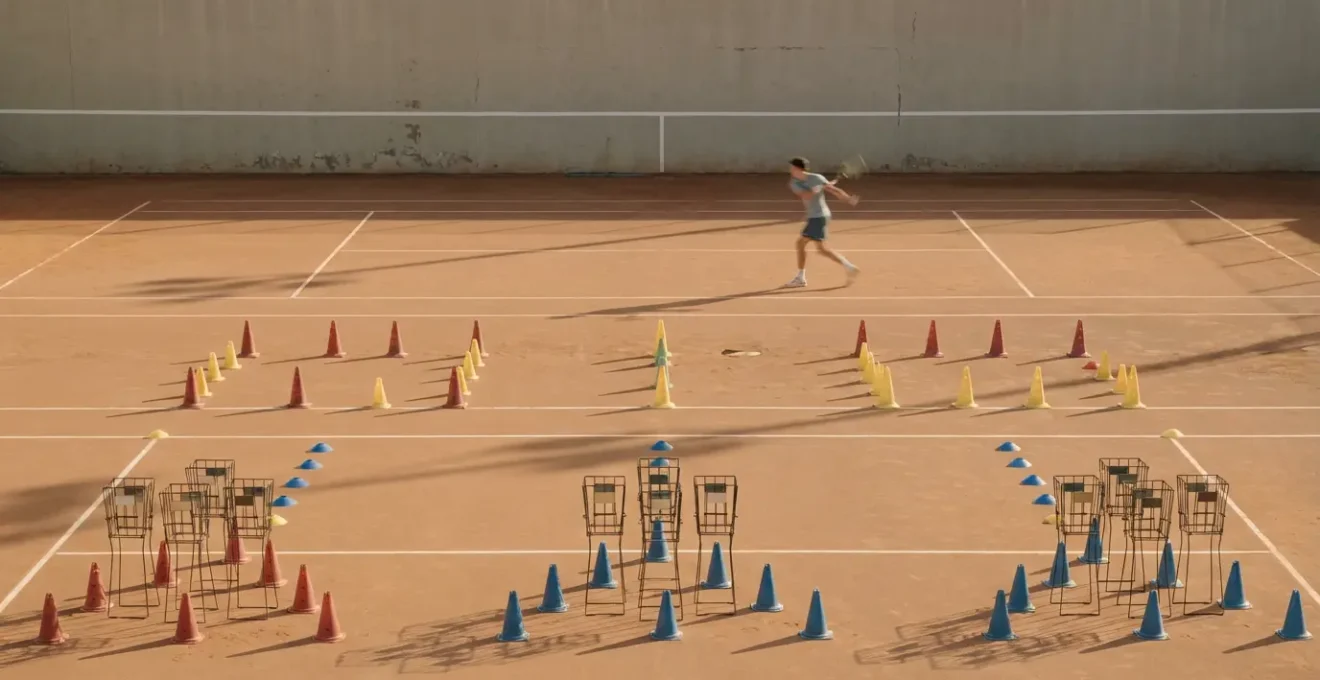
The efficiency of a practice zone is not determined by its size, but by its logistical design to maximize repetition throughput.
- Systematically arranged boundaries and equipment workflows can drastically reduce non-value-added time (ball retrieval, setup changes).
- Player spacing and movement paths must be engineered using concepts like the “kinetic bubble” to prevent collisions and maintain drill intensity in group settings.
Recommendation: Stop thinking about the court as open space and start treating it like a factory floor, where every element is positioned to streamline the production of correct muscle memory.
For any coach or facility manager, the goal is simple: create an environment where players can achieve the highest number of quality repetitions in the shortest amount of time. Yet, most practice sessions are plagued by logistical inefficiencies. Players spend more time retrieving stray balls and waiting for instructions than they do executing strokes. The common advice—use more balls, set up targets—is a starting point, but it fails to address the root problem: the practice space itself is not engineered for optimal workflow.
The layout of your court, the placement of a ball hopper, and the defined boundaries of a drill are not minor details; they are the core components of a system. This system can either facilitate or hinder the development of correct muscle memory. A poorly designed space reinforces bad habits and wastes valuable time, whereas a strategically optimized zone acts as a silent coach, enforcing correct patterns and providing constant, subtle feedback. This guide moves beyond generic tips to provide a logistical framework for transforming any standard court into a high-throughput station for technical mastery.
This article provides a logistical blueprint for structuring your training space. We will dissect how to define boundaries to increase intensity, arrange equipment to eliminate downtime, and manage player flow to ensure safety and efficiency. The focus is on turning your facility into a true engine for player development.
Summary: A Facility Director’s Guide to High-Throughput Practice Zones
- Why defined boundaries in practice zones increase drill intensity?
- How to organize ball hoppers and targets to minimize downtime?
- Robot-Assisted Lane vs. Wall Practice: Which builds consistency faster?
- The spacing error that causes racquet collisions in group drills
- How to retrofit a standard court into a high-rep practice station?
- Solo Studio vs. Public Court: Where to fix a broken serve mechanics?
- How to program a “random oscillation” drill to simulate match play?
- How Long Does It Really Take to Overwrite Bad Muscle Memory?
Why defined boundaries in practice zones increase drill intensity?
The most immediate way to increase the operational efficiency of a drill is to constrain the space in which it is performed. Unstructured space leads to unfocused practice. By establishing clear, non-negotiable boundaries, you invoke a psychological principle akin to Parkinson’s Law: work expands to fill the time allotted. Similarly, a player’s focus and effort will conform to the spatial constraints imposed. A smaller, defined zone forces a higher degree of precision and control, inherently increasing the intensity of each repetition.
This is not a theoretical benefit; it is quantifiable. Research on youth tennis players demonstrated that training within spatially constrained areas leads to significant performance gains. A 2025 study found that players who practiced in such zones showed a 15% improvement in ITN scores and a 10% reduction in their T-drill agility test completion times. These boundaries create a clear feedback loop: a ball landing outside the zone is an immediate, visual indicator of an error, requiring no verbal input from a coach. This principle is utilized by elite programs, such as the Australian national junior academies, which heavily rely on structured, zone-based tasks to develop groundstroke and serve technique through concentrated repetition.
Action Plan: Implementing High-Intensity Zones
- Set specific target zones using cones placed 6 feet inside the baseline to establish initial boundaries.
- Instruct players to hit 10 consecutive shots into each zone before progressing to a new target area.
- Increase difficulty by systematically reducing the zone size or by adding mandatory movement patterns between shots.
- Implement a tracking system for success rates (e.g., shots in vs. shots out) to measure and improve concentration.
- Rotate zone locations and sizes weekly to prevent stagnation and adapt the challenge.
By defining the operational area, you are not just setting up a drill; you are programming the environment to demand a higher level of performance. This transforms a simple hitting session into a targeted, measurable, and far more intense training module.
How to organize ball hoppers and targets to minimize downtime?
Once boundaries are set, the next logistical bottleneck to address is equipment workflow. A player walking back and forth to a single ball hopper is dead time, effectively lowering the repetition throughput of your facility. The goal is to create a “practice triangle” or a similar ergonomic setup that places the player, the ball supply, and the targets in a configuration that minimizes movement and maximizes hitting time. This is a problem of feedback loop logistics.
This paragraph introduces the core concept of the practice triangle setup. To better understand this logistical arrangement, the illustration below shows an optimal configuration.
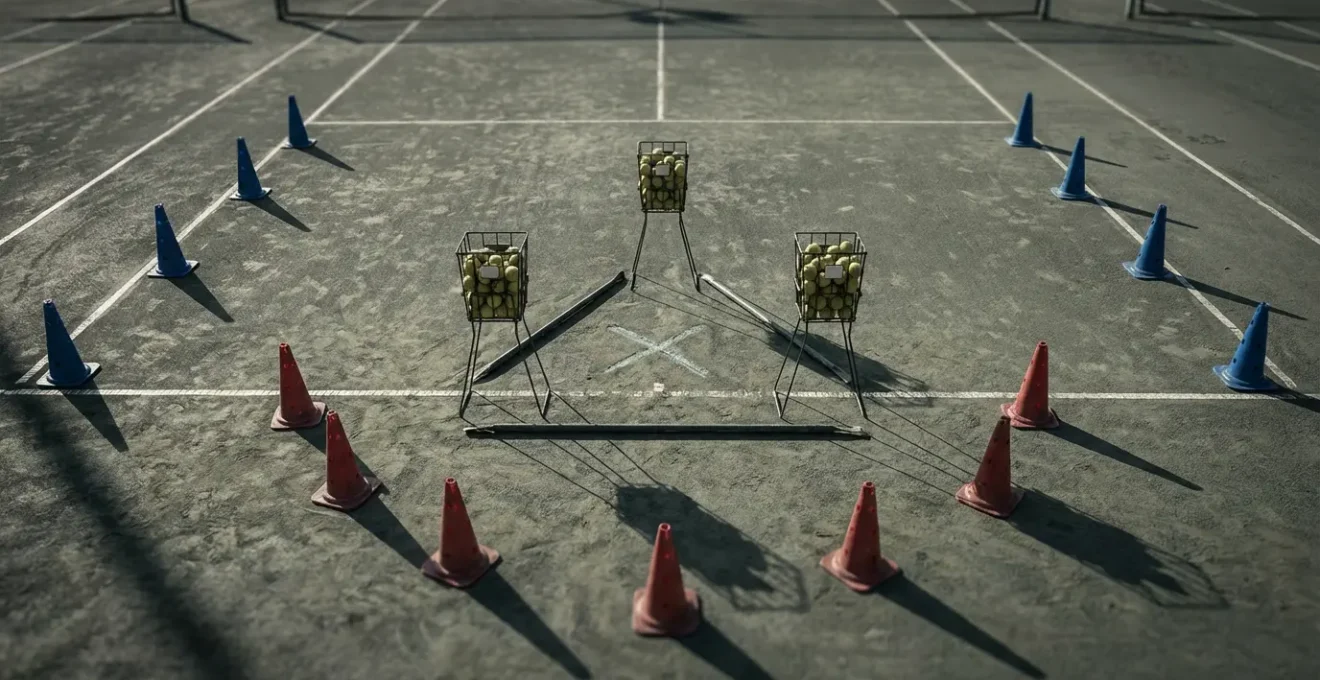
As the diagram shows, the player is at the center of the workflow. Ball hoppers are placed within arm’s reach, allowing for a seamless transition from one shot to the next. This setup eliminates the “search and retrieve” phase that plagues many practice sessions. The efficiency gains are not marginal; they represent a fundamental shift in how practice time is utilized.
The following table, based on common coaching observations, compares the time efficiency and ball usage of different setups. As shown in an analysis of essential tennis drills, a structured formation significantly outperforms traditional methods.
| Setup Method | Time Efficiency | Ball Usage | Feedback Quality |
|---|---|---|---|
| Traditional Single Hopper | Low | 50-75 balls/hour | Limited |
| Triangle Formation | High | 150-200 balls/hour | Immediate |
| Multi-Station Setup | Very High | 200+ balls/hour | Zone-specific |
Organizing your equipment is not about tidiness; it is a strategic imperative. By engineering the court layout to reduce movement and decision-making, you directly increase the number of quality repetitions a player can execute per hour.
Robot-Assisted Lane vs. Wall Practice: Which builds consistency faster?
For building foundational stroke mechanics, the volume of repetition is key. Two of the most effective tools for achieving high volume are the practice wall (or backboard) and the ball machine. From a facility director’s perspective, the choice between them depends on the specific training objective: raw repetition volume versus programmable consistency. The practice wall is the undisputed leader in maximizing sheer contact volume. It provides an immediate return, eliminating all ball-retrieval time.
The data on this is unequivocal. Research from the ITF Coaching Review demonstrated that wall practice sessions can generate up to 3 times more ball strikes per player compared to drills with a human partner. This makes the wall an unparalleled tool for grooving the basic motor pattern of a stroke through massive repetition. However, its primary limitation is the lack of variation in ball speed, spin, and trajectory. It provides consistent quantity, but not necessarily consistent quality of feed.
This is where the ball machine, or a robot-assisted lane, provides a distinct advantage. While the repetition throughput may be slightly lower than a wall, its value lies in its programmability. A ball machine can deliver thousands of identical balls to the exact same spot, allowing a player to isolate and correct a minute flaw in their swing path or contact point. It offers controlled, repeatable conditions that a wall cannot. This setup is ideal for the initial stages of overwriting bad muscle memory, where consistency of the incoming ball is paramount to ingraining a new, correct movement.
Ultimately, the two are not mutually exclusive but serve different phases. The wall is for mass volume and rhythm development, while the robot-assisted lane is for precision engineering of a specific technical element. The fastest path to consistency involves using both as forms of “environmental scaffolding” at different stages of development.
The spacing error that causes racquet collisions in group drills
When transitioning from solo to group practice, the primary logistical challenge becomes managing multiple players within a shared space. The single most common and dangerous error is linear formations, where players stand side-by-side. This layout fails to account for the “kinetic bubble”—the three-dimensional space a player’s racquet occupies during a full swing, including their follow-through. A mis-timed swing or a slight shift in position can lead to equipment damage or injury.
The solution is to abandon linear setups in favor of a staggered, triangular formation. This geometric arrangement ensures that each player’s kinetic bubble remains clear of their neighbors’, even during dynamic movement drills. Visualizing and managing this space is critical for both safety and drill efficiency.
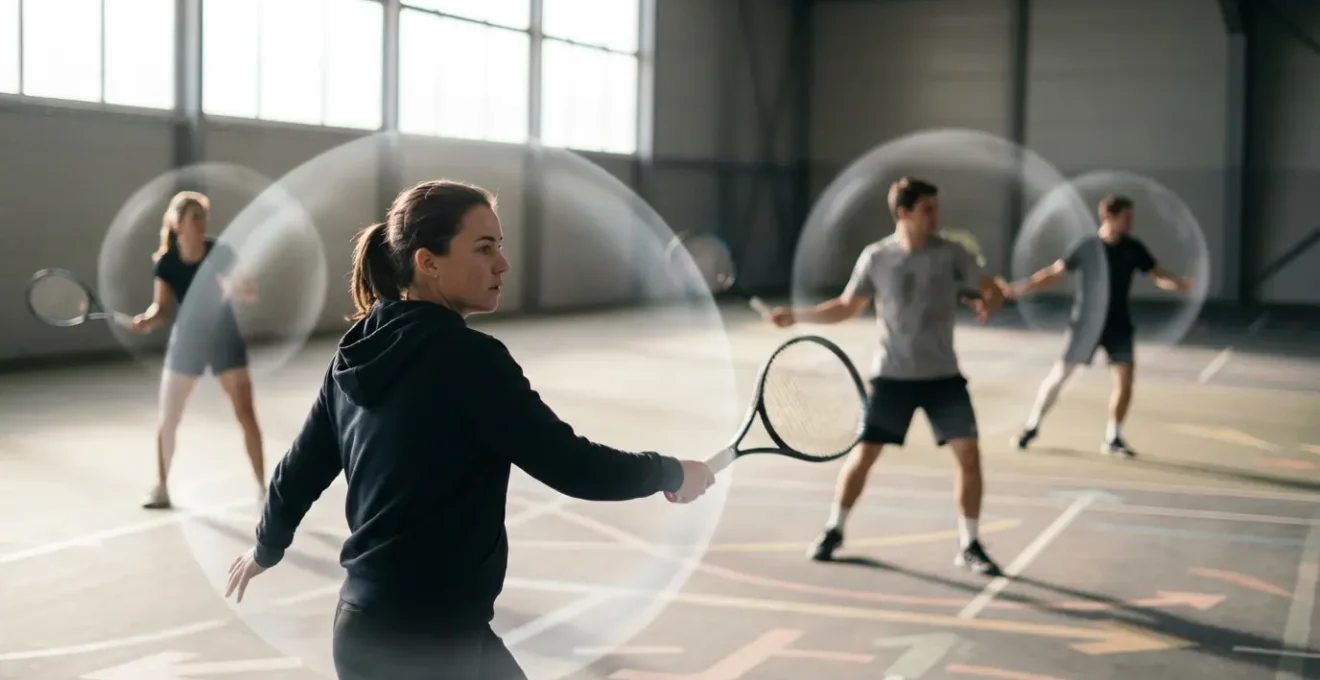
As seen in the image, a staggered layout provides a natural buffer zone around each athlete. To implement this effectively, facility managers should use temporary court markers to map out each player’s designated station and movement paths. The goal is to create a clear “spatial grammar” for the drill. This includes establishing one-way rotation systems, where players move to the next station or to the back of the line in a predictable, circular flow. For volley drills, a minimum interval of 2 meters between players should be strictly enforced to provide an adequate safety margin for lunges and reactive movements.
By engineering the player layout and flow, you transform a potentially chaotic group session into a synchronized, high-efficiency operation. This systematic approach to spacing preempts collisions and allows coaches to focus on instruction rather than traffic management.
How to retrofit a standard court into a high-rep practice station?
A standard tennis court is designed for match play, not for high-repetition training. Its large, open space is inefficient for isolating specific skills. However, any court can be temporarily transformed into multiple, high-throughput practice stations with minimal equipment and setup time. The key is to use physical dividers and constraints to create smaller, dedicated “micro-courts.”
The most effective method is the use of mini-net divisions. Placing one or two portable mini-nets across the court immediately divides the space into smaller, more manageable zones. This allows up to four players to engage in short-court or volley drills simultaneously in a space traditionally occupied by two. Another technique is using “vertical constraints,” such as a rope or bungee cord strung a few feet above the net, to force players to hit with a specific trajectory, ideal for developing topspin or a higher net clearance on groundstrokes.
These modifications are not just about fitting more players on a court; they are about creating an environment that accelerates skill acquisition. The table below outlines the effectiveness of various retrofitting methods.
| Modification Type | Setup Time | Drill Variety | Skill Transfer |
|---|---|---|---|
| Mini-net Divisions | 5-10 min | High (4+ drills) | Excellent |
| Gamified Overlays | 2-5 min | High (unlimited) | High engagement |
| Vertical Constraints | 10-15 min | Medium (2-3 drills) | Good for trajectory |
By using these simple retrofitting techniques, a facility manager can dramatically increase the utility and repetition throughput of their existing court space. This allows for more focused, simultaneous drills, maximizing the value of every minute of court time and catering to a larger group of players without compromising the quality of practice.
Solo Studio vs. Public Court: Where to fix a broken serve mechanics?
Fixing a deeply ingrained flaw in a complex motion like the serve requires a two-phase approach: isolation and integration. Attempting to correct a major mechanical error directly on a public court is often counterproductive. The pressure to perform, the external distractions, and the focus on the outcome (getting the ball in) prevent a player from focusing on the process. The ideal environment for the initial correction phase is a controlled solo studio.
In a studio, a player can deconstruct the motion without judgment. The use of mirrors is critical for isolating specific checkpoints, like the trophy pose or the racquet drop. Video-delay apps provide immediate, objective visual feedback that is impossible to get on a full court. Furthermore, resistance bands can be used to activate and strengthen the specific muscle groups responsible for the flawed part of the kinetic chain. This is the “environmental scaffolding” needed to build the new, correct movement pattern in a sterile setting.
However, a serve fixed in a studio is not a fixed serve. The second phase, integration, must occur on a real court. As Hernández-Davo et al. noted in the Journal of Sports Science:
Variable training: effects on velocity and accuracy in the tennis serve showed that alternating between controlled studio environments and court-based practice optimizes serve mechanics development.
– Hernández-Davo et al., Journal of Sports Science
On the court, the focus shifts to testing the new mechanics under realistic pressure. This is where tools like radar guns to measure pace and pressure-sensitive mats to track weight transfer become invaluable. The process should be progressive: start with hitting serves into the fence with no target, then move to serving into the service box, and finally, practice serving under simulated match conditions. This dual-environment approach ensures the new mechanic is not only learned but also durable under pressure.
How to program a ‘random oscillation’ drill to simulate match play?
Once a player has grooved a stroke through high-volume, blocked repetition, the next step is to make that skill resilient under unpredictable, match-like conditions. This is the purpose of a “random oscillation” drill. However, “random” is a misleading term from a training logistics perspective. Truly random ball feeds are often less effective than a structured, sequential approach that mimics the patterns of a real game. The goal is not chaos, but structured unpredictability.
Interestingly, research on anticipation training has shown that a purely random practice order can be less effective for skill retention. One study found that a sequential practice structure improved retention and transfer compared to completely random training. This suggests that the most effective “random” drills are actually based on common game patterns (e.g., cross-court, down-the-line, approach shot). A ball machine can be programmed to run these patterns in an unpredictable sequence, forcing the player to recognize the situation and react accordingly, just as they would in a match.
This approach moves beyond simple ball-feeding. As one study on elite player development notes, advanced players require “smarter, more intentional repetitions” designed to mimic pressure situations and target real weaknesses. A well-programmed drill might involve a sequence of five deep cross-court backhands followed by an unexpected short ball, forcing a transition to the net. The oscillation is “random” from the player’s perspective, but it is deliberately programmed by the coach to test pattern recognition and decision-making. Virtual reality systems like Sense Arena Tennis utilize this principle effectively, using drills with random combinations of baseline shots to simulate match conditions while maintaining a high, consistent feed rate.
Therefore, programming an effective random oscillation drill is about creating a library of common match-play sequences and having the ball machine execute them in a shuffled order. This builds not just a robust stroke, but a tactically aware player.
Key Takeaways
- Practice zone efficiency is a function of logistical design, not just equipment availability.
- Systematic workflows (like the “practice triangle”) and spatial constraints (defined boundaries) are essential to maximize repetition throughput.
- Safety in group drills is achieved by engineering player spacing (“kinetic bubble”) and flow, not just by issuing warnings.
How Long Does It Really Take to Overwrite Bad Muscle Memory?
The ultimate purpose of designing a high-repetition practice zone is to overwrite faulty muscle memory and ingrain correct technique. This is a neurobiological process, and facility managers must understand its timeline to set realistic expectations for their players and coaches. It is not a matter of a few sessions. Overwriting an established motor pattern is a significant undertaking that requires both high volume and strategic timing.
The process hinges on myelination, where the brain wraps neural pathways in a fatty sheath to make them faster and more automatic. To build a new “super-highway” for a correct forehand, a player must fire that specific neural circuit repeatedly and consistently. According to neuroscience research on motor learning, meaningful consolidation of muscle memory requires a dedicated period of focused effort. Studies indicate a timeline of at least 4 weeks of training, with practice sessions spaced within 1-2 days of each other to allow for consolidation without degradation.
This highlights why practice efficiency is so critical. If a player only gets 50 quality repetitions in an hour due to poor court logistics, they will struggle to achieve the required volume within this biological window. Furthermore, the practice must be highly focused. As coach Archie Dan Smith points out:
Often coaches will try to cover the forehand, the backhand, approach shots, volleys and serves all in an hour! The brain simply can’t cope with multiple strokes. And that’s why progress is painstakingly slow.
– Archie Dan Smith, Muscle Memory and Imagery: Better Tennis
Therefore, a facility designed for high-repetition, single-stroke drills is not just a convenience; it is a necessity for aligning training with the biological reality of how the brain learns. It provides the only viable path to hitting the required volume of correct repetitions needed to overwrite years of bad habits.
By shifting your perspective from simply providing a court to engineering a complete training system, you create an environment that actively accelerates player development. The next logical step is to audit your own facility’s workflow and identify the key areas of downtime that can be eliminated through better spatial design.