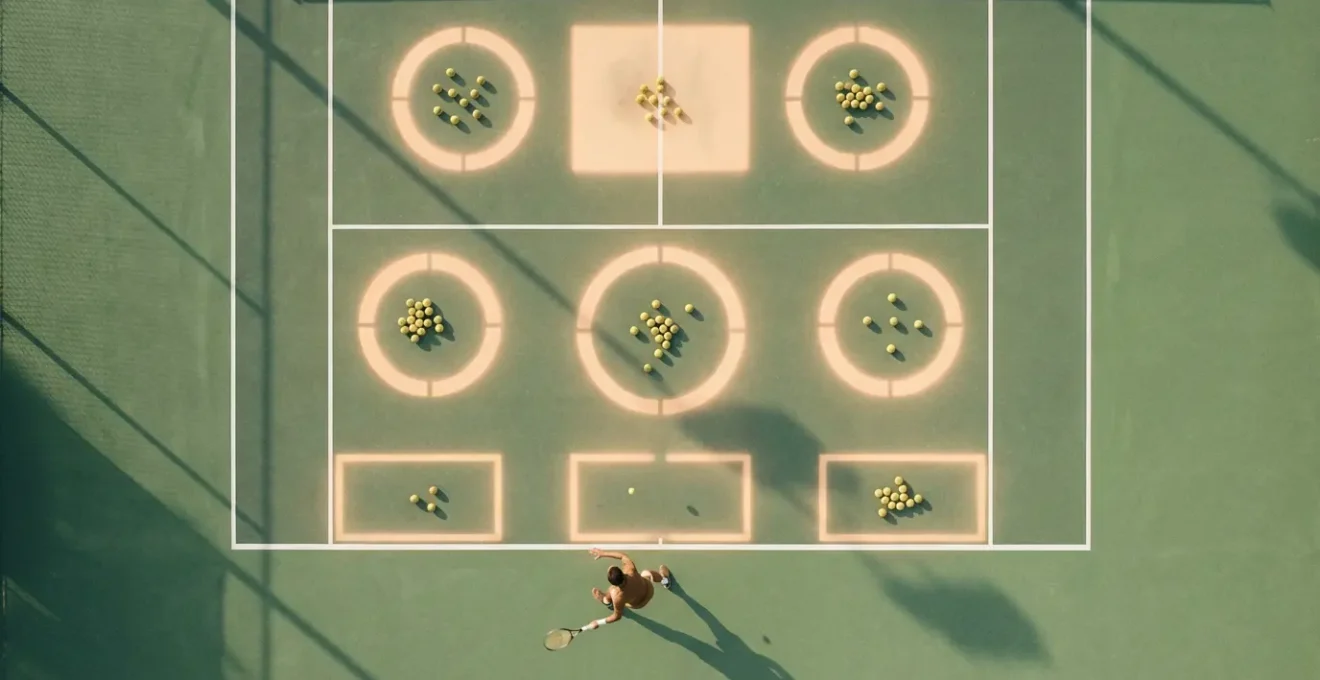
In summary:
- Effective training in a limited timeframe requires shifting from volume-based practice (“hitting balls”) to a data-driven approach where every drill is a measurable experiment.
- Structure your sessions using quantifiable feedback loops, such as target grids and statistical tracking, to identify and correct performance variance.
- Systematically manage training load by periodizing the ratio of accuracy-to-power drills (e.g., 80/20 to 30/70) to maximize gains and prevent injury.
- Progress from static, predictable drills to dynamic, chaotic scenarios using a structured framework to ensure skills transfer to match play.
For the serious competitive amateur, the most significant constraint is not talent or ambition, but time. With only ten hours per week, the conventional wisdom to simply “hit more balls” is not just inefficient; it’s a direct path to stagnation. The frustration of training hard without seeing measurable improvement on the scoreboard is a common experience. Players spend hours grooving strokes but fail to develop the situational precision required to win critical points. This happens because unstructured practice lacks the fundamental component of effective skill acquisition: a quantifiable feedback loop.
The common approach focuses on repetition, hoping that sheer volume will forge consistency. Players might use a ball machine for an hour or play practice sets, but they rarely exit the court knowing, with statistical certainty, if their backhand crosscourt accuracy improved by 5% or if their serve placement under pressure degraded after 45 minutes. The key isn’t to practice more, but to practice smarter. This involves a radical shift in mindset. What if every training session was treated not as a workout, but as a data acquisition opportunity? What if the goal of each drill was not just execution, but the generation of performance statistics?
This is the core of a mathematical approach to training. By treating every drill as a controlled experiment, you can isolate variables, measure outcomes, and make data-informed adjustments. This guide moves beyond generic advice and provides a structured system for integrating precision modules into your limited training schedule. We will deconstruct why measurement is the bedrock of training, how to build a statistical feedback system, manage the critical balance between accuracy and power, and know precisely when to transition from controlled practice to the chaos of live-ball play. This is how you transform your 10 hours from mere repetition into a high-yield investment in performance.
To navigate this structured methodology, the following sections will break down each component of a data-driven training plan. This roadmap is designed to guide you from foundational principles to advanced application, ensuring every minute on court is maximized for measurable improvement.
Summary: A Mathematical Framework for the 10-Hour Training Week
- Why “hitting balls” is not training unless you measure accuracy?
- How to configure a target grid for statistical feedback?
- Accuracy Drills vs. Power Drills: What ratio prevents form breakdown?
- The volume mistake in precision drills that leads to tendonitis
- When to transition from static precision to live-ball chaos?
- Why defined boundaries in practice zones increase drill intensity?
- Why “total distance” is a vanity metric compared to “high-speed distance”?
- Programmable vs. Static Ball Machines: Which Improves Reaction Time?
Why “hitting balls” is not training unless you measure accuracy?
The fundamental distinction between unstructured practice and systematic training lies in a single variable: measurement. “Hitting balls” is a physical activity focused on volume and feel. Training, in a technical sense, is a process designed to elicit a specific, measurable adaptation. Without a metric for success or failure beyond the binary of the ball landing in or out, you are operating in an informational vacuum. You cannot manage what you do not measure. This is why a player can hit 500 forehands and see no tangible improvement in match-play performance; they have practiced the motion but not the outcome under specific constraints.
Elite performance is built on razor-thin margins defined by statistics. For instance, an analysis of top professionals shows that elite players achieve exceptional first-serve accuracy rates of 72.4% under competitive pressure. This isn’t an accident of talent; it’s the result of countless hours of training where success was defined not by “hitting a good serve,” but by hitting a specific target zone a statistically significant number of times. This creates a powerful feedback loop: set a target, attempt to hit it, record the result (hit, miss, and by how much), and adjust. This is the scientific method applied to tennis.
Each shot in a measured drill becomes a data point. Over a session, these data points form a distribution that reveals your true performance level, including your consistency (standard deviation) and your biases (average error). Are you consistently missing wide on your crosscourt backhand? By how many feet? Only by tracking this can you diagnose the root cause—be it footwork, contact point, or timing—and design a corrective drill. Hitting balls without this feedback is like studying for an exam without ever checking your answers. You’re putting in the time, but the learning is incidental, not intentional.
How to configure a target grid for statistical feedback?
A target grid is the physical manifestation of a data-driven training philosophy. It transforms the abstract court space into a quantifiable, measurable environment. Instead of aiming for “deep and crosscourt,” you are now aiming for “Zone 4C.” This specificity is critical for generating reliable performance data. The configuration of this grid is not arbitrary; it must be designed to test the specific variables you wish to improve, such as depth, width, and consistency under different conditions. The size and location of the targets directly influence the difficulty and the type of feedback you receive.
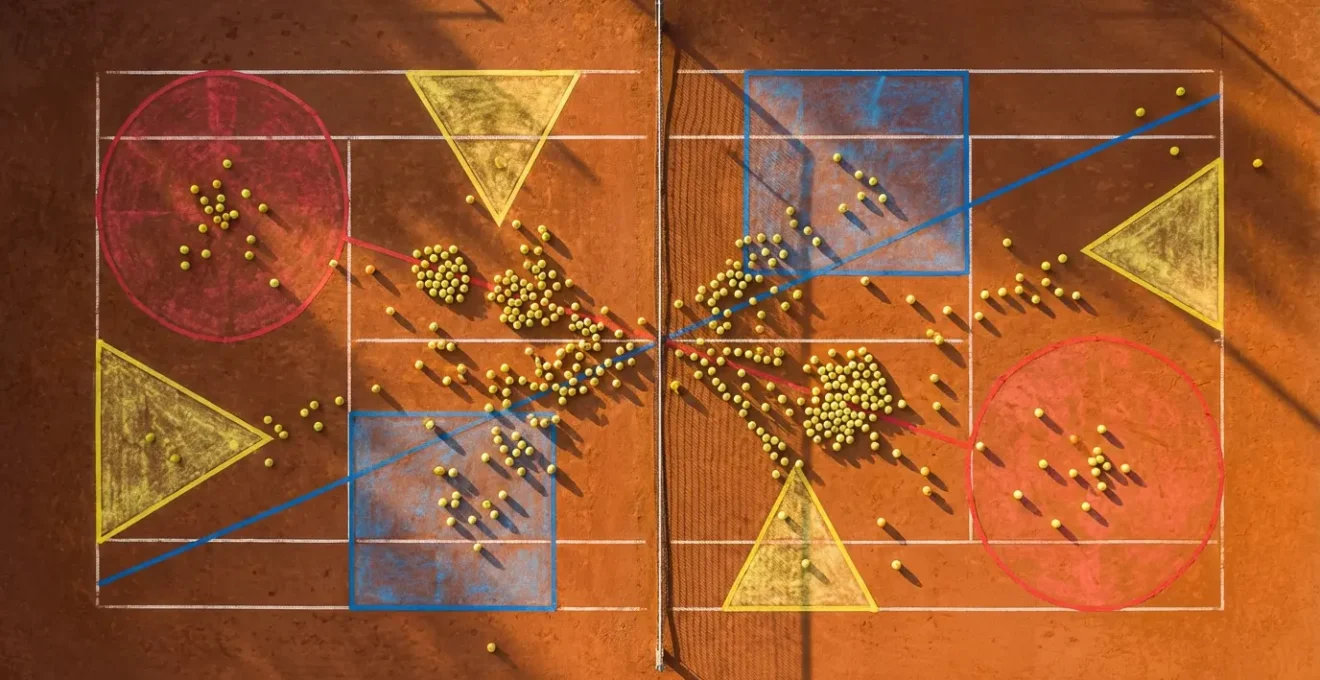
To design an effective grid, you must balance drill difficulty with the need for statistical significance. Targets that are too large may not challenge your precision enough, while targets that are too small may result in a miss rate so high that it becomes difficult to gather meaningful data on form or consistency. A structured approach involves defining zones for different strategic intentions.
A comparative analysis of different target configurations provides a mathematical basis for this design. The data below shows how target size and location affect performance metrics like Bivariate Variable Error (BVE), a statistical measure of consistency. For instance, a smaller 1x1m target naturally produces a higher BVE, indicating a greater challenge to a player’s precision.
| Target Area | Size | Location | Variable Error |
|---|---|---|---|
| Short Area | 2×2 m | Between service & baseline | Normalized SD |
| Deep Area | 2×2 m | Just inside baseline | Normalized SD |
| Large Area | 2×4 m | Center location | Lower BVE |
| Small Area | 1×1 m | Center location | Higher BVE |
Action Plan: Auditing Your Precision Feedback System
- Points of Contact: List all drill types where you need to measure accuracy (e.g., serve placement, groundstroke depth, volley angle).
- Collecte: Inventory your current tracking method. Are you using cones, tape, or just visual estimation? Gather data from 20 shots for a baseline accuracy percentage.
- Cohérence: Compare your accuracy data against your strategic goals. If you aim to be an aggressive baseliner, is your deep-ball percentage above a defined threshold (e.g., 60%)?
- Mémorabilité/émotion: Evaluate your grid. Is it simple and clear, or overly complex? The zones must be instantly recognizable to maintain drill intensity without cognitive overload.
- Plan d’intégration: Based on the audit, define one specific, measurable goal for your next session. Example: Increase backhand-down-the-line accuracy into a 2x2m zone by 5%.
Accuracy Drills vs. Power Drills: What ratio prevents form breakdown?
The relationship between accuracy and power is an inverse one, governed by the laws of biomechanics and motor control. As you increase stroke velocity, the fine motor adjustments required for precision become exponentially more difficult. A common mistake for ambitious players is to over-index on power drills, leading to a breakdown in technique and a plateau in performance. The key to sustainable improvement is not to choose one over the other, but to periodize the ratio between them throughout your training week and cycle.
Think of accuracy as the foundation of your technique. It is built through high-repetition, low-to-moderate velocity drills where the focus is on clean mechanics, balance, and hitting a specific target. Once a technical pattern is grooved and a high degree of accuracy is achieved at a baseline speed (e.g., 80% success rate in a 2x2m zone), you can begin to incrementally introduce power. Attempting to add velocity before the form is stable is the primary cause of technical degradation and chronic injury.
A structured training week should see a dynamic shift in this ratio. Early in the week, or during a technical rebuilding phase, the focus should be heavily skewed towards accuracy. As you move towards a competitive event, the ratio shifts to incorporate more power and live-ball scenarios, ensuring your technique holds up under the pressure of increased pace. This systematic manipulation of training variables is the essence of periodization.
Dynamic Training Ratio Guidelines
- Start the week with a ratio of 80% accuracy / 20% power, focusing on rebuilding and refining form in controlled drills.
- Progress to a 50/50 balance mid-week to consolidate skills, attempting to maintain accuracy while increasing stroke velocity.
- Shift to 30% accuracy / 70% power in the days leading up to a competition, prioritizing match-specific intensity and pace.
- Rigorously monitor neurological fatigue indicators (e.g., reaction time, unforced error rate) between sessions to prevent overtraining.
- Implement ‘hybrid drills’ that combine both elements, such as hitting a power shot followed immediately by a touch/angle shot.
The volume mistake in precision drills that leads to tendonitis
In the pursuit of precision, there is a dangerous assumption that more is always better. Competitive players often fall into the trap of high-volume, repetitive precision drills, believing that thousands of repetitions will forge perfect muscle memory. However, this approach ignores a critical factor: neurological and physiological load. Tendonitis and other overuse injuries in tennis are often not the result of a single traumatic event, but the cumulative effect of excessive volume without adequate recovery, particularly in drills that demand high levels of concentration and fine motor control.
Precision drills are neurologically demanding. Maintaining intense focus to hit a small target repeatedly fatigues the central nervous system far more quickly than simply rallying. As neurological fatigue sets in, form begins to break down. The body compensates by using larger, less efficient muscle groups, placing undue stress on tendons and joints—the classic pathway to tendonitis in the elbow, shoulder, or wrist. The volume mistake is not just about the number of balls hit, but the *density* of high-concentration shots within a session.
Modern sports science provides tools to mitigate this risk. Training readiness is no longer a subjective feeling; it can be quantified. For instance, studies show that wearable sensors can predict training readiness with up to 85% accuracy by analyzing metrics like heart rate variability and sleep quality. An athlete who trains in a state of high fatigue is not only limiting their ability to improve but is also significantly increasing their injury risk. Therefore, the volume of precision drills must be modulated based on objective data of your body’s recovery state, not just on the training plan written on paper. A shorter, high-quality session in a fresh state is infinitely more valuable—and safer—than a long, grinding session on an empty tank.
When to transition from static precision to live-ball chaos?
Mastering precision in a static, predictable environment is only the first half of the equation. The ultimate goal is to execute those same precise shots amidst the “chaos” of a live point: reacting to an opponent’s unpredictable shots, moving under pressure, and making split-second tactical decisions. A common failure in player development is the inability to bridge this gap. Players often become “great drillers” but “poor competitors” because their skills are context-dependent and fragile. The transition from a controlled environment to a dynamic one must be as systematic as the initial skill acquisition.
The transition should not be a sudden jump but a gradual progression along a “chaos continuum.” This involves systematically layering elements of unpredictability onto a stable technical base. You start with a static drill where the feed is predictable. Once you achieve a high success rate (e.g., >75% accuracy), you introduce one element of chaos, such as a random feed (varying height, spin, or pace) while keeping the target constant. The goal is to challenge your adaptability without completely overwhelming your technical foundation.
Advanced players don’t need more reps. They need smarter, more intentional ones.
– Scott Baxter, PlayYourCourt Advanced Tennis Drills
The key is to progress only when a level of mastery is demonstrated at the current stage. Rushing this process leads to a regression in form. A structured framework, like the 5-Level Chaos Scale, provides a clear pathway for this transition, ensuring that each new layer of complexity is built upon a solid foundation of precision.
- Level 1: Static Drill, Predictable Feed. Player is stationary, ball is fed to the same spot, single target. Focus is 100% on technical execution.
- Level 2: Static Drill, Random Feed. Player is stationary, but the feed varies in pace, spin, or direction. Focus shifts to reaction and adjustment.
- Level 3: Movement Drill, Predictable Feed & Target. Player moves to a predetermined spot to hit a predictable feed to a single target. Focus is on maintaining form while moving.
- Level 4: Movement Drill, Random Feed & 2 Target Choices. Player moves to react to a random feed and must choose between two potential targets based on the situation. This introduces tactical decision-making.
- Level 5: Open Point Play Simulation. Fully live-ball play, starting from a specific tactical scenario (e.g., player is pulled wide and must hit a defensive ball).
Why defined boundaries in practice zones increase drill intensity?
The introduction of defined boundaries—using cones, lines, or other markers to create smaller practice zones—is a powerful tool for amplifying drill intensity without increasing physical volume. This concept works on both a psychological and a neurological level. Psychologically, a constrained space creates a heightened sense of purpose and focus. Instead of the entire court being the target, a small, well-defined box becomes the sole objective. This eliminates mental ambiguity and forces a level of concentration that is often absent in open rallying.
Neurologically, these constraints force the brain to make more refined motor calculations. Hitting a forehand into a 10-foot-wide area requires a different level of neural processing than hitting it into a 3-foot-wide channel. The smaller target demands a more precise command from the brain to the muscles, increasing the ‘difficulty’ and thus the training stimulus of each repetition. This is a form of cognitive load that elevates the quality of practice. You are not just training your arm to swing; you are training your brain to solve a more complex geometric problem under time pressure.

This increased intensity translates into greater efficiency. A 20-minute drill within a constrained zone can provide a greater training effect for precision than a 40-minute drill in an open court. The number of ‘quality’ repetitions, where focus is at its peak and the motor system is being truly challenged, is far higher. This is a critical concept for the time-crunched athlete. By manipulating the practice environment with defined boundaries, you can increase the training density of your session, achieving more in less time. The boundaries act as an external pressure, simulating the mental pressure of a match point where the margins for error shrink dramatically.
Key Takeaways
- Training is Measurement: The transition from amateur to pro-level practice begins when you stop “hitting balls” and start collecting data on every shot.
- Periodize Ratios, Not Just Volume: Systematically shift the balance between accuracy and power drills throughout the week to build stable technique and prevent form breakdown.
- Metrics Dictate Reality: Focus on performance indicators like high-speed distance and shot accuracy within defined zones, not vanity metrics like total time on court or total balls hit.
Why “total distance” is a vanity metric compared to “high-speed distance”?
In the age of wearable technology, athletes are inundated with data. However, not all metrics are created equal. One of the most misleading is “total distance covered.” For a tennis player, knowing you ran 3 kilometers during a match is largely irrelevant. It’s a vanity metric because it fails to correlate directly with the most critical moments of performance. The winner of a match is not the one who jogs the farthest, but the one who can execute explosive, high-speed movements to get to the ball in a balanced position during crucial points.
The far more valuable metric is “high-speed distance” or “explosive efforts.” This measures the total distance covered above a certain velocity threshold (e.g., >15 km/h) or the number of accelerations and decelerations performed. This data points directly to a player’s physical capacity to handle the demands of aggressive, modern tennis. Two players can cover the same total distance, but Player A might achieve it through steady jogging between points, while Player B achieves it through 50 explosive 5-meter sprints. Player B is demonstrating a far more relevant and match-deciding physical quality.
Focusing on meaningful metrics allows for more precise training interventions. If your high-speed distance is low, you know you need to work on anaerobic power and first-step quickness, not general endurance. The predictive power of these specific metrics is profound. Advanced analytical models that focus on such performance indicators are remarkably effective; studies show that by using sophisticated data, neural network models achieve up to 96.8% testing accuracy in predicting match outcomes. This demonstrates a clear mathematical principle: the quality and specificity of your data are more important than the quantity. Chasing an increase in total distance is a waste of valuable training resources; chasing an increase in your ability to cover the first three steps explosively is an investment in winning points.
Programmable vs. Static Ball Machines: Which Improves Reaction Time?
The choice of a ball machine is not merely a matter of convenience; it is a strategic decision that directly impacts the type of skills you develop. A static ball machine, which feeds balls to the same location at a consistent pace and spin, is an excellent tool for grooving the mechanics of a stroke in isolation. It allows for high-volume repetition with minimal variability, perfect for the initial stages of learning or for technical adjustments (Level 1 on the Chaos Scale). However, its primary limitation is that it does not train reaction time or decision-making.
A programmable ball machine, on the other hand, can simulate the unpredictability of a real opponent. By varying the location, speed, spin, and frequency of the feed, it forces the player to engage in the full “perceive-decide-act” cycle. You must read the ball’s trajectory, anticipate its landing spot, decide on the appropriate shot, and execute—all in a fraction of a second. This is what trains reaction time. You are not just practicing a swing; you are practicing the cognitive processes that precede the swing. This is crucial because in a match, you never hit a ball in a vacuum. Your shot is always a reaction to your opponent’s.
The effectiveness of a player is often defined by their ability to perform under pressure and time constraints. For example, serve effectiveness is a key performance indicator, and on the professional tour, even with powerful serves, the ATP Tour players achieve an average of 58% first serve effectiveness. This highlights that simply getting the ball in is not enough; placement and the opponent’s reaction are key. Training with a programmable machine that simulates various serves and returns is a direct way to improve the reactive component of your return game. While a static machine builds the foundation of your stroke, a programmable machine builds the adaptive, responsive skill set that wins matches.
Begin by implementing a single quantifiable metric in your next session. The path to measurable improvement starts not with more hours, but with better data.