
The key to in-match recovery isn’t just “staying positive”—it’s executing a structured mental protocol to detach, analyze, and re-engage with purpose.
- Shift focus from winning to competing via a “Second Scoreboard” of controllable process goals.
- Use time-boxed analysis windows (e.g., 10 seconds) to learn from errors without dwelling.
Recommendation: Build and practice your reset routine (breathing, keywords) in training until it becomes an automatic response to pressure.
The scoreboard is grim. Your best shot just sailed long, and the opponent’s confidence is palpable. In these moments, the internal monologue can become your worst enemy, replaying every mistake on a loop. You feel the match, and your composure, slipping away. The common advice to “shake it off” or “stay positive” feels hollow and impossible to execute. It often ignores the powerful psychological forces at play that anchor us to our errors.
But what if the solution wasn’t brute-force positivity, but a trainable, systematic protocol? What if you could build psychological armor that allows you to process failure constructively and re-engage with tactical clarity? This guide is not about ignoring mistakes. It’s about developing a structured mental reset process—a series of concrete steps you can deploy under pressure to halt a negative spiral, learn from the last point, and focus entirely on the next one. It’s time to move beyond wishing for mental toughness and start building it, one deliberate action at a time.
This article provides a complete playbook, breaking down the mental mechanics of performance under pressure. We will explore why your brain clings to errors, how to shift your definition of success mid-match, and the exact rituals you can build to regain control when you feel like you have none.
Summary: Your Playbook for In-Match Mental Recovery
- Why your brain remembers the one missed shot over ten good ones?
- How to change “I have to win” to “I get to compete” instantly?
- Resilience vs. stubbornness: Knowing when to adapt strategies?
- The fantasy error: Why visualizing only success leaves you unprepared for failure?
- When to use a “keyword” to snap back into focus during a match?
- Why does your heart rate spike 20bpm higher in a match vs practice?
- The thinking error that turns analysis into self-torture
- How to Decompress After a High-Stakes Loss Without Dwelling?
Why your brain remembers the one missed shot over ten good ones?
The frustrating tendency to fixate on a single unforced error while ignoring a dozen solid shots is not a personal failing; it’s a hardwired feature of your brain. This is the negativity bias, an evolutionary survival mechanism that gives greater weight to negative experiences than positive ones. Your brain treats a missed shot like a potential threat, flagging it for intense review to prevent it from happening again. In contrast, a successful shot is registered as “normal” and receives far less mental attention.
The problem is that this ancient wiring is counterproductive in a competitive sports environment. Dwelling on the error floods your system with stress hormones, tightens your muscles, and clouds your tactical judgment. To overcome this, you can’t just tell yourself to “be positive.” You must implement a conscious, physical process to actively “tag” and encode positive moments. Neuroscience research indicates that it takes 10-20 seconds of focused attention for a positive experience to transfer from short-term to long-term memory. Without this deliberate focus, your good shots will simply fade, while the bad ones stick.
Building new neural pathways requires a structured routine. You must give your brain a compelling reason to remember the successes as vividly as the failures. The following technique is designed to do exactly that by linking positive outcomes to physical and emotional anchors.
Your Action Plan: The Mental Re-Tagging Technique
- Acknowledge the Good: After executing a good shot, pause for 3 full seconds to consciously acknowledge it. Don’t rush to the next point.
- Create a Physical Anchor: Connect the positive shot to a physical sensation. This could be a small fist pump, a deep, deliberate breath, or even a slight smile.
- Encode the Experience: Hold the positive experience and the associated physical feeling in your attention for 10-20 seconds. This is the crucial step for encoding it into long-term memory.
- Build a Highlight Reel: Actively “tag” each successful shot with a positive emotion or thought. You are manually creating a mental highlight reel to draw upon later.
- Practice in Training: Make this routine a non-negotiable part of every practice session. The goal is to make positive focus an automatic habit, not an effortful choice.
How to change “I have to win” to “I get to compete” instantly?
The phrase “I have to win” is one of the heaviest burdens an athlete can carry. It frames the competition as a threat and the outcome as a judgment on your worth. This mindset triggers a pressure response, leading to tight muscles, hesitant decisions, and a focus on avoiding mistakes rather than executing your strategy. The shift to “I get to compete” is not just semantic; it’s a profound change in perspective. It reframes the event from a trial into an opportunity—a chance to test your skills, solve problems, and perform.
The most effective way to make this shift is to detach from the primary scoreboard (the win/loss result) and create what performance coaches call a “Second Scoreboard.” This is an internal, personalized scoreboard based entirely on process goals—the actions and behaviors that are 100% within your control. Instead of focusing on the score, you focus on metrics like hitting a certain percentage of first serves, executing a specific pattern of play, or maintaining a composed demeanor between points. This shifts your measure of success from an uncontrollable outcome to a controllable process.

This mental reframing is essential at the elite level, where physical skills are often evenly matched. The ability to reset focus onto process goals can be the deciding factor in a tight match. Even top athletes must consciously work on this shift.
Coco Gauff’s Mental Reset Strategy
During a challenging stretch in her 2024 season, which included early exits at the Paris Olympics and the Canadian Open, commentators noted a shift from Coco Gauff’s typically aggressive and confident play. Former player Monica Puig suggested Gauff would benefit from a mental reset. Puig stated, “I would love to see her make a mental reset. We know the type of tennis she is capable of playing. She needs to focus on serving well, playing the aggressive game style.” This highlights that even for the world’s best, slumps are often more mental than physical, requiring a conscious shift back to the processes that lead to success, rather than dwelling on the pressure of winning.
Resilience vs. stubbornness: Knowing when to adapt strategies?
In the heat of competition, there’s a fine line between resilience—the admirable quality of sticking to your game plan through adversity—and stubbornness, which is rigidly adhering to a strategy that simply isn’t working. Confusing the two is a common and costly mistake. Resilience is about trusting a sound, well-executed plan. Stubbornness is about refusing to acknowledge that either your plan is flawed or your execution of it is failing.
The key to telling them apart is honest, unemotional diagnosis. After a lost point or a difficult game, you must ask two critical questions: 1) Did I execute my intended strategy correctly? 2) Is the strategy itself effective against this opponent today? Answering these questions allows you to make smart adjustments instead of emotional reactions. Forcing a strategy that the opponent has clearly figured out isn’t toughness; it’s tactical suicide. Conversely, abandoning a sound strategy because you made one or two execution errors is a sign of panic, not adaptability.
The following decision matrix, based on a concept from analysis by tennis strategists, can help you clarify your next move. It provides a logical framework for deciding whether to persevere or pivot.
| Scenario | Execution Quality | Strategy Effectiveness | Decision |
|---|---|---|---|
| Strategy working but facing resistance | Good | Effective | Resilience – Continue with current approach |
| Poor implementation of sound strategy | Poor | Potentially effective | Improve execution before changing |
| Well-executed but ineffective approach | Good | Ineffective | Adapt – Switch strategies |
| Poor execution and wrong strategy | Poor | Ineffective | Complete reset needed |
Ultimately, high-level performance requires navigating moments of difficulty without losing faith in the process. As legendary coach Christopher Sommer notes, this is a universal principle of achieving excellence.
Dealing with temporary frustration of not making progress is an integral part of the path towards excellence…achieving the extraordinary is not a linear process.
– Christopher Sommer, Donovan Tennis Strategies
The fantasy error: Why visualizing only success leaves you unprepared for failure?
Visualization is a cornerstone of mental preparation, but a common mistake renders it ineffective or even counterproductive: the “fantasy error.” This is the practice of only visualizing a flawless performance—perfect shots, an easy victory, and the feeling of triumph. While this feels good, it leaves you psychologically brittle and completely unprepared for the inevitable moment when things go wrong. When the first set is a disaster, your fantasy-based preparation offers no mental script for how to respond. The gap between your perfect vision and the messy reality creates a shock that can trigger a full-blown mental collapse.
Effective mental preparation isn’t about fantasizing; it’s about rehearsing. This includes rehearsing your response to adversity. Mentally tough athletes don’t just visualize success; they visualize the entire process, including potential obstacles and their planned reactions to them. This creates a robust mental plan that doesn’t shatter on first contact with reality.
Professional Athletes’ Recovery Visualization Training
Research on mentally tough tennis players shows that instead of dwelling on mistakes, they use a simple release and reset routine. This might include taking a deep breath, walking to the back fence, or bouncing the ball a set number of times before serving. These physical and mental cues send a clear signal to the brain: the last point is over, and it is time to focus on the next one. By visualizing and practicing this *recovery* process, you stop one mistake from turning into a string of lost points, building resilience rather than fantasy.
A powerful framework for this realistic preparation is the WOOP method (Wish, Outcome, Obstacle, Plan). It forces you to confront potential challenges and pre-program your response, turning obstacles into cues for action rather than triggers for panic.
- Wish: Define your desired outcome clearly (e.g., “I want to win this match”).
- Outcome: Vividly visualize achieving your wish and how it would feel. This is the “fantasy” part, and it’s still important for motivation.
- Obstacle: Now, imagine the specific, internal challenges you’ll face (e.g., “losing the first set and feeling hopeless,” or “getting angry after a series of errors”).
- Plan: Create a concrete IF-THEN response. For example: “IF I lose the first set, THEN I will take the full 90 seconds, drink water, focus on my ‘Second Scoreboard’ of process goals, and start the next set with three high-percentage shots.”
When to use a “keyword” to snap back into focus during a match?
A keyword, or cue word, is a simple but powerful tool for anchoring your focus in the chaotic environment of a match. It acts as a mental shortcut, a single word that triggers a pre-programmed physical or mental state. However, its effectiveness depends entirely on when and how you use it. Randomly telling yourself to “focus” when you’re spiraling is useless. A keyword must be the final step in a structured reset ritual, used not as a plea but as a command to re-engage.
The right moment to use a keyword is after you have consciously let go of the previous point and centered yourself. It’s the bridge between your mental reset and your preparation for the next action. The keyword shouldn’t be a generic motivational phrase like “win” or “believe.” The most effective keywords are instructional and tied to a physical feeling. For example, a player prone to getting tight might use the word “Smooth” to cue a relaxed, fluid service motion. A player who gets passive might use “Explode” to trigger aggressive footwork toward the ball.
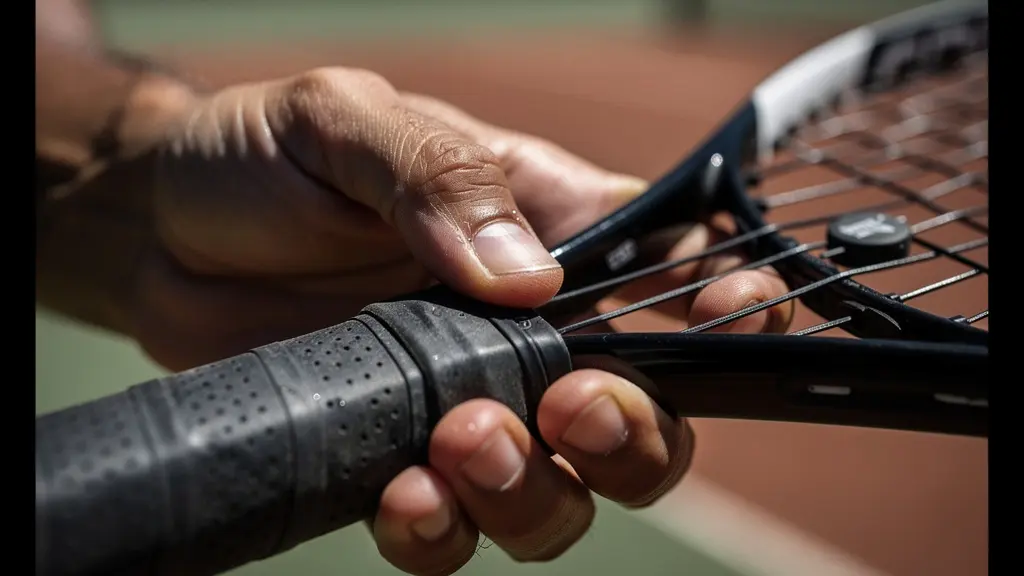
The keyword is the final command in a sequence. A proven structure is a three-part ritual that you practice hundreds of times in training until it becomes automatic. This creates a neural pathway that your brain can execute under pressure without conscious thought.
- Release Phase: Use a physical action and a word to let go. For example, wipe the towel across your face and mentally say “Gone” to release the last point. This should take no more than 2 seconds.
- Centering Phase: Re-regulate your physiology. A 4-7-8 breath (inhale for 4, hold for 7, exhale for 8) is extremely effective at calming the nervous system.
- Intentional Cue: Just before you begin your service motion or prepare to return, say your action keyword to yourself (e.g., “Legs,” “Forward,” “Calm”). This word directs your focus to the single most important technical or tactical element for the upcoming point.
Why does your heart rate spike 20bpm higher in a match vs practice?
That familiar feeling of your heart pounding in your chest, breathing becoming shallow, and muscles tensing up during a match is not your imagination. For many athletes, heart rate can be significantly higher—sometimes 20 beats per minute or more—in competition compared to a physically identical practice session. This isn’t just about physical exertion; it’s a direct physiological manifestation of your body’s threat response, commonly known as “fight or flight.”
In practice, your brain perceives the environment as safe. In a match, however, the stakes are raised. The fear of losing, of being judged, or of failing to meet expectations can cause your brain to interpret the situation as a genuine threat. This triggers the amygdala to release a cascade of stress hormones like adrenaline and cortisol. These hormones are responsible for the elevated heart rate, increased blood pressure, and muscle tension. While designed for survival, this response is detrimental to fine motor skills and complex decision-making required in sports.
A key indicator of this stress state is Heart Rate Variability (HRV), the measure of the variation in time between each heartbeat. A high HRV indicates a calm, adaptable nervous system, while a low HRV signals stress. In fact, sports science research demonstrates that athletes experiencing high stress levels show significantly reduced HRV. This stressed state not only impairs in-match performance but can also hinder long-term physical adaptation, as these athletes often make smaller strength gains compared to their less-stressed counterparts. Your body is spending its resources managing a perceived threat instead of focusing on performance and recovery.
The thinking error that turns analysis into self-torture
There is a crucial difference between productive analysis and destructive self-torture. Productive analysis is a brief, objective assessment of a mistake aimed at making a tactical adjustment. Self-torture is an endless, emotional loop of self-criticism, blame, and “what-if” scenarios. The thinking error that separates the two is asking the wrong question. In the seconds after an error, asking “Why did I do that?” almost always leads to a destructive path. “Why” invites emotional, judgmental answers: “Because I’m a choker,” “Because I’m not good enough.”
The high-performance alternative is to ask “What?” and “How?”. “What happened?” focuses on objective facts (e.g., “The ball landed long,” “My feet weren’t set”). “How can I adjust?” immediately shifts the brain into a problem-solving mode (e.g., “Add more topspin,” “Take an extra split-step”). This subtle shift in questioning is the key to staying analytical instead of emotional. As sports psychologist Dr. Patrick Cohn explains, this realization is critical for breaking a slump.
Mental resets help you understand that the continuation of your slump is more mental than physical. This realization helps you recognize that you haven’t ‘lost’ your ability to play at your peak.
– Dr. Patrick Cohn, Sports Psychology Tennis
To prevent analysis from becoming self-torture, you must contain it within a non-negotiable time frame. The “10-Second Analysis Window” is a powerful protocol for this. It provides just enough time for a tactical adjustment without allowing room for emotional dwelling.
- Immediately after the point ends, a mental timer starts.
- 0-10 seconds: You are a detective. Ask “What?” and “How?”. The focus is on objective data and a single, specific tactical adjustment for the next point.
- 10+ seconds: The window closes. Your focus must shift entirely to your pre-point preparation routine for the *next* point. The previous point is now in the past and no longer open for analysis.
Key Takeaways
- Your brain’s negativity bias is a default setting, not a personal failing. You must actively train to counter it with structured protocols.
- Shift your focus from the external scoreboard (win/loss) to an internal “Second Scoreboard” of controllable process goals.
- A mental reset is a structured protocol: Detach (physical cue), Analyze (briefly and objectively), and Re-engage (with a clear intention).
How to Decompress After a High-Stakes Loss Without Dwelling?
The match is over, and you lost. The moments and hours immediately following a tough loss are a critical window that can determine whether the experience becomes a scar or a lesson. Dwelling on the loss—endlessly replaying mistakes with a sense of regret and frustration—is a form of mental quicksand. It reinforces negative neural pathways and erodes confidence without offering any path to improvement. The goal is not to ignore the loss, but to decompress effectively before you reflect productively.
Decompression requires creating a mandatory buffer zone between the emotional heat of the match and the cool-headed analysis that should follow. This means physically and mentally disengaging from the event for a set period (e.g., 30-60 minutes). During this time, analysis of the match is strictly forbidden. The purpose is to allow your nervous system to calm down and your emotional brain (the amygdala) to take a back seat so your rational brain (the prefrontal cortex) can later engage effectively. World No. 1 Iga Swiatek provides a powerful example of this reset in action.
Iga Swiatek’s Post-Match Reset Protocol
At the 2021 Italian Open, Iga Swiatek had a difficult Round of 16 match, hitting 25 unforced errors in the first set. She later admitted, “I just had a tough day mentally. It was hard for me to be positive. … Usually in this situation I was the kind of person that was kind of giving up mentally.” Instead of dwelling, she was able to let the match go and hit the reset button. This mental shift was crucial, as it allowed her to come back and win her quarterfinal, semifinal, and final matches all in dominant straight sets, demonstrating the power of a post-match mental reset.
This process of letting go is a skill. It involves having a pre-planned decompression routine, such as listening to a specific music playlist, performing a full-body stretching sequence, or talking to a friend about anything other than the match. Only after this buffer can you engage in healthy reflection, which is a purposeful, objective review aimed at extracting lessons for the future.
This is not about erasing losses; it is about owning your response to them. This psychological armor is not built on game day; it is forged in the daily discipline of practice. Start building your reset protocols today, so they are an automatic, unshakeable part of your arsenal when the pressure is on.
Frequently Asked Questions on Mental Reset in Sports
What’s the difference between dwelling and reflecting on a match?
Dwelling is emotionally re-living the loss with no purpose (a loop), while reflecting is analyzing the loss to extract lessons for future performance (a line forward). The key differentiator is whether the process ends with a concrete action plan.
How long should I wait before analyzing a tough loss?
Take a mandatory 30-60 minute ‘Decompression Buffer’ immediately after the match where no analysis is allowed. This allows your emotional brain (amygdala) to quiet down before your rational brain (prefrontal cortex) can effectively reflect.
What should I focus on during the decompression period?
Engage in completely unrelated activities like listening to a specific music playlist, doing a full-body stretch routine, or calling a friend to talk about anything except the match.