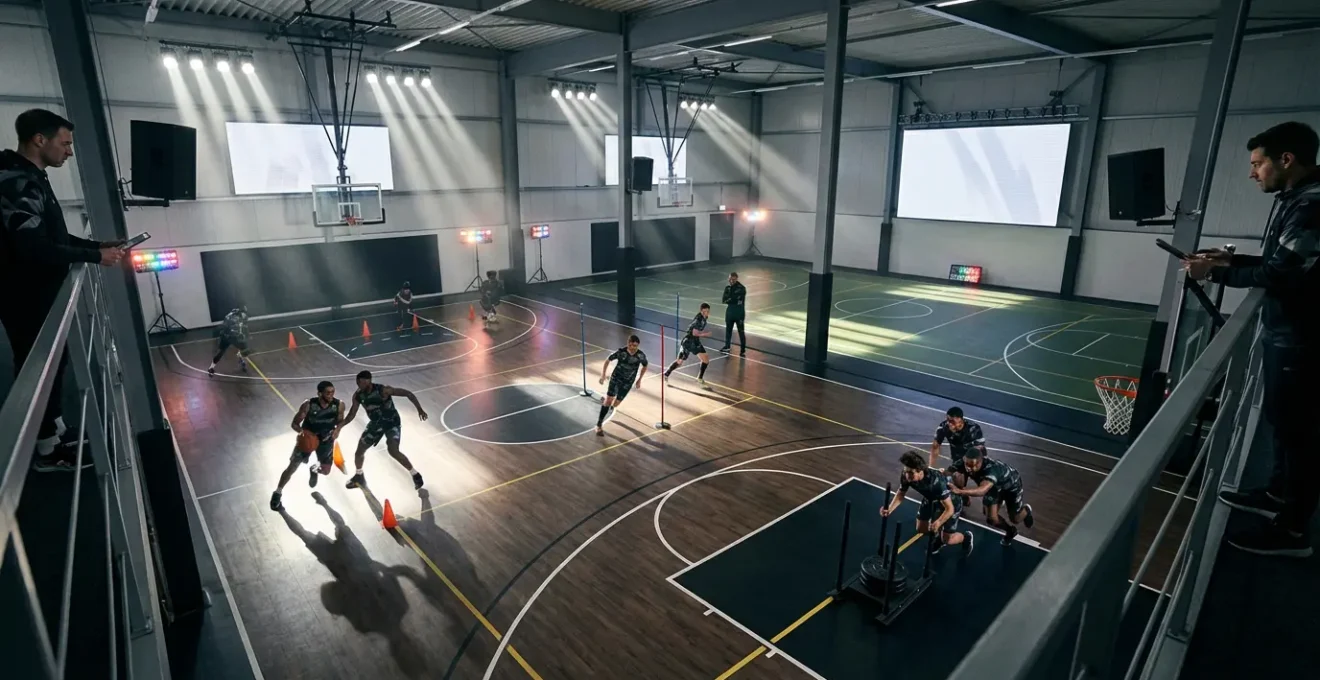
Contrary to popular advice, the key to overcoming competition anxiety isn’t to calm down—it’s to systematically expose yourself to that exact pressure in training until it becomes normal.
- Your body’s stress response in a match is a physiological reality that relaxation techniques alone cannot defeat.
- Winning in practice is irrelevant if you aren’t simultaneously training your mind to execute under duress.
Recommendation: Stop avoiding pressure. Start manufacturing it with targeted, consequence-based drills to build a genuine immunity to game day stress.
You know the feeling. In practice, you’re a god. Every shot lands, every move is fluid, every decision is sharp. You are unbeatable. Then comes game day. The lights feel brighter, the crowd is a low hum, and suddenly your heart is a drum against your ribs. Your palms sweat, your movements become stiff, and the skills that were second nature hours ago feel alien. You play not to lose, instead of playing to win. You choke. This is the frustrating gap between your practice self and your competition self, a gap that haunts countless dedicated athletes.
The conventional wisdom is to “just relax,” visualize success, or use breathing exercises. While these have their place, they are surface-level treatments for a deep-seated physiological and psychological reaction. They fail because they try to convince your mind of something your body knows is a lie: that the pressure isn’t real. You can’t just wish away a legitimate threat response honed by millennia of evolution. The solution is not to run from the pressure. It’s to run towards it.
This is not a guide about calming your nerves. This is a battle plan for forging them into steel. We are going to deconstruct the anatomy of pressure and rebuild your training regimen to systematically inoculate you against it. You will learn to stop treating practice as a safe space and start turning it into a laboratory for stress. By manufacturing high-stakes, consequence-driven scenarios, you will become so accustomed to the fire of competition that game day will feel less like an execution and more like a homecoming.
This guide provides a structured protocol to transform your preparation. We will dissect the physiological roots of anxiety, introduce practical drills to simulate it, and outline the precise steps to take in the days and hours leading up to a major event.
Summary: From Practice Hero to Competition Champion
- Why does your heart rate spike 20bpm higher in a match vs practice?
- How to use handicap scoring to mimic “break point” pressure in practice?
- Indoor vs. Outdoor: Preparing for wind and sun glare distractions
- The error of winning practice matches while ignoring tactical development
- The 3-day countdown: When to stop hard sparring before the tournament?
- When to transition from static precision to live-ball chaos?
- The “Bag Check” ritual: What emergency items save you from forfeit?
- The 24-Hour Protocol: What to Eat and Do Before a Major Final?
Why does your heart rate spike 20bpm higher in a match vs practice?
That sudden, jarring increase in heart rate isn’t just in your head; it’s a primal, physiological response. When your brain perceives the high stakes of competition—the risk of failure, the social evaluation, the finality of the result—it triggers the sympathetic nervous system. This is the “fight or flight” response, flooding your body with adrenaline and cortisol. Your heart beats faster to pump more oxygen to your muscles, your breathing becomes shallow, and fine motor control deteriorates. In practice, these stakes are absent, so your body remains in a calm, parasympathetic state. This isn’t a sign of weakness; it’s a biological reality. In fact, research indicates that competitive anxiety affects between 30 to 60% of athletes, making it a common, not an exceptional, experience.
The mistake is trying to suppress this response on game day. It’s too late. The key is to trigger it deliberately and repeatedly in training. You must teach your body that this heightened state of arousal is a cue to perform, not to panic. By creating consequences and evaluation in practice, you are essentially giving yourself a controlled dose of the “competition” virus, allowing your system to build an immunity. This is the core principle of pressure inoculation.
Case Study: Max Whitlock’s Olympic Pressure Simulation
For the Tokyo 2021 Olympics, British gymnast Max Whitlock faced the challenge of competing in a silent, empty arena—a starkly different pressure from a roaring crowd. To prepare, he didn’t just practice his routine; he meticulously recreated the environment. He trained on the pommel horse in a vast, empty hall, live-streaming his sessions to a small audience to simulate the feeling of being watched. By deliberately making himself uncomfortable and normalizing the unique pressure of the upcoming event, he adapted his nervous system. The result? He successfully defended his Olympic gold medal, a testament to the power of specific pressure simulation.
You cannot expect to perform in an environment you haven’t prepared for. The physical and mental feelings of a match are a unique condition. Therefore, you must make that condition a regular part of your training. Only then will the spike in heart rate become an ally, signaling readiness, rather than an enemy, signaling fear.
How to use handicap scoring to mimic “break point” pressure in practice?
The pressure of a “break point” or a “match point” isn’t just about the score; it’s about the weight of consequence. A single error feels catastrophic. To replicate this, you must abandon the comfort of balanced practice games and introduce asymmetrical consequence. This means designing drills where the penalty for failure is dramatically higher than the reward for success. Handicap scoring is the perfect tool for this.
Stop playing regular sets. Instead, start every game with you, the pressure-sensitive athlete, already behind. For example, in tennis, start the game at 15-40. In basketball, start a scrimmage down by 10 points with only two minutes left. The goal is not just to win the game, but to force your mind and body to execute your core skills when the scoreboard is screaming that you are about to lose. This isn’t about fairness; it’s about forging resilience. You are intentionally creating a sense of desperation and teaching your nervous system how to operate calmly within it.
Here are some methods to implement this progressive pressure training:
- Consequence-Based Scoring: Design drills where your errors cost you 3 points, but your successful winners only gain you 1 point. This forces a focus on consistency over risky, low-percentage plays.
- Judgment Consequences: Make performance public. Use leaderboards displayed prominently in the training facility that track success rates in these specific high-pressure drills. The feeling of being evaluated is a key component of competition anxiety.
- Undesirable Task Consequences: Link failure in pressure drills to a non-punitive but undesirable task, such as being responsible for equipment cleanup for the entire team. This adds a tangible, immediate consequence to underperformance.
The key is to start with small handicaps and increase them as you succeed—a “pressure ratchet system.” When you can consistently perform and win from a disadvantaged position, the feeling of an even score on game day will feel like a luxury, not a threat. You will have transformed a point of panic into a familiar challenge.
Indoor vs. Outdoor: Preparing for wind and sun glare distractions
Your performance on game day can be derailed by factors that have nothing to do with your opponent. Unpredictable wind, blinding sun glare, or extreme temperatures are not minor annoyances; they are tactical variables that can sabotage your execution. A pristine, climate-controlled indoor practice facility creates a false sense of security. You are not just training your skills; you are training your ability to apply those skills amidst chaos. This requires deliberately introducing environmental friction into your preparation.
Stop seeking perfect conditions. Instead, actively seek out and train in the worst possible conditions you might face. If your tournament is outdoors, schedule practice sessions during the windiest part of the day. Practice at high noon to deal with the harshest sun. As performance psychology expert Dr. Williams notes, the goal is about “making practice as competition-like as feasible.” This philosophy is not about comfort; it is about preparation.
Making practice as competition-like as feasible by raising stakes and introducing spectators. Getting accustomed to dealing with pressure in training builds confidence and leads to less marked stress responses when the environment is recreated in a real match.
– Dr. Williams, Warrior Collective – Combat Sports Psychology
If training in real-world conditions isn’t always possible, simulate them. This is not about perfect replication but about training your brain to filter out sensory noise. The following table, based on common sports psychology adaptations, outlines a clear strategy for this. As a recent comparative analysis shows, these methods are designed to overload your senses in a controlled way, making the real-world variables feel manageable.
| Environmental Factor | Training Adaptation | Expected Outcome |
|---|---|---|
| Sun Glare | Strobe glasses during drills | Improved visual processing under light interference |
| Wind Conditions | Fan-generated airflow in indoor training | Better ball trajectory prediction |
| Crowd Noise | Sound generators during practice | Enhanced focus filtering ability |
| Temperature Extremes | Varied training environment temperatures | Physiological adaptation to conditions |
By making these disruptive elements a regular part of your training, you strip them of their power. The wind is no longer an excuse; it’s a known variable. The sun is no longer a blinding shock; it’s a familiar challenge. You will have turned the environment from a potential adversary into a neutral battlefield.
The error of winning practice matches while ignoring tactical development
There is a dangerous trap in practice: the obsession with winning. You rely on your A-game, your most comfortable and reliable skills, because it feels good to win, even when the stakes are zero. This is a massive error. Practice is not for winning; it’s for building the weapons you will need to win when it counts. Winning a practice match with your old, predictable patterns while neglecting to develop a new skill under pressure is a strategic failure. It reinforces comfort and actively avoids the very discomfort needed for growth.
The focus must shift from outcome to process. True preparation involves willingly sacrificing a practice win to achieve a specific tactical goal. This is the concept of tactical forfeiture. For example, you decide that for an entire practice match, you will only use your weaker backhand, even if it means losing badly. The goal isn’t the final score; it’s to hit 15 high-quality backhands in high-pressure situations. This approach is backed by data; studies on goal-setting demonstrate that athletes who focus on process goals show 70% better skill development than those who only care about the outcome.
When you focus on tactical execution, you are training your mind to stay locked on the task at hand, regardless of the score. This is the antidote to the panicked, outcome-focused mindset that leads to choking. You are learning to find success in the perfect execution of a single movement, even in the middle of a losing effort.
Action Plan: Tactical Development Over Winning
- Set specific tactical execution goals for each practice match (e.g., attempt a new skill a minimum of 15 times).
- Measure your success by the percentage of tactical attempts made, not by the final score of the match.
- Keep a detailed tactical decision journal, logging good, poor, and missed opportunities after each session.
- Design forced-strategy games where points can only be scored by using the specific play or skill you are developing.
- Review video footage of your practice, focusing solely on your tactical execution and decision-making, while completely ignoring the match’s outcome.
Adopting this protocol requires discipline and a strong ego. It feels bad to lose, even in practice. But every practice match you “lose” while successfully integrating a new tactic is a massive strategic victory for your future game day self.
The 3-day countdown: When to stop hard sparring before the tournament?
As the competition approaches, the temptation is to train harder, to cram in more physical repetitions. This is a critical mistake. The final 72 hours are not for building new skills or pushing your physical limits; they are for sharpening the blade, not forging it. Intense, hard sparring or full-contact drills too close to a tournament lead to physical fatigue, muscle soreness, and mental burnout. You arrive on game day depleted, not peaked. The goal in this final phase is to taper physical intensity while ramping up mental and tactical rehearsal.
Most elite athletes implement a 48-72 hour tapering protocol. During this window, all high-impact, high-fatigue training ceases. The focus shifts entirely. Instead of live, unpredictable sparring, you engage in “confidence drills.” These are mastered skills performed to perfection with a compliant partner or in a controlled setting. The goal here is purely psychological: to flood your brain with the feeling of flawless execution. You are grooving the neural pathways of success, reminding your body what it feels like to perform at its best.
This period is also prime time for visualization. Research on elite athletes who substitute physical sparring with tactical visualization in the final days shows they report feeling mentally sharper and physically fresher. In a quiet space, you should mentally rehearse your entire competition day, from waking up to the final handshake. Visualize your game plan, see yourself executing your key tactics, and, crucially, imagine encountering adversity—a bad call, an unforced error—and see yourself responding with calm, focused composure. This mental rehearsal prepares your nervous system for the emotional highs and lows of the match.
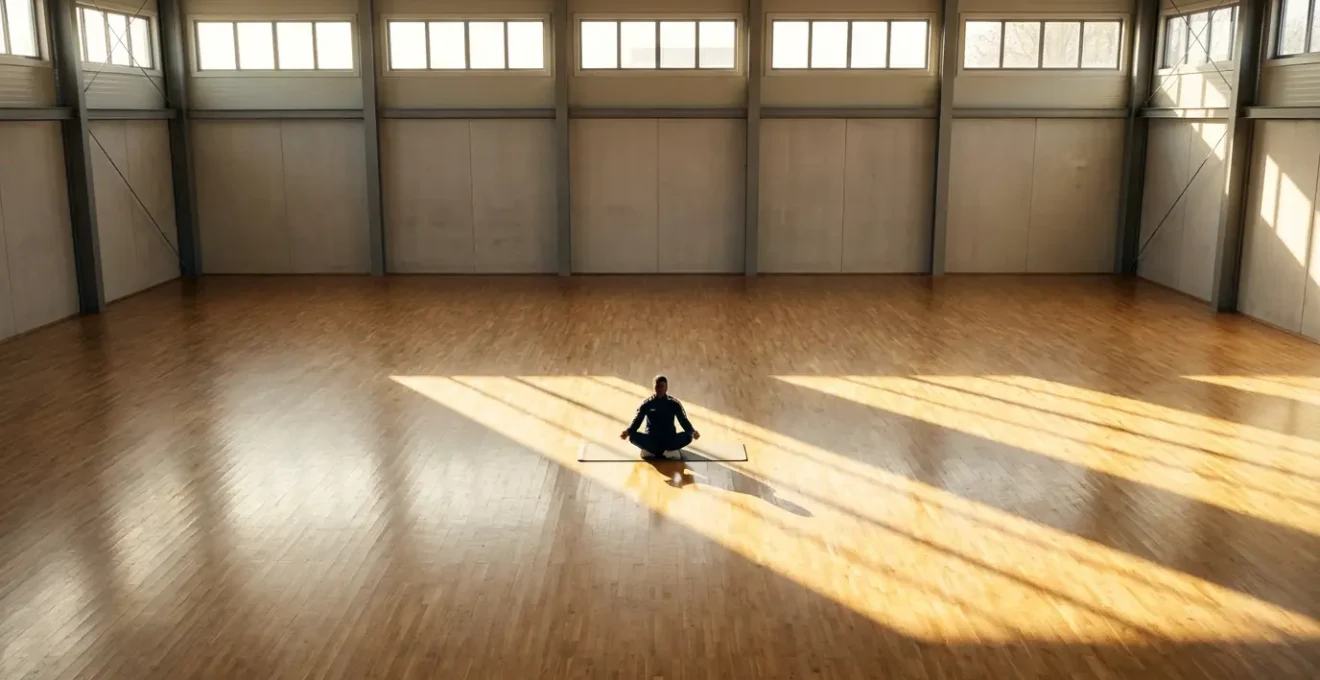
The final training session, ideally 24-48 hours before, should be short, sharp, and leave you feeling confident and energetic. It’s a final tune-up, not a final exam. You should walk out of the gym feeling better than when you walked in, hungry to compete.
When to transition from static precision to live-ball chaos?
There’s a massive difference between executing a perfect technique in a static, closed drill and executing it in the chaotic, unpredictable environment of a live game. Many athletes master a skill in isolation but can’t make it work under pressure. This failure is not a flaw in the skill itself, but a flaw in the training process. The transition from controlled precision to live-ball chaos must be a structured, deliberate process, not an abrupt jump.
The bridge between these two worlds is built through a staged progression. You cannot go from hitting a stationary ball to a full-speed match. You must introduce variables one at a time. The key is to have a clear, objective metric for when to advance. Hope is not a strategy. You need a rule. Performance-based transition research shows an 85% success rate on at least 50 consecutive repetitions is a reliable benchmark. Until you can achieve that level of mastery in one stage, you are not ready to advance to the next.
This progression can be broken down into a 4-stage model:
- Stage 1 – Closed: This is the foundation. You perform the skill alone, with no external variables. It’s a static drill focused purely on perfect mechanics (e.g., shadow boxing, hitting a ball off a tee).
- Stage 2 – Semi-Open: You introduce a cooperative partner and predictable patterns. The environment is still controlled, but you must now time your skill in relation to another person (e.g., a partner feeding you balls to the same spot).
- Stage 3 – Constrained-Competitive: This is the critical “chaos transition” phase. You compete in themed games with specific, limiting rules designed to force the use of your new skill in a live but controlled scenario (e.g., a tennis game where all points must start with a slice backhand).
- Stage 4 – Open-Chaos: You are now ready for unrestricted match play. All variables are active, and there are no constraints. Your skill must now perform in the most unpredictable environment.
By moving through these stages methodically, you are not just learning a skill; you are learning to access it under progressively more chaotic conditions. You are building a robust skill that doesn’t crumble when the perfect, predictable world of practice disappears.
Key Takeaways
- Performance anxiety is a physiological response that must be trained, not just mentally suppressed.
- The goal of practice is not to win, but to systematically develop skills and mental resilience under simulated pressure.
- A structured tapering and pre-game protocol is non-negotiable for arriving at a competition physically peaked and mentally sharp.
The “Bag Check” ritual: What emergency items save you from forfeit?
On game day, your mental energy is a finite and precious resource. The last thing you want is to waste it on preventable logistical nightmares. A broken string, a missing piece of equipment, a sudden energy crash—these small crises can trigger a spiral of panic and completely derail your focus. A meticulously prepared competition bag is not just a container for your gear; it’s a psychological safety net. It is your pre-planned solution to chaos.
The “Bag Check” should be a non-negotiable pre-competition ritual. It’s an act of taking control over every possible variable within your power. This ritual provides a sense of certainty and preparedness that calms the mind. Your bag should contain solutions for both physical and mental emergencies. You are planning for failure so that you can focus entirely on success. What would be a worst-case scenario? Plan for it. What could possibly go wrong? Have a solution for it already packed.
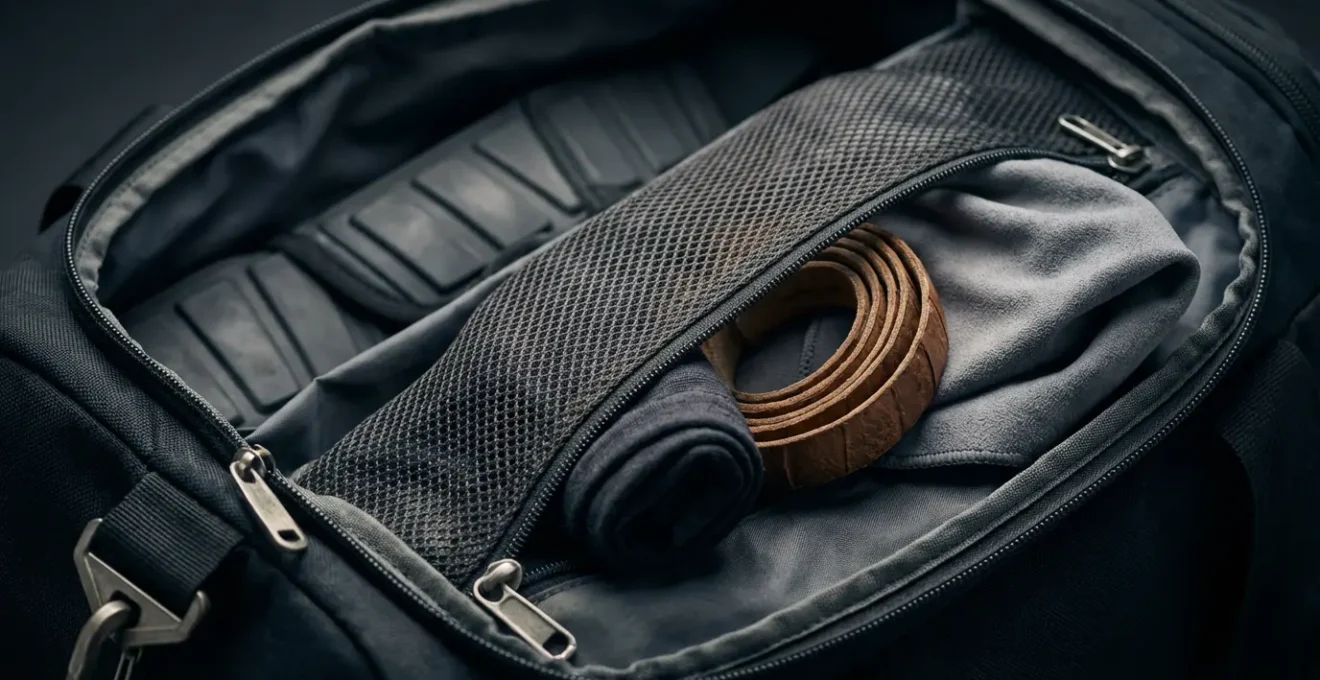
Beyond the obvious spare equipment, your emergency kit should be deeply personalized. It’s about having what *you* need to feel secure. This includes specific nutritional items that you know work for you, and mental tools that you have practiced using in training. The goal is to create a self-sufficient bubble where no minor setback can penetrate your focus.
Your bag check should be a physical and mental checklist, covering every contingency:
- Physical Items: Have backups for all critical equipment (e.g., spare racket, extra shoes, replacement parts). Pack a small medical kit with essentials like bandages, tape, and pain relievers. Include your proven nutrition and hydration items—never try something new on game day.
- Mental Response Cards: Carry small, laminated cards with pre-written action plans for your three worst-case scenarios (e.g., “What I will do if I lose the first set 6-0”).
- Focus Recovery Kit: Include a grounding object (like a smooth stone to hold) or a specific scent (like peppermint oil) that you have trained with to act as a sensory trigger to reset your focus.
- Crisis Keywords: Have one-word mental reset triggers written down to combat negative self-talk. These are words you’ve practiced using to snap out of a negative spiral.
This bag is your declaration that you are ready for anything. When you know you have a plan for the worst, you are free to perform at your best.
The 24-Hour Protocol: What to Eat and Do Before a Major Final?
The final 24 hours before a competition are the culmination of all your hard work. How you manage this period determines whether you arrive at the starting line primed for peak performance or already halfway to burnout. This is not a time for guesswork or improvisation. You need a precise, rehearsed protocol for nutrition, rest, and mental activation. The goal is to stabilize your physiology and quiet your mind, creating the optimal internal state for competition.
Your nutrition in this window is critical. It’s about fueling your body for endurance and your brain for focus. Research on pre-competition protocols shows a clear pattern for success. Athletes who follow a structured 24-hour plan, including a meal of complex carbohydrates 3-4 hours before the event and a small, easily digestible glucose intake (like a sports gel or a few pieces of fruit) 30-45 minutes prior, demonstrate significantly better focus and optimal arousal levels. This is not the time to experiment. You should have tested and perfected this exact meal timing and content during your less-important practice competitions.
Physical activity should be minimal and focused on activation, not exertion. A light walk or some gentle dynamic stretching can help ease pre-competition jitters and keep your muscles loose. This is also the time for your final mental rehearsals. Review your mental response cards from your bag check. Run through your visualization one last time. Engage in a brief meditation or listen to a specific playlist that you have conditioned to signal a state of focused intensity. Every action should be deliberate and familiar, a step in a well-worn path that leads directly to the competition arena.
Avoid decision fatigue. Have your clothes laid out, your bag packed, and your travel plans confirmed. The less mental energy you expend on trivial logistics, the more you have available for the match itself. This 24-hour protocol is your final act of control. It’s the last and most important part of your pressure inoculation system, ensuring that when the moment arrives, your body and mind are in perfect alignment, ready to execute.
Now, stop reading and start preparing. The anxiety you feel on game day is not a character flaw; it is a training deficit. Go fix it. Build your pressure drills, create your consequence-based games, and turn your practice environment into the furnace where your competitive character will be forged. The path to becoming a clutch performer begins the moment you decide to make pressure your closest training partner.