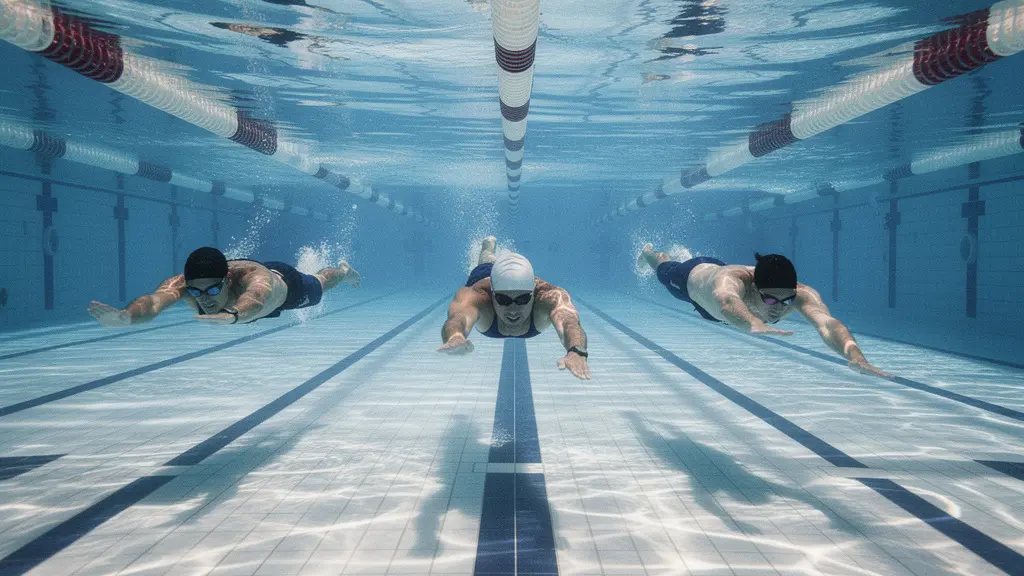
Fading after 35 meters in a 50m pool is not a fitness flaw; it’s a technical and structural breakdown that turns can no longer mask.
- Long-course swimming exposes core instability and stroke inefficiencies that are hidden by the frequent rests and push-offs of a 25m pool.
- Building true stamina requires training specifically to defeat the “Fatigue Cliff”—the point where form collapses—by integrating targeted drills, advanced tool use, and a robust aerobic base.
Recommendation: Dedicate the majority of your training volume to Zone 2 aerobic work. This builds the massive engine required to maintain technique under duress and fuel the explosive power needed for the final 15 meters.
For any serious triathlete or competitive swimmer, the 50-meter pool is the ultimate proving ground. It’s a long, unforgiving stretch of water that exposes every weakness. You feel strong for the first 25, maybe even 30 meters, and then it happens: an invisible wall. Your hips start to sink, your stroke feels heavy, and the far wall seems to move further away with every pull. The common advice is to simply “build more endurance” or “do more laps,” but this misses the fundamental point. The challenge of a 50-meter pool is not just about cardiovascular fitness; it’s about maintaining propulsive integrity under continuous tension.
The frequent turns in a 25-meter pool provide a micro-rest, a moment to reset your core and benefit from a powerful push-off. In a long-course pool, that safety net is gone. You are forced to hold your technique together for twice as long, fighting a battle against a specific point of failure I call the “Fatigue Cliff.” This is where core stability evaporates, leading to a cascade of technical errors, from a dropped elbow to a scissor kick. Beating this requires a complete shift in training philosophy.
This guide is not about swimming more; it’s about swimming smarter. We will dissect the unique demands of the 50-meter pool, deconstruct the common points of failure, and provide a strategic framework to build the kind of stamina that doesn’t just endure the distance but dominates it. We will move beyond generic advice and into the specific drills, sets, and mental models required to hold your split times and finish every 50 with power. Forget everything you thought you knew about simply adding volume. It’s time to re-engineer your workout structure from the ground up.
To build this unbreakable stamina, we will explore a complete training philosophy. This guide provides a detailed roadmap, from understanding the core problem to implementing advanced training strategies and building the foundational endurance that underpins all elite performance.
Summary: A Coach’s Blueprint for 50m Pool Dominance
- Why training in a 50m pool exposes fitness gaps hidden by 25m turns?
- How to hold split times over 50 meters without fading?
- Pull Buoy vs. Kickboard: Which isolates the stroke mechanics better?
- The stroke error that causes “Swimmer’s Shoulder” in long pools
- When to pass slower swimmers: The unspoken rules of the fast lane
- Basketball vs. Swimming: Which is the safer off-season option for runners?
- How to structure a “virtual hill” interval session for VO2 Max?
- Is Zone 2 Cardio Necessary for Explosive Court Sports?
Why training in a 50m pool exposes fitness gaps hidden by 25m turns?
The transition from a 25-meter to a 50-meter pool is a harsh diagnostic tool. The core issue is the elimination of frequent, restorative push-offs. In a short-course pool, a swimmer executes a turn approximately every 15-20 seconds. This action, while demanding, provides a brief respite from active propulsion and a powerful velocity boost from the wall. Your core gets a micro-break. In a 50-meter pool, you are under continuous muscular tension for 30, 40, or even 60 seconds straight. This prolonged stabilization demand is what exposes the gap between perceived fitness and true, functional swimming strength.
This lack of rest unmasks a critical weakness: core fatigue. As your core muscles tire, your hips begin to drop, dramatically increasing your frontal drag. This forces you to compensate with inefficient movements, such as pressing down on the water instead of pulling back, just to stay afloat. This is the “Fatigue Cliff,” the point where technique catastrophically breaks down. It’s not a gradual decline; it’s a sudden and noticeable collapse of form.
Case Study: The 35-Meter Breakdown
A 21-year-old swimmer training without a coach documented their struggle transitioning to a 50m pool. Despite a decent 31-second 50m freestyle time, they experienced significant form breakdown consistently after the 35-meter mark. The primary cause was identified as core fatigue, which was masked in a 25m pool by the recovery from turns. By implementing specific sets like pyramid intervals (4x100m, 4x75m, 4x50m, 4x25m) and speed kick drills, they directly targeted the endurance needed for continuous swimming. The goal was to hit a 27-second time within six months by closing the critical gap between short-course “turn-assisted” speed and true long-course stamina.
Therefore, training in a 50-meter pool is not just about swimming twice the distance in one direction. It is a completely different physiological and biomechanical event. It tests your ability to maintain a high, stable body position and an efficient high-elbow catch for an extended period without any external assistance. Failure to train for this specific demand is why even fit athletes feel like they’ve “hit a wall” two-thirds of the way down the pool.
How to hold split times over 50 meters without fading?
Maintaining speed over a full 50 meters is a game of controlled aggression, not just brute force. Fading is the direct result of a breakdown in efficiency, often caused by a poor pacing strategy. Many swimmers go out too hard, burning through their anaerobic reserves in the first 25 meters and leaving nothing for the second half. The key is to establish and hold a sustainable stroke rate and distance per stroke (DPS) that you can maintain under fatigue. This requires an almost metronomic sense of rhythm.
One critical factor in this equation is breathing. While holding your breath for a 25m sprint might be viable, it’s unsustainable over 50m. However, every breath introduces a slight disruption to your streamline and stroke rhythm. In fact, research by McCable et al. (2015) demonstrates that breathing during a sprint can decrease velocity by as much as 3%, which can translate to nearly a full second in a race. Therefore, your training must incorporate developing a bilateral breathing pattern (e.g., every 3 or 5 strokes) that is so ingrained it causes minimal disruption. This ensures you get the oxygen you need without sacrificing speed.
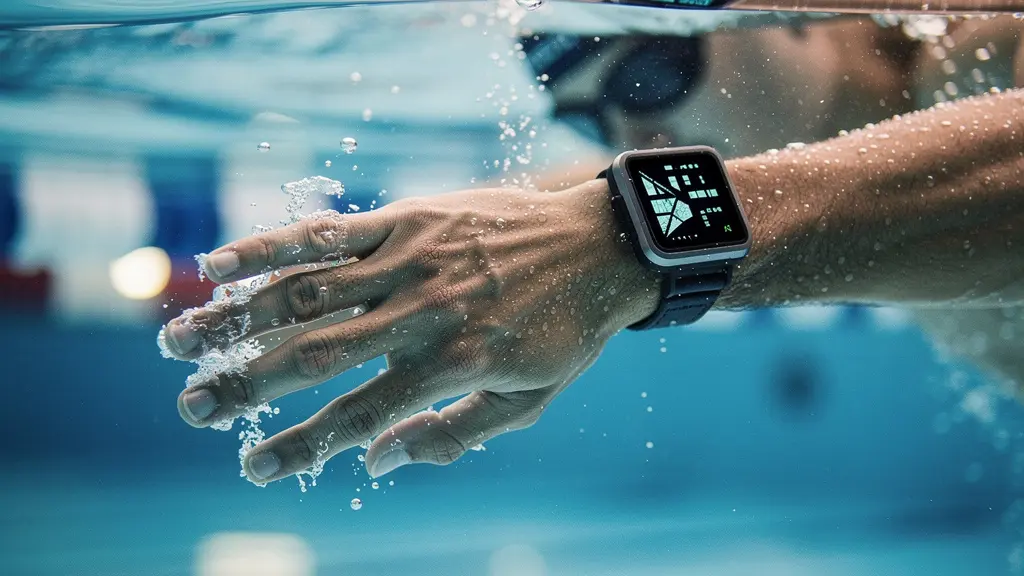
To build this consistency, tools like a waterproof tempo trainer are invaluable. By setting it to your target stroke rate, you receive an audible beep that forces you to maintain your cadence even as fatigue sets in. The goal is to find the sweet spot: a rate that is fast enough for your goal time but not so fast that your stroke shortens and becomes inefficient. Practice sets like 10 x 50m on a fixed interval, aiming to hold your stroke count and time identical on every single repeat. This teaches your body the feeling of consistent, efficient speed.
Pull Buoy vs. Kickboard: Which isolates the stroke mechanics better?
In the quest for better stroke mechanics, swimmers universally turn to pull buoys and kickboards. However, in the context of 50-meter stamina, their traditional use can be counterproductive. A pull buoy, used alone, is often a crutch. It artificially lifts the hips, masking the very core weakness that the long pool is designed to expose. It creates a false sense of a perfect body line, giving you confidence in the pool that evaporates the moment the buoy is removed and you hit the 35-meter mark in a race.
A kickboard, while excellent for isolating the legs, does little to teach you how to integrate your kick with your core and upper body rotation, which is essential for maintaining momentum over 50 meters. For a competitive swimmer, these tools must be used in a more sophisticated way to build true propulsive integrity, not just isolate muscle groups. The goal is connection, not separation. The most effective drills force the entire kinetic chain to work together as it would in whole-stroke swimming.
The following table, based on modern coaching principles, breaks down how these tools should be used—or modified—for effective 50-meter pool preparation. The distinction between “low” and “high” core engagement is critical; your training must force realistic engagement to have any real-world benefit. As an analysis of sprint training shows, effective workouts are those that build a robust and integrated system.
| Training Tool | Core Engagement | Fatigue Masking | 50m Stamina Impact | Recommended Use |
|---|---|---|---|---|
| Pull Buoy Alone | Low – artificially lifts hips | High – hides core weakness | Negative – creates false confidence | Not recommended for 50m prep |
| Pull Buoy + Ankle Band | High – forces realistic engagement | Low – exposes true fatigue | Positive – builds real endurance | 2-3 times per week |
| Kickboard Traditional | Moderate – isolates legs | Medium – partial body position | Neutral – leg-focused only | Once per week max |
| Kickboard 6-Kick Switch | High – full body connection | Low – integrates rotation | Very Positive – improves propulsion chain | 3-4 times per week |
The clear takeaway is to modify your use of these standard tools. Combining a pull buoy with an ankle band eliminates the ability to sneak in a stabilizing kick, forcing your core to do the work. Drills like the 6-Kick Switch on a kickboard teach you to drive your rotation from your hips, connecting your kick to your pull. This is how you isolate and fix mechanics without creating bad habits.
The stroke error that causes “Swimmer’s Shoulder” in long pools
“Swimmer’s Shoulder” is not a random occurrence; it’s an overuse injury with a predictable cause, and the 50-meter pool is its prime breeding ground. The most common culprit is a technical flaw that emerges under fatigue: the “dropped elbow” during the pull phase. In a fresh state, most swimmers can maintain a high-elbow catch, using their lats and core to anchor their hand and pull their body past it. However, as the Fatigue Cliff approaches, this breaks down.
The Causal Chain of Fatigue-Induced Impingement
Analysis of competitive swimmers reveals a consistent pattern: the dropped elbow error rarely appears in the first 25 meters of a 50m swim but consistently emerges after 30-35 meters. There’s a clear causal chain. First, core muscles fatigue from prolonged stabilization (30-60 seconds vs. 15-20 in a 25m pool). Second, the hips drop due to this lost core support, increasing drag. Third, the swimmer instinctively compensates by pressing downward with a dropped elbow to regain body height. Finally, this downward press places immense strain on the small muscles of the shoulder rotator cuff and anterior shoulder capsule, leading to the impingement and pain that frequent turns would have prevented.
This biomechanical failure is illustrated below. The image on the left shows the powerful, sustainable high-elbow position. The image on the right shows the fatigued, injury-prone dropped-elbow position. The difference is not a choice; it’s a consequence of a failing core. The shoulder is simply the last link in a broken chain. Therefore, preventing Swimmer’s Shoulder is not about “stronger shoulders.” It’s about building a core that is so resilient it never forces the shoulder into a compromised position in the first place.
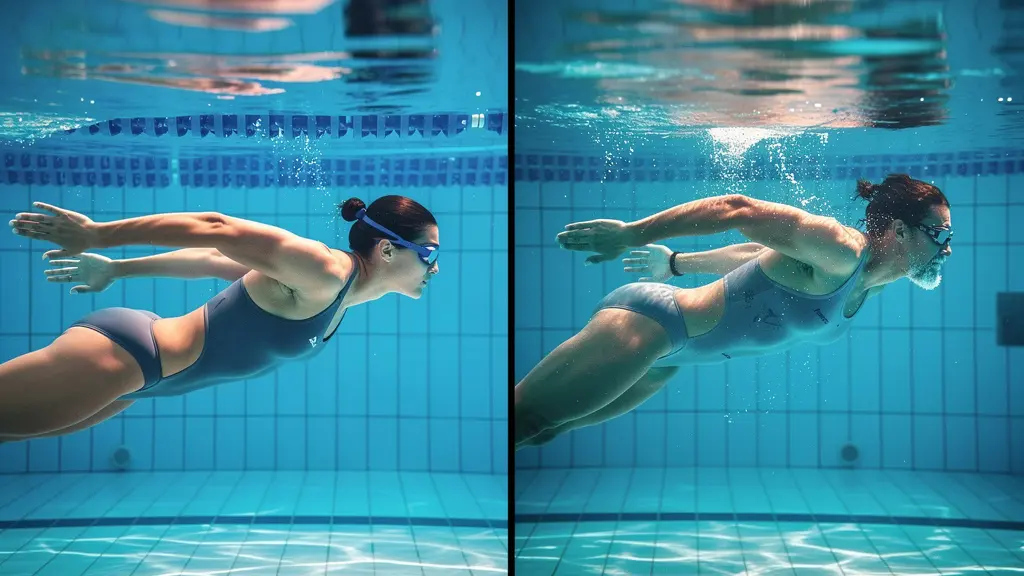
This means your training must include a heavy dose of core-focused swim drills (like swimming with an ankle band) and dry-land exercises that prioritize rotational stability (like planks with arm/leg raises and medicine ball twists). Without this foundation, you are simply waiting for the injury to happen.
Your 5-Step Audit to Defeat the Fatigue Cliff
- Identify the Breakdown Point: Swim a hard 75m and have a coach or friend video you from the side. Pinpoint the exact meter mark where your hips start to drop or your elbow begins to fall. This is your baseline “Fatigue Cliff.”
- Collect Stroke Data: Swim 4x50m at 85% effort, counting your strokes per length (SPL) and recording your time for each. An increase in SPL with a stable or slower time on the 3rd and 4th reps is a clear sign of efficiency loss.
- Test Core Cohesion: Perform a 60-second plank. If you cannot hold perfect form without your hips sagging, your core is not ready for the demands of continuous 50m swimming. This is a non-negotiable benchmark.
- Assess Propulsive Integrity: Perform a “sculling” drill for 25m focusing only on the catch. Do you feel immediate pressure on your forearm and palm, or do you feel your wrist breaking and your elbow dropping to “find” the water? The latter indicates a weak catch.
- Formulate a Correction Plan: Based on the above, prioritize one flaw. If the core is weak, add 3 core-focused drills to every workout. If the catch is failing, dedicate 10 minutes to sculling variations before your main set. Attack one weakness at a time.
When to pass slower swimmers: The unspoken rules of the fast lane
Training in a 50-meter pool often means sharing a lane, and navigating traffic is a skill in itself. The “fast lane” has its own etiquette, and violating it not only causes frustration but can also sabotage your own workout. The primary rule is to respect the set. If a swimmer in front of you is on a hard interval, attempting to pass them mid-length is disruptive and dangerous. The best practice is to wait for the wall, where you can either flip-turn on the other side of the ‘T’ or let them go first on the next repeat.
However, there are exceptions. If you are on a specific VO2 max set, the surge required to pass mid-pool can actually be integrated as part of the effort. In this scenario, the energy spike contributes to your training goal rather than compromising it. The key is context and communication. A subtle but clear way to signal your intent to pass is the “Shoulder-to-Shoulder” signal: instead of tapping their feet (which can be startling and is often considered rude), pull up alongside the lead swimmer’s shoulder in the last 10 meters. This communicates that you will take the other side of the lane at the turn.
Making the wrong decision has a real physiological cost. A sudden, aggressive surge to pass a slower swimmer can ruin a carefully paced aerobic or threshold set. In fact, physiological monitoring shows a 15-20 BPM heart rate spike that can last for 30-45 seconds after such a maneuver. This unplanned effort floods your muscles with lactic acid, compromising your ability to complete the rest of the interval at your target pace. In many cases, it is metabolically cheaper to lose a few seconds by drafting behind the slower swimmer than it is to gain a second by passing them incorrectly.
Ultimately, the decision to pass should be strategic, not emotional. Assess the goal of your current set. Is it a steady-state aerobic piece where consistency is king? Then wait. Is it an all-out sprint where every second counts? Then pass cleanly and decisively. Intelligent lane navigation is part of being a mature, elite athlete.
Basketball vs. Swimming: Which is the safer off-season option for runners?
For endurance athletes like triathletes and runners, the off-season is a critical time for recovery and cross-training. The goal is to maintain or even improve cardiovascular fitness while reducing the repetitive impact stress of running. When choosing an activity, the primary concern should be minimizing injury risk while maximizing aerobic benefit. Comparing a high-impact court sport like basketball to swimming reveals a clear winner for the serious endurance athlete.
Basketball, while excellent for developing agility and explosive power, carries a significant risk of catastrophic joint injury. The constant jumping, cutting, and landing places immense stress on the ankles and knees, with ankle sprains and ACL tears being common, season-ending injuries. For a runner whose entire sport depends on the health of these joints, this is an unacceptable risk. Swimming, by contrast, is a near-zero-impact activity, making it an ideal environment for active recovery and cardiovascular conditioning without the threat of a debilitating injury.
Furthermore, the type of cardiovascular training is fundamentally different. Basketball is primarily an anaerobic, stop-start activity. Swimming provides continuous, horizontal, aerobic work that more closely mimics the sustained demands of long-distance running. As TritonWear’s performance analysis notes, “Swimming’s forced, rhythmic breathing strengthens respiratory muscles (diaphragm, intercostals) in a way that ground-based sports can’t. This translates directly to a runner’s ability to fight off oxygen debt in the final stages of a race.”
The following table provides a clear risk-benefit analysis for a runner choosing an off-season cross-training sport.
| Factor | Basketball | Swimming | Relevance to Runners |
|---|---|---|---|
| Catastrophic Joint Injury Risk | High (ankle sprains, ACL tears) | Near zero | Season-ending injuries derail running goals |
| Cardiovascular Training Type | Vertical, stop-start anaerobic | Horizontal, continuous aerobic | Swimming mimics running’s aerobic demands |
| Overuse Injury Development | Immediate (impact-based) | Gradual (shoulder only if poor technique) | Swimming injuries are preventable with proper form |
| Respiratory Muscle Training | Minimal controlled breathing | Forced rhythmic breathing strengthens diaphragm | Improves runner’s finishing kick capacity |
For an athlete whose primary goal is endurance performance, the choice is clear. Swimming offers a superior and safer method for building the aerobic engine and respiratory strength that are directly transferable to running, without the high risk of derailing a season due to injury.
How to structure a “virtual hill” interval session for VO2 Max?
To truly conquer the 50-meter pool, you need to develop the power to accelerate through the Fatigue Cliff. Standard intervals are good, but to simulate the intense, grinding effort needed to fight rising drag, you must incorporate “virtual hills.” These are high-intensity interval sets that use resistance or hypoxia to mimic the feeling of swimming uphill, forcing your body to recruit more muscle fibers and generate more power to maintain speed. This is a direct and potent way to boost your VO2 max.
These are not simple endurance sets; they are designed to push you to your absolute limit for short bursts, followed by recovery. This type of training is incredibly effective. In fact, a European Journal of Sport Science review (2023) found that this form of high-intensity interval training can lead to an 11-14% improvement in swim efficiency within just eight weeks. The key is creating an overload that forces adaptation. You can achieve this in several ways, each targeting the propulsive system differently.
Here are three effective methods for structuring a virtual hill session in the pool:
- Resistance Hills: This method directly adds drag. A classic set is 8x50m. For the first 25m, swim with drag socks or a resistance parachute at maximum effort. At the 25m mark, shed the equipment and sprint the final 25m. This simulates the feeling of cresting a hill and accelerating downhill, teaching your nervous system to fire at a high tempo even when tired.
- Stroke Rate Power Hills: This method uses tempo to create the hill. Set your tempo trainer to a cadence that is challenging but manageable. Swim a 50m interval, but at the 25m mark, add paddles while maintaining the exact same stroke rate. This forces you to generate significantly more power per stroke to keep up with the tempo, creating a massive power demand.
- Hypoxic Hills: This method uses oxygen deprivation to create stress. A set of 4x50m with a progressive breathing pattern is brutally effective. For the first 25m, breathe every 3 strokes. For the second 25m, switch to breathing every 7 or 9 strokes. This simulates the oxygen debt you feel at the end of a race and trains your body to tolerate high levels of CO2 while maintaining form.
Incorporating one of these virtual hill sessions into your weekly plan, especially in the 6-8 weeks leading up to a competition, will provide a powerful boost to your top-end speed and your ability to close out a 50-meter race with authority.
Key takeaways
- The 50m pool’s primary challenge is not distance, but the ‘Fatigue Cliff’—a technical breakdown around 35m caused by a lack of turn-based recovery.
- Building long-course stamina requires focusing on core stability to prevent hip drop and the resulting ‘Swimmer’s Shoulder’ injury from a dropped-elbow compensation.
- Advanced tool usage (e.g., pull buoy with an ankle band) is superior to traditional methods as it forces realistic core engagement and exposes weaknesses instead of masking them.
Is Zone 2 Cardio Necessary for Explosive Court Sports?
While this guide focuses on swimming, the underlying principle of endurance applies universally, even to explosive court sports like basketball or tennis. There’s a common misconception that athletes in these sports only need to train for anaerobic power and agility. However, elite coaches understand that a massive aerobic base, built through extensive Zone 2 training, is the foundation upon which explosive performance is built. It is not about “slow training”; it is about building a bigger, more efficient engine.
Zone 2 cardio isn’t about ‘slow swimming’; it’s about building a massive aerobic engine. This engine is what allows for quick recovery between heats and provides the endurance to not fade before the explosive final 10 meters of a race.
– Todd DeSorbo, U.S. National Team Coaching Philosophy
The logic is simple. A strong aerobic system, developed through hours in Zone 2, improves mitochondrial density. This means your body becomes far more efficient at producing energy using oxygen. For a court athlete, this translates to faster recovery between points. For a swimmer, it means being able to hold perfect technique for longer before tapping into finite anaerobic reserves. It allows you to get to the last 15 meters of a 50m race feeling fresh and ready to unleash your explosive power, while your competitor who neglected their aerobic base is already hitting the Fatigue Cliff.
Case Study: The Zone 2 Foundation for Sprint Performance
An analysis of competitive swimmers shows that those who dedicate 60-70% of their total training volume to Zone 2 aerobic work demonstrate a superior ability to maintain technique under fatigue during the crucial final 10 meters of a 50m race. This extensive Zone 2 base increases their mitochondrial density, allowing for more efficient aerobic energy production. This preserves precious glycogen stores for the all-out anaerobic finish. These athletes consistently report faster recovery times between heats and a noticeable prevention of the technical breakdown that plagues competitors who rely purely on anaerobic capacity.
Therefore, Zone 2 training is not an “extra” or something only for distance athletes. It is an absolute necessity. It builds the capacity to recover, the endurance to maintain form, and the platform from which all explosive, race-winning speed is launched. Neglecting it is the single biggest mistake an aspiring elite athlete can make.
Stop training harder; start training with intelligence and discipline. Take these principles, apply them to every workout, and build the unbreakable stamina that wins races. Your journey to conquering the 50-meter pool begins now.
Frequently Asked Questions on 50m Pool Training
Should I pass mid-pool if I’m on a VO2 max set?
Yes, for VO2 max sets, the mid-pool surge can be integrated as part of the effort. The energy spike actually contributes to your training goal rather than compromising it.
What’s the physiological cost of passing incorrectly?
A sudden surge to pass can spike heart rate out of the intended training zone, creating lactic acid that compromises the rest of your interval – sometimes losing 5 seconds by drafting is better than gaining 2 seconds by passing.
How do I signal my intent to pass without speaking?
Use the ‘Shoulder-to-Shoulder’ signal: pull up alongside the lead swimmer’s shoulder (not feet) in the last 10 meters to signal you’ll flip-turn on the other side of the lane line.