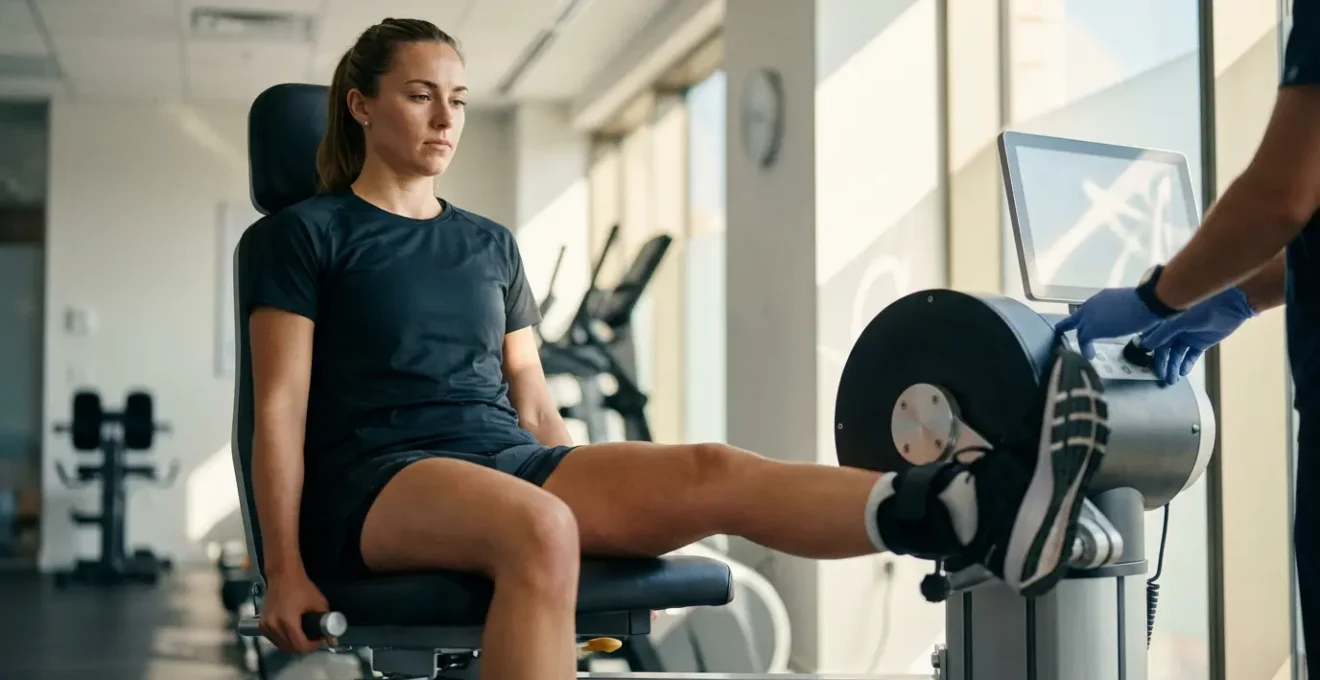
The true safety of kinetic equipment isn’t just about controlling speed; it’s about the machine’s ability to create “intelligent resistance” that actively adapts to your body’s limits in real-time.
- Unlike free weights that impose a constant, unforgiving load, kinetic systems engage in a biomechanical dialogue, matching your force output precisely through every degree of motion.
- This technology allows for targeted interventions, like eccentric-only training for tendons and quantifiable data tracking, that are nearly impossible to replicate with traditional weights.
Recommendation: While free weights have their place, for joint rehabilitation or for older adults prioritizing safety, kinetic equipment offers an unparalleled level of engineered safety and effectiveness for rebuilding strength with confidence.
For any athlete recovering from an injury or an older adult looking to maintain strength, the weight room can feel like a double-edged sword. The goal is to get stronger, but the fear of a setback—or a new injury—is constant. The debate often simplifies to a choice between traditional free weights and modern machines. While many tout machines as “safer,” this generalization misses the profound engineering leap represented by isokinetic equipment.
The conversation shouldn’t be about “safe” versus “dangerous.” It should be about understanding the physics of resistance and how it interacts with vulnerable joints. Free weights offer a constant gravitational load, which your body must control. Any fluctuation in strength, stability, or concentration can lead to compensatory movements that strain recovering tissues. Kinetic equipment fundamentally changes this paradigm. It doesn’t impose a load; it responds to one.
This article moves beyond the surface-level debate. As a rehabilitation engineer, my aim is to deconstruct the mechanics of these two modalities. We will not just state that kinetic technology is safer; we will explore *how* its principle of intelligent, adaptive resistance creates a controlled environment for neuromuscular re-education. The key isn’t just to avoid re-injury, but to build a more resilient foundation for future performance. This guide will walk you through the core mechanisms, common pitfalls, and data-driven advantages that define modern, safe rehabilitation.
To navigate this technical analysis, this article breaks down the comparison into key functional questions. We will examine how resistance is adapted, its application in specific therapies, and how to maximize the benefits while avoiding critical errors.
Table of Contents: Kinetic Equipment vs. Free Weights: A Technical Breakdown
- How isokinetic machines adapt resistance to your fatigue level instantly?
- How to use eccentric-only modes to heal tendinopathy?
- Cable vs. Kinetic: Which provides better tension through the full range of motion?
- The setup mistake that negates the safety benefits of kinetic machines
- Data Output: What power metrics should you track on digital machines?
- Warm-up vs. Workout: Where to place rotator cuff exercises?
- Manual Therapy vs. Active Rehab: Which yields long-term results?
- How Core Stability Stops Lower Back Pain in High-Rotation Sports?
How isokinetic machines adapt resistance to your fatigue level instantly?
The core principle that sets isokinetic dynamometers apart is their “accommodating resistance.” Unlike a dumbbell, which has a fixed mass, an isokinetic machine provides resistance that is perfectly proportional to the force you apply, all while keeping the speed of movement constant. This creates a unique biomechanical dialogue. If you push harder, the machine resists more. If you start to fatigue and your force output drops, the machine instantly reduces its resistance. This is safety by design, eliminating the risk of being “stuck” under a weight you can no longer lift.
This “intelligent resistance” is achieved through a dynamometer, a sophisticated system that measures force and controls velocity. You set the speed (in degrees per second), not the weight. For early-stage rehabilitation, slower speeds are ideal for building foundational strength. In fact, research shows that isokinetic training parameters are often set at a slow 0.3-0.5 m/s for initial recovery, gradually increasing to over 1.0 m/s to develop power as the patient heals. This ensures the muscle is loaded optimally throughout the entire range of motion, something a free weight, with its variable moment arm, cannot achieve.
The sensation is one of perfect opposition at every point. As your natural strength curve varies through a movement (e.g., you’re stronger in the middle of a bicep curl than at the very top or bottom), the machine adapts. This means you’re always working at your maximum safe capacity, which accelerates neuromuscular re-education without ever overloading the joint or connective tissues. It’s the safest way to achieve maximal muscle contraction during every repetition.
How to use eccentric-only modes to heal tendinopathy?
Tendinopathy, the painful degradation of a tendon, is often a frustratingly persistent injury. A key reason is that tendons respond best to a specific type of load: heavy, slow, eccentric (lengthening) contraction. Trying to achieve this with free weights is clumsy and often unsafe. You need a spotter to help with the concentric (lifting) phase, and it’s difficult to control the load on the way down. Isokinetic machines with an eccentric-only mode completely solve this problem.
In this mode, the machine actively performs the concentric part of the movement for you, moving the limb to the starting position without any effort on your part. Then, it provides a pre-set resistance that you must control as the lever arm moves back—the eccentric phase. This allows for the precise application of controlled tension that stimulates collagen synthesis and tendon remodeling. This targeted approach is a cornerstone of modern tendinopathy treatment, allowing therapists to load the tendon effectively without aggravating the injury.

This level of precision is critical because the body’s healing response is complex. For example, recent research indicates that metabolic factors can significantly impair eccentric exercise outcomes, particularly in patients with metabolic syndrome. The ability of isokinetic machines to precisely control and monitor force output allows clinicians to adjust protocols for such populations, ensuring the therapy remains within the optimal therapeutic window. This is a level of personalization that free weights simply cannot offer.
Cable vs. Kinetic: Which provides better tension through the full range of motion?
Cable machines are a step up from free weights, providing a more constant line of pull. However, the resistance they provide is isotonic—meaning the weight stack remains constant throughout the movement. While better than a dumbbell, this still doesn’t account for the body’s natural strength curves or the points of vulnerability within a range of motion. Isokinetic machines operate on a completely different principle, providing dynamic, accommodating resistance that offers superior tension management and joint protection.
The fundamental difference lies in how resistance is applied and where the peak tension occurs. A cable machine provides the same force from start to finish. An isokinetic machine, by contrast, matches your force output to maintain a constant speed. This means it provides less resistance where you are weak (at the beginning and end of the motion) and more resistance where you are strong (mid-range). This mirrors the body’s natural biomechanics, maximizing muscle activation while minimizing stress on the joint at its most vulnerable angles. The table below outlines these key distinctions.
This comparative data highlights the engineering behind isokinetic safety, as further explained in a comprehensive analysis of dynamometry in rehabilitation.
| Characteristic | Cable Machine | Isokinetic Machine |
|---|---|---|
| Resistance Type | Near-constant (isotonic) | Variable to maintain speed |
| Tension at Start Position | Constant force | Lower resistance |
| Tension at Mid-Range | Constant force | Peak resistance |
| Tension at End Position | Constant force | Lower resistance |
| Deceleration Safety | No active deceleration | Active limb deceleration |
| Joint Protection | Same stress throughout ROM | Matches biomechanical leverage |
This adaptive capability is what allows for such precise therapeutic application. As expert Adam Loiacono notes, the goal is to leverage this control:
Isokinetic training allows for extreme manipulation of the force-velocity curve to increase specificity of training or rehab adaptations
– Adam Loiacono, Ultimate Guide to Isokinetic Testing
The setup mistake that negates the safety benefits of kinetic machines
The sophisticated engineering of an isokinetic machine is its greatest strength, but it also introduces a critical dependency: proper setup. Unlike picking up a dumbbell, using a kinetic machine requires precision. A single setup error can not only reduce the effectiveness of the exercise but can also negate its primary safety features, potentially introducing harmful shear forces to a recovering joint. The most common and critical mistake is misalignment.
The machine’s axis of rotation must be perfectly aligned with the anatomical axis of the joint being exercised. For a knee extension, for example, the machine’s axle must line up exactly with the axis of rotation of the knee joint. If it’s too high, low, forward, or back, the machine will apply shear and torsional forces to the knee ligaments and cartilage as the limb moves. This completely undermines the “safety by design” and can turn a therapeutic exercise into a harmful one. It is the digital equivalent of lifting a free weight with dangerously poor form.
Beyond alignment, other setup parameters are crucial. Range of motion (ROM) limits must be set to avoid moving into painful arcs, and stabilization straps must be used to prevent the body from compensating with other muscles. Forgetting to secure the pelvis during a hip abduction exercise, for instance, means the work will be done by the lower back, not the target gluteus medius. These are not minor details; they are fundamental to the safety and efficacy of the treatment.
Your 5-Point Pre-Session Safety Audit: Critical Setup Checks
- Axis Alignment: Does the machine’s axis of rotation perfectly match the anatomical joint’s axis? Use anatomical landmarks for precise alignment to prevent harmful shear forces.
- ROM Limits: Have you set the start and end points to stay within a completely pain-free range? Begin conservatively and expand the range only as mobility improves.
- Compensation Prevention: Are all necessary stabilization straps and core bracing techniques in use? Isolate the target muscle by locking down the rest of the body.
- Correct Attachment: Are you using the specific pad or grip designed for this exercise? The right attachment is essential for maintaining proper biomechanics.
- Speed Selection: Are you starting with an appropriate, slower speed (e.g., 60-90°/s) to ensure control before progressing to higher, power-focused velocities?
Data Output: What power metrics should you track on digital machines?
One of the most significant advantages of kinetic equipment over free weights is the objective, quantifiable data it provides. While lifting a dumbbell tells you only the weight you lifted, an isokinetic machine provides a detailed report on the quality of your movement. This data transforms rehabilitation from a subjective process (“it feels stronger”) to an objective, data-driven science. But what metrics are most important to track?
The primary metrics are related to torque, work, and power. Peak torque (the highest force produced during the repetition) is a good indicator of raw strength. Total work (the force applied over the entire range of motion) provides a better measure of functional capacity. Power (the rate at which work is done) is crucial for athletes needing explosive strength. However, the most insightful data often comes from comparing these numbers.
A key diagnostic metric is the agonist/antagonist ratio. This compares the strength of opposing muscle groups, such as the quadriceps and hamstrings. Imbalances are a major predictor of injury. For instance, research on agonist-antagonist relationships shows that an optimal Quadriceps-to-Hamstring ratio is between 60-80%. If a report shows a hamstring strength that is only 45% of the quadriceps strength, it highlights a dangerous imbalance that must be addressed to protect the ACL. This is the kind of actionable insight that guides effective, long-term rehabilitation.
Case Study: Isokinetic Testing for Athletic Performance
Modern systems like the HUMAC Norm and 1080 Quantum Synchro offer comprehensive muscular assessments. An athlete’s data might be captured on a HUMAC Norm, revealing excellent peak torque in their quadriceps but a significant deficit in the hamstring-to-quadriceps ratio. The 1080 Quantum could then be used for dynamic, sport-specific training at variable speeds to specifically target and strengthen the hamstrings eccentrically, directly addressing the imbalance identified by the data and reducing future injury risk.
Warm-up vs. Workout: Where to place rotator cuff exercises?
The rotator cuff is a delicate group of muscles critical for shoulder stability, and its health is paramount for both overhead athletes and older adults. The question of when to exercise it—as part of a warm-up or as a main component of a workout—is a common point of confusion. With isokinetic equipment, the answer isn’t “either/or” but “both, with different intentions and parameters.” The technology allows for precise manipulation of speed and load to achieve different physiological goals.
As a warm-up or pre-activation drill, rotator cuff exercises on a kinetic machine should be performed at low loads and high speeds (e.g., 180-300°/s). The goal here is not to build strength or induce fatigue. It is to increase blood flow, enhance neuromuscular activation, and prime the stabilizers for the main workout. These fast, light movements essentially “wake up” the connection between the brain and the shoulder muscles, improving stability for subsequent heavy lifts or activities.
Conversely, when the goal is to build foundational strength in the rotator cuff, the parameters are reversed. These exercises should be performed as part of the main workout, using high loads and slow speeds (e.g., 60-90°/s). This is where you work to improve the muscle’s capacity and address any strength deficits, such as imbalances between internal and external rotators. For throwing athletes, a third phase can be added: velocity-specific training at high speeds to improve the cuff’s ability to decelerate the arm, a crucial component of injury prevention. This strategic layering of stimuli—activation, strength, and velocity-specific endurance—is a level of periodization made simple by kinetic technology.
Manual Therapy vs. Active Rehab: Which yields long-term results?
In rehabilitation, a common debate is the role of passive treatments versus active participation. Manual therapy—hands-on techniques like massage and joint mobilization—can provide immediate relief by restoring mobility. Active rehab—strengthening exercises and movement re-education—is what builds long-term resilience. The most effective approach is not to choose one over the other, but to synergistically combine them. Kinetic equipment serves as the perfect bridge between these two worlds.
Manual therapy is excellent for “unlocking” a stiff joint or releasing tight soft tissues. However, its effects can be temporary. If the patient doesn’t have the strength and motor control to use their newfound range of motion, the body often reverts to its old, dysfunctional pattern. This is where active rehab, particularly with kinetic equipment, becomes essential. Immediately after a manual technique creates new mobility, loading that new range of motion with an isokinetic machine helps to “lock in” the gains. The accommodating resistance ensures the movement is safe, controlled, and effective, teaching the nervous system how to control the limb in its new, expanded workspace.
The FAKTR Approach: Unlocking and Locking In Gains
An innovative model that demonstrates this synergy is FAKTR (Functional and Kinetic Treatment with Rehabilitation). As detailed by clinics like Elite Physical Therapy, this system uses instrument-assisted manual therapy to break down scar tissue, followed immediately by active movement protocols. This combination addresses the joint restriction first (manual) and then immediately builds stability and control within that new range (active). It’s a comprehensive system that confirms long-term results come from integrating, not separating, these approaches.
This combined approach recognizes that mobility without stability is useless, and attempts at stability without adequate mobility are often impossible. The two must progress together. Manual therapy opens the door, and active, kinetic-based rehab teaches the body how to live in the bigger house.
Key Takeaways
- Safety by Design: Isokinetic machines offer safety not just by controlling speed, but by providing “intelligent resistance” that instantly adapts to your fatigue and strength, preventing overload.
- Precision is Paramount: The benefits of kinetic equipment are entirely dependent on proper setup. Misaligning the machine’s axis with the joint’s axis negates its safety features.
- Data-Driven Recovery: Kinetic systems transform rehab from a subjective process to an objective science by tracking metrics like torque and agonist/antagonist ratios, allowing for targeted, effective interventions.
How Core Stability Stops Lower Back Pain in High-Rotation Sports?
For athletes in sports like golf, tennis, or baseball, the kinetic chain is everything. Power is generated from the ground up, transferred through the hips and core, and finally expressed through the limbs. A common source of lower back pain in these athletes is a failure of the core to provide a stable base. When the core is weak or improperly activated, the lumbar spine is forced to generate or absorb rotational forces it isn’t designed for. Kinetic equipment, when used correctly, is a powerful tool for re-establishing the proper sequence, but only if core stability is treated as the foundation.
Core stability is the ‘anchor’ that makes kinetic machine exercises for the limbs effective and safe. Without a stable core, the body will generate compensatory rotation in the lumbar spine
– Physical Therapy Research Team, Kinetic Chain Rehabilitation Studies
The goal is to teach the core to function as a stabilizer, not a prime mover for rotation. This means focusing on anti-rotation exercises. A kinetic trunk rotation machine is ideal for this. By emphasizing the eccentric (resisting) phase, you are training the core muscles to act as “brakes,” controlling rotation and protecting the lumbar spine. This proximal stability is a prerequisite for any distal mobility or power work. You must be able to anchor the ship before you can fire the cannons.
When an athlete performs any limb exercise on a kinetic machine—be it for the shoulder or the knee—a therapist must monitor for compensation patterns at the core. Any unwanted twisting or arching of the back is a sign that the core is failing to stabilize. The accommodating resistance of the machine is a benefit here, as the force can be instantly reduced to a level the core can manage, allowing for true isolation and strengthening of the target limb without compromising the spine. The focus should always be:
- Build proximal stability (core and hips) before seeking distal mobility (limbs).
- Emphasize anti-rotation and eccentric control in the trunk.
- Use the machine’s feedback to eliminate compensatory movements during all exercises.
By understanding these engineering and biomechanical principles, you can engage in a more informed dialogue with your physical therapist, ensuring your rehabilitation program is not only safe but maximally effective for a strong, resilient recovery.