Practice
Practice is the bridge between aspiration and achievement in any athletic pursuit. Yet most athletes spend countless hours training without understanding the underlying principles that separate mere repetition from transformative improvement. The quality of your practice environment, your mental state, and your approach to skill development all determine whether you’re building championship habits or simply reinforcing mediocrity.
This comprehensive exploration examines the multifaceted nature of effective practice, from the neuroscience governing your attention to the physical setup of your training space. Whether you’re refining a tennis serve, perfecting a golf swing, or developing court awareness in basketball, understanding these foundational principles will revolutionize how you approach every training session. You’ll discover why environment matters as much as effort, how your brain builds skills under pressure, and what separates casual training from the deliberate practice that forges elite performers.
Why Your Practice Environment Shapes Performance
The space where you practice isn’t just a backdrop—it’s an active participant in your skill development. Think of your practice environment as a laboratory where you’re conducting experiments on yourself. Every element, from the lighting overhead to the sounds in the background, either accelerates your learning or introduces friction that slows progress.
Creating isolated conditions is essential for deliberate practice and deep work. This means intentionally removing distractions that fragment your attention. When a basketball player practices free throws in an empty gym versus a crowded game situation, they’re training different neural pathways. The isolated environment allows for pure repetition without the cognitive load of managing external stimuli, building the foundational motor patterns that will later become automatic under pressure.
Choosing the Right Space for Your Specific Skill
Different skills demand different environmental conditions. A golfer working on putting needs a consistent, level surface with minimal wind interference, while a soccer player developing ball control might benefit from varied terrain that challenges their touch. The key is matching your environment to your training objective. If you’re building muscle memory, consistency matters most. If you’re developing adaptability, controlled variability becomes your tool.
Environmental Triggers and How to Eliminate Them
Your brain creates powerful associations between context and behavior. If you always check your phone when you hear a notification, you’ve experienced an environmental trigger. In practice settings, these triggers can be subtle: a cluttered space might trigger scattered thinking, or certain music might energize or distract depending on the task. Identifying and eliminating counterproductive triggers—whether it’s turning off your phone, removing visual clutter, or controlling noise levels—creates the mental clarity necessary for focused skill development.
The Role of Lighting in Sustained Focus
Lighting might seem trivial, but it profoundly impacts both visual performance and mental state. Natural light promotes alertness and reduces eye strain during extended sessions, while harsh fluorescent lighting can cause fatigue. For precision skills requiring visual acuity—like tracking a baseball or reading a putting green—optimal lighting isn’t a luxury; it’s a necessity. Many elite training facilities now use adjustable lighting systems that can simulate different game conditions while maintaining visual comfort.
The Neuroscience Behind Focused Practice
Understanding how your brain learns transforms practice from a physical activity into a sophisticated mental process. When you repeat a movement, you’re not just training muscles—you’re strengthening neural connections through a process called myelination, where nerve fibers develop insulating layers that make signals travel faster and more reliably.
Focus acts as the gatekeeper to this process. Neuroscientists have discovered that attention literally changes brain structure. When you practice with full concentration, your brain releases neurochemicals that strengthen the synaptic connections involved in that specific skill. Conversely, distracted practice creates weaker, less reliable neural pathways. This is why ten minutes of intensely focused practice often yields better results than an hour of unfocused repetition.
The Neurology of Soft Hands and Touch
The term “soft hands” in sports—whether referring to a receiver catching a football, a baseball infielder fielding a ground ball, or a tennis player hitting a drop shot—describes a neurological phenomenon as much as a physical one. The brain’s somatosensory cortex processes tactile information, and elite athletes have developed heightened sensitivity in sport-specific areas. This enhanced neural processing allows them to make micro-adjustments in milliseconds, absorbing force or redirecting momentum with seemingly effortless precision. This sensitivity isn’t innate—it’s built through thousands of repetitions where attention is focused on the tactile feedback during each contact.
Setting Up Your Practice Zone for Maximum Efficiency
A well-designed practice station is your competitive advantage. Whether you’re creating a home hitting cage, a putting green in your garage, or a ball-handling area in your driveway, the setup process requires strategic thinking about workflow, safety, and adaptability.
The Private Drill Station: Components and Configuration
Start by defining your primary training objective. A pitcher working on mechanics needs a clear throwing lane with proper mound elevation, a net or backstop, and potentially video recording capability for analysis. Structure the space to enforce repetition and consistency—everything should be within arm’s reach so you’re not breaking focus to retrieve equipment. Consider the layout like a chef designs a kitchen: the most frequently used items should be most accessible, and the flow should minimize wasted motion between repetitions.
Automated vs. Manual Practice Zones
Technology has introduced automated training tools—pitching machines, ball return systems, programmed rebounders—that offer consistent repetition without a partner. These excel at building volume and muscle memory. However, manual zones where you must reset each repetition teach discipline and create natural rest intervals that prevent mental fatigue. The ideal approach often combines both: use automation for high-volume foundational work, then transition to manual drills that incorporate decision-making and variability.
Safety Considerations in Compact Training Areas
Tight practice zones present unique hazards. A batting cage with insufficient netting, a golf hitting net too close to windows, or slippery flooring under a basketball hoop can turn productive practice into an injury. Conduct a thorough safety audit before your first session:
- Ensure adequate clearance for your full range of motion plus a safety margin
- Install proper netting or barriers to contain balls or equipment
- Check flooring for slip resistance and appropriate cushioning
- Verify that ceiling height accommodates your movements (particularly important for overhead motions)
- Remove any fragile items or sharp edges from the practice area
Upgrading and Evolving Your Training Space
Your practice zone should evolve with your skills. What works for a beginner learning basic mechanics may need modification as you progress to advanced techniques. Plan for upgradability from the start—modular equipment, adjustable settings, and flexible layouts allow you to increase complexity without complete reconstruction. Many athletes find that starting with a basic setup and gradually adding elements (mirrors for form checking, measurement tools for tracking progress, resistance bands for strength integration) creates a more thoughtful, personalized training environment than trying to build everything at once.
Developing Skills That Perform Under Pressure
The practice-to-performance gap frustrates countless athletes: techniques that feel smooth in training crumble under competition pressure. This gap exists because practice conditions rarely replicate performance demands. Closing this gap requires intentional progression from isolated skill work to integrated, pressure-tested execution.
Mastering Fine Motor Skills and Touch
Fine motor control—the precise, delicate movements required for a golfer’s putting stroke, a point guard’s fingertip pass, or a pitcher’s changeup grip—demands different training than gross motor skills. These movements require heightened proprioception (body awareness) and exceptional neuromuscular coordination. Develop them through graduated progression: start with exaggerated, slow-motion movements to build the neural pattern, then gradually increase speed while maintaining precision. Like a musician practicing scales, the goal is to make complex movements feel simple through patient, focused repetition.
Drills for Surface and Equipment Adaptation
Elite athletes can perform on any surface because they’ve trained their nervous systems to adapt rapidly to changing conditions. A basketball player should practice on different court surfaces, a tennis player on various court speeds, a golfer from different lies and turf conditions. This variability training teaches your brain to quickly calibrate to new sensory input rather than relying on a single, memorized pattern. When designing drills, systematically vary one element at a time—surface texture, ball pressure, equipment weight—so your nervous system learns to identify and adjust to specific variables.
Pressure Simulation and Tactical Decision-Making
Physical skills are only half the equation. Tactical errors—poor shot selection, mistimed decisions, mental lapses—often determine competitive outcomes more than physical ability. Simulate pressure in practice by introducing constraints: time limits, consequence for errors (additional conditioning if you miss), or competitive scenarios against a partner. The discomfort you feel during pressure drills is your nervous system adapting to perform while managing stress. This is precisely the adaptation you need, making these sessions among your most valuable despite being the least comfortable.
Designing Your High-Volume Practice Workflow
Consistency separates professionals from amateurs, and consistency requires a sustainable workflow. High-volume practice sessions—where you’re accumulating hundreds or thousands of repetitions—demand strategic planning to maintain quality throughout.
Structure your sessions with clear phases: a warm-up period to activate your nervous system, a focused skill-building segment where quality is paramount, a high-volume repetition phase where you’re grooving patterns, and a cool-down that includes reflection on what you learned. Mental fatigue often precedes physical fatigue in skill-based practice. When you notice your focus waning or technique degrading, that’s your signal to take a break or shift to a different skill rather than continuing to reinforce poor patterns.
Track your practice with simple metrics—not just volume, but quality indicators. A basketball player might track not just makes and misses, but whether each shot felt mechanically sound. This awareness transforms mindless repetition into deliberate practice where every rep contains feedback that informs the next one.
The journey from novice to expert is paved with thousands of hours of practice, but not all practice hours are created equal. By understanding the environmental factors that enhance focus, the neuroscience governing how skills are encoded in your brain, and the progressive methods that build pressure-proof performance, you transform training from time served into genuine capability built. Your practice environment, your mental approach, and your systematic progression all work together to determine whether you’re simply busy or actually improving. The principles outlined here provide the foundation—now it’s up to you to implement them with the same dedication you bring to your sport.
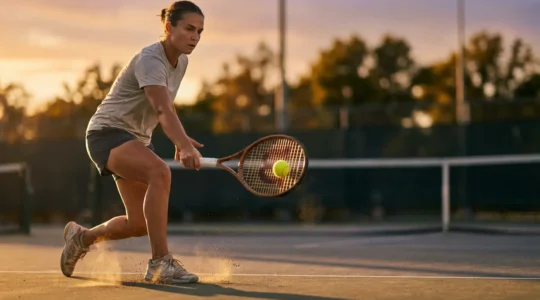
Beyond Soft Hands: How to Engineer Touch Accuracy on Fast Courts
Mastering touch on fast courts isn’t a gift, but a science of force management. Grip pressure is a measurable and trainable skill, directly impacting shot consistency and your ability to absorb pace. Strategic positioning after a shot, based on tactical…
Read more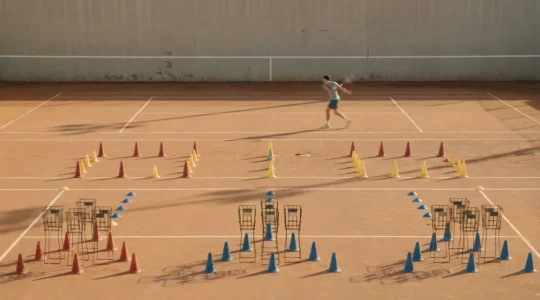
How to Design a Practice Zone That Enforces Correct Repetition?
The efficiency of a practice zone is not determined by its size, but by its logistical design to maximize repetition throughput. Systematically arranged boundaries and equipment workflows can drastically reduce non-value-added time (ball retrieval, setup changes). Player spacing and movement…
Read more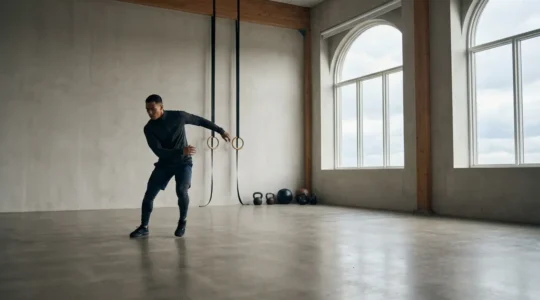
Architecting the Void: How to Build a Distraction-Free Zone for Maximum Practice Efficiency
Your training environment isn’t neutral; it’s either an accelerant or a brake on your skill acquisition. Eliminating sensory ‘noise’ (auditory and visual) drastically reduces extraneous cognitive load, freeing up mental resources for skill development. Manipulating environmental factors like light color…
Read more