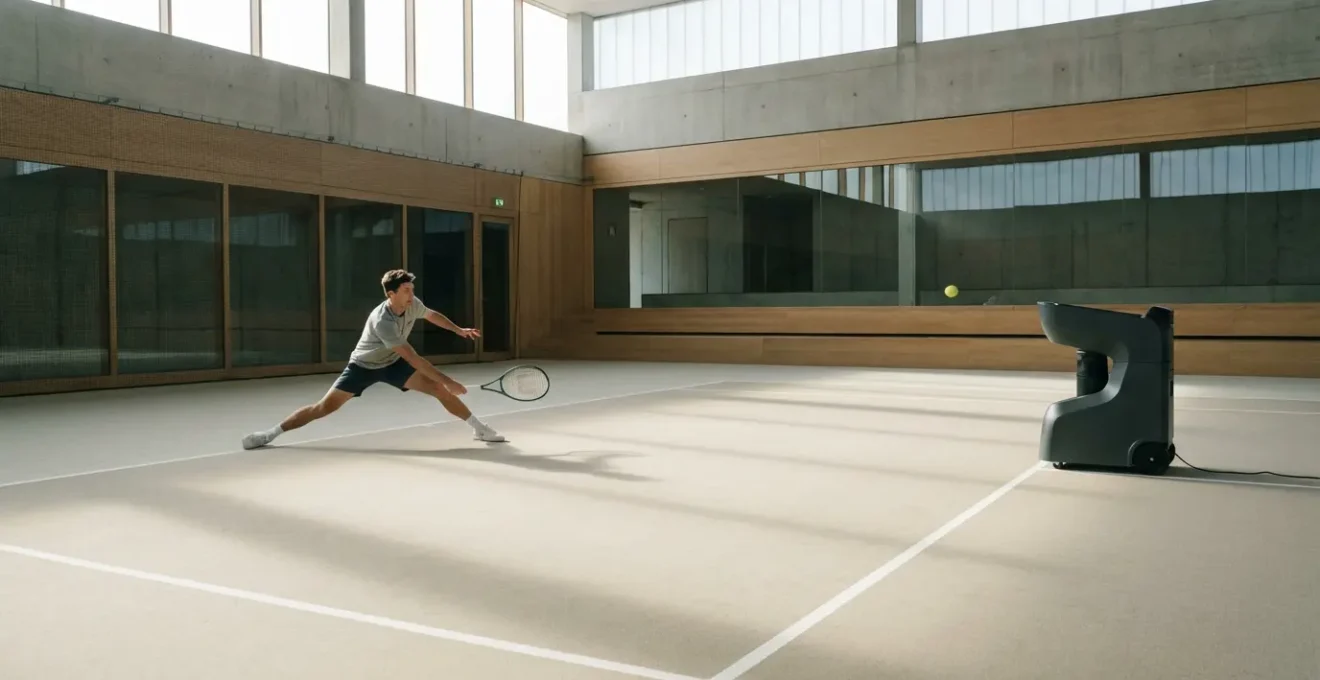
The critical difference isn’t features, but the training methodology: programmable machines enable ‘structured unpredictability’ that actively rewires your reaction cycle, while static machines primarily groove muscle memory.
- Programmable drills simulate the variable shot sequences of a real match, forcing the brain to improve ball recognition and decision-making speed.
- Static machines excel at building high-volume consistency on a single shot but can inadvertently create timing flaws by being too predictable.
Recommendation: For a club member or home-court owner investing in long-term skill development, a programmable machine is the superior tool for breaking training plateaus and enhancing match-day performance.
For any serious tennis player with a home court or club access, the ball machine represents the ultimate solo training partner. The decision to invest in one, however, often stalls at a crucial crossroads: is a basic, static machine sufficient, or is a feature-rich programmable model worth the significant extra cost? The common wisdom suggests static machines are for grooving strokes and programmable ones are for advanced players. This view, however, misses the fundamental point about how skill, and specifically reaction time, is developed.
The debate shouldn’t be about a simple list of features versus a lower price point. It’s about understanding two profoundly different approaches to training. One is about repetition and muscle memory; the other is about adaptation and neurological development. While a static machine throws a consistent ball to a consistent spot, a programmable machine can introduce controlled chaos—a concept we’ll call structured unpredictability. This isn’t just about random feeds; it’s about a systematic way to deconstruct and rebuild your entire reaction cycle, from perception to execution.
This guide moves beyond the surface-level comparison. We will analyze the specific capabilities of modern machines and connect them directly to the mechanisms of skill acquisition. We’ll explore why topspin is non-negotiable, how to program drills that genuinely simulate match play, and how to avoid the common timing errors that predictable machines can instill. The goal is to equip you, the investor, with the technical knowledge to choose the machine that will deliver the best return on your primary goal: becoming a faster, smarter, and more adaptable player.
This article provides a detailed breakdown of the key technical and practical considerations for choosing a ball machine. Explore the sections below to understand how each feature translates into tangible on-court improvement.
Summary: Programmable vs. Static Ball Machines for Enhanced Performance
- Why top-spin capability is non-negotiable for modern training machines?
- How to program a “random oscillation” drill to simulate match play?
- AC Power vs. Lithium Battery: Which machine suits remote courts?
- The timing error 90% of ball machine users develop (and how to fix it)
- When to replace throwing wheels to maintain speed accuracy?
- Robot-Assisted Lane vs. Wall Practice: Which builds consistency faster?
- How to configure a target grid for statistical feedback?
- How to Refine Touch Accuracy on Fast Surfaces Without Losing Control?
Why top-spin capability is non-negotiable for modern training machines?
In the modern game, a flat ball is a rarity. The vast majority of shots, from baseline rallies to passing shots, are hit with significant topspin. A training tool that cannot replicate this fundamental characteristic of tennis is preparing a player for a game that no longer exists. A static machine feeding flat, predictable balls only reinforces a response to an unrealistic stimulus. It fails to train the player’s ability to judge a ball that kicks up high and fast off the bounce, a crucial component of ball recognition.
Programmable machines with advanced topspin capabilities are essential for realistic training. They allow a player to practice against the higher, heavier ball that is now standard in competitive play. This forces adjustments in footwork, swing path, and contact point that are impossible to develop against a flat feed. Furthermore, the ability to vary the amount of spin, from a light roll to a heavy, kicking ball, adds another layer of structured unpredictability. Some modern AI-powered machines demonstrate a 3000 RPM spin capability, a level of performance that closely mimics professional-level shots.
Ultimately, a machine without robust topspin functionality is not just a lesser version; it’s a fundamentally flawed training partner. It teaches reactions to a ball that will seldom be seen in a real match, creating a gap between practice performance and competitive results. For any player serious about improvement, the ability to train against realistic spin is not a luxury feature—it is the absolute baseline requirement.
Case Study: Tennibot’s AI-Driven Adaptive Training
Advanced machines are moving beyond pre-programmed settings. Systems like Tennibot utilize AI-powered tracking to analyze a player’s return shots in real time. The machine can recognize if a player is consistently hitting winners or struggling to keep up. Based on this analysis, it automatically adjusts the speed, spin, and placement of the next feed to maintain an optimal level of challenge. This customizes the workout on the fly, ensuring the player is always operating at the edge of their ability, which is the most effective zone for skill acquisition.
How to program a “random oscillation” drill to simulate match play?
The term “random oscillation” is often used as a key selling point for programmable machines, but true match simulation requires more than just scattering balls across the court. A real opponent doesn’t hit randomly; they construct points with purpose. The power of a programmable machine lies in its ability to create drills that mimic this structured unpredictability, training not just your feet but also your tactical brain.
A simple random horizontal oscillation can be a good starting point for improving movement and recovery, but it doesn’t train shot recognition or decision-making. To truly simulate match play, you must combine different types of oscillation. For instance, combining horizontal (side-to-side) with vertical (short-and-deep) oscillation forces you to react to changing ball depth, a critical skill for transitioning between defense and offense. This setup prevents you from simply running along the baseline and instead requires you to read the ball and move forwards or backwards, just as you would in a point.
The goal is to move beyond simple repetition and create a dynamic environment that demands constant adaptation. This is where you train your reaction cycle—perceiving the incoming ball, deciding on the appropriate response, and executing the shot under pressure. The illustration below visualizes the difference between a simple side-to-side drill and a more complex, multi-dimensional random pattern that better reflects the reality of a competitive match.
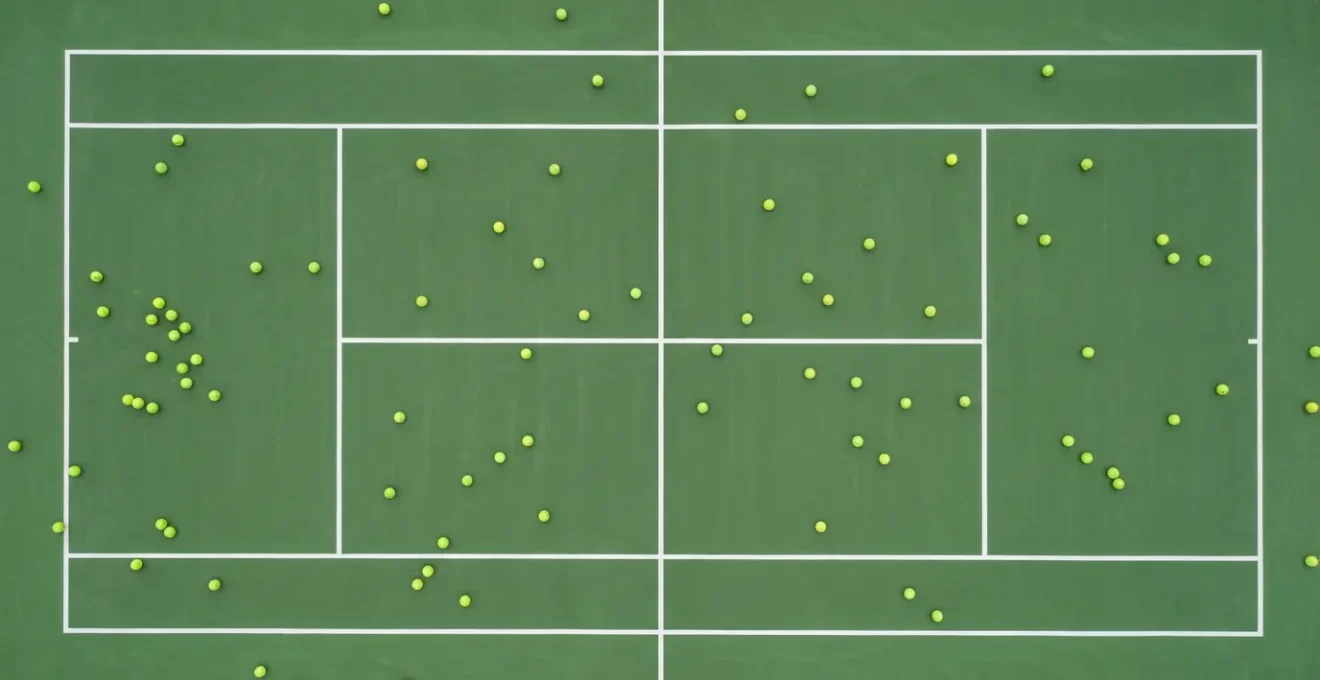
As the pattern shows, a truly effective drill forces the player to cover all corners of the court in an unpredictable sequence. This not only builds physical endurance but also sharpens the mental game, training the player to anticipate, react, and recover in a continuous, match-like flow. This level of dynamic training is simply unattainable with a static machine.
Action Plan: 5-Step Random Oscillation Programming Method
- Establish Baseline Rhythm: Set alternating forehands and backhands with minimal movement required. This warms up grip changes and basic footwork.
- Introduce Width Challenge: Progress to a medium-width oscillation that challenges your endurance and the integrity of your technique while on the move.
- Add Depth Variation: Program balls to be fired randomly short or deep. This specifically trains your ability to be aggressive on shorter balls and defend deeper ones.
- Combine Dimensions: On machines that support it, combine a 2-line drill setting with random vertical oscillation (e.g., ‘RANDOM VERT ON’ mode) to create unpredictable depth on both wings.
- Simulate Full Court Pressure: As the ultimate test, enable a shot sequence that randomizes feeds across the full width of the singles court, combined with random depth variations, to mimic the physical and mental demands of a tough rally.
AC Power vs. Lithium Battery: Which machine suits remote courts?
The choice between an AC-powered and a battery-powered ball machine is a critical logistical consideration that directly impacts where and when you can train. An AC-powered machine offers the significant advantage of unlimited runtime, making it an excellent choice for clubs or home courts with readily available power outlets. You never have to cut a session short due to a dead battery. However, this reliance on an outlet severely limits its portability, tethering you to specific, powered courts.
Lithium battery technology has revolutionized the portability of ball machines. Modern battery-powered models offer complete freedom, allowing you to train on any court, anywhere—from a remote club court without power to a public park. The trade-off is finite runtime. While a machine with an external, heavy lead-acid battery might offer a few hours, newer models with integrated lithium batteries are lighter and more efficient. Some high-end models offer impressive longevity; for instance, recent testing of the Pongbot system confirms an 8-hour battery life can be genuinely achieved, far exceeding the needs of a typical training session.
For the prospective buyer, the decision hinges on their primary training location. If you have guaranteed access to a powered court, an AC model provides hassle-free, endless operation. However, if your training locations vary or include unpowered courts, a lithium battery model is the only practical choice. The following table breaks down the key performance differences based on an analysis of current market offerings.
| Feature | AC Power | Lithium Battery |
|---|---|---|
| Runtime | Unlimited with power access | 5-7 hours (5 hours intensive use at high speeds) |
| Weight Impact | +External battery pack | 20 lbs total with integrated battery |
| Performance Consistency | 100% constant | Drops after 50% charge |
| Court Flexibility | Limited to courts with outlets | Any court location |
While the table indicates a potential drop in performance as a lithium battery depletes, this is more characteristic of older lead-acid batteries. High-quality lithium-ion systems are engineered to provide more consistent power output throughout their discharge cycle. This makes them a reliable choice for the player who values flexibility above all else.
The timing error 90% of ball machine users develop (and how to fix it)
One of the most persistent criticisms of ball machines is that they can ruin a player’s timing. This concern is valid, but it’s not an indictment of the technology itself—rather, it’s a result of using a predictable, static machine improperly. A static machine delivers the ball with the same trajectory, speed, and spin every single time. This allows the player to develop a “lazy” reaction, where they time their swing based on the machine’s rhythm rather than on reading the ball. This creates a significant timing flaw that becomes glaringly obvious when facing a human opponent whose shots have natural variation.
The core of the issue lies in the visual processing component of the reaction cycle. As the Playmate Tennis Technical Guide notes, true skill comes from early judgment:
Ball machines can really enhance your ball recognition skills. Ball recognition is your ability to judge the ball in flight early enough to play the ball in the appropriate strike-zone for your out-going shot.
– Playmate Tennis Technical Guide, Playmate Ball Machine Tips Manual
A programmable machine, with its ability to introduce structured unpredictability, directly combats this problem. By varying the speed, spin, and depth of each shot, it forces the player to abandon their reliance on rhythm and instead engage in active ball recognition for every feed. This trains the brain to make micro-adjustments on the fly, a skill that is central to high-level play.
The Neuroscience of a Timing Error
The timing error is rooted in how our eyes work. To see a moving object clearly, our eyes perform rapid movements called saccades. For optimal reaction, your eyes must arrive and focus on the contact zone *before* the ball gets there. With a predictable machine, players often get lazy, and their saccadic jump only happens *as* the ball is being struck. By the time their retina’s image stabilizes, the crucial information is already gone. A programmable machine that fires unpredictable shots forces the player to develop the correct visual habit: getting their eyes to the anticipated contact area early, which is the key to better reaction time.
When to replace throwing wheels to maintain speed accuracy?
A programmable ball machine is a precision instrument. Its ability to deliver consistent and accurate feeds is entirely dependent on the condition of its throwing wheels. Over time, the constant friction from tennis balls wears down the wheels’ surfaces. This wear isn’t always obvious, but it directly impacts the machine’s performance, leading to a gradual but significant loss of ball speed and inconsistent spin application. For an owner who has invested in a high-performance machine, neglecting wheel maintenance is like driving a sports car on bald tires—you’re simply not getting the performance you paid for.
The first sign of wear is often a change in the wheel’s surface texture. New wheels have a slightly rough, grippy surface. Worn wheels become smooth and shiny, a condition known as glazing. A glazed surface can no longer grip the ball effectively, causing slippage that reduces the energy transferred to the ball, resulting in lower speeds. This also makes spin application erratic, undermining the precision of programmed drills. If you’ve set a drill for heavy topspin but the machine is delivering a mix of flat balls and light spin, worn wheels are the most likely culprit.
To ensure your machine performs to spec, a regular maintenance and testing protocol is crucial. You don’t need to wait for a total failure; proactive monitoring will maintain the quality of your training. Here are the key steps to follow:
- Clean the exterior and ball feeding mechanism regularly to prevent debris from interfering with operation.
- Test the maximum speed output of the machine every 40-50 hours of use with a radar gun or a trusted app.
- Document any speed drop that exceeds 10% from the baseline speed when the machine was new.
- Visually inspect the wheels for any signs of glazing or shiny surfaces on the contact points.
- Monitor for any inconsistent spin application on shots that are programmed to be identical.
Following this protocol ensures that your investment continues to provide the accurate, reliable performance necessary for effective, deliberate practice. Replacing the wheels when performance drops is a necessary part of long-term ownership.
Robot-Assisted Lane vs. Wall Practice: Which builds consistency faster?
For decades, the practice wall has been the go-to tool for solo players looking to build consistency. It’s free, accessible, and forces a quick reaction time. However, it has a fundamental limitation: you can’t control the incoming ball. The ball comes back with a speed and spin dictated entirely by your last shot. A ball machine, or “robot-assisted” training, fundamentally changes this dynamic by putting the player in complete control of the training variables, leading to a much faster development of consistency.
The primary advantage of a ball machine is the sheer volume of controlled repetition it enables. A player can hit hundreds of the exact same shot in a short period, grooving the correct muscle memory far more efficiently than with a wall, where every return is slightly different. Data from training centers highlights this massive difference in volume; for example, Court 16’s ball machine training data shows players hitting over 300 balls in just 30 minutes. This high-volume approach allows a player to isolate and fix a specific technical flaw—like a late contact point or an abbreviated follow-through—with a level of focus that is impossible against a wall or even a human partner.
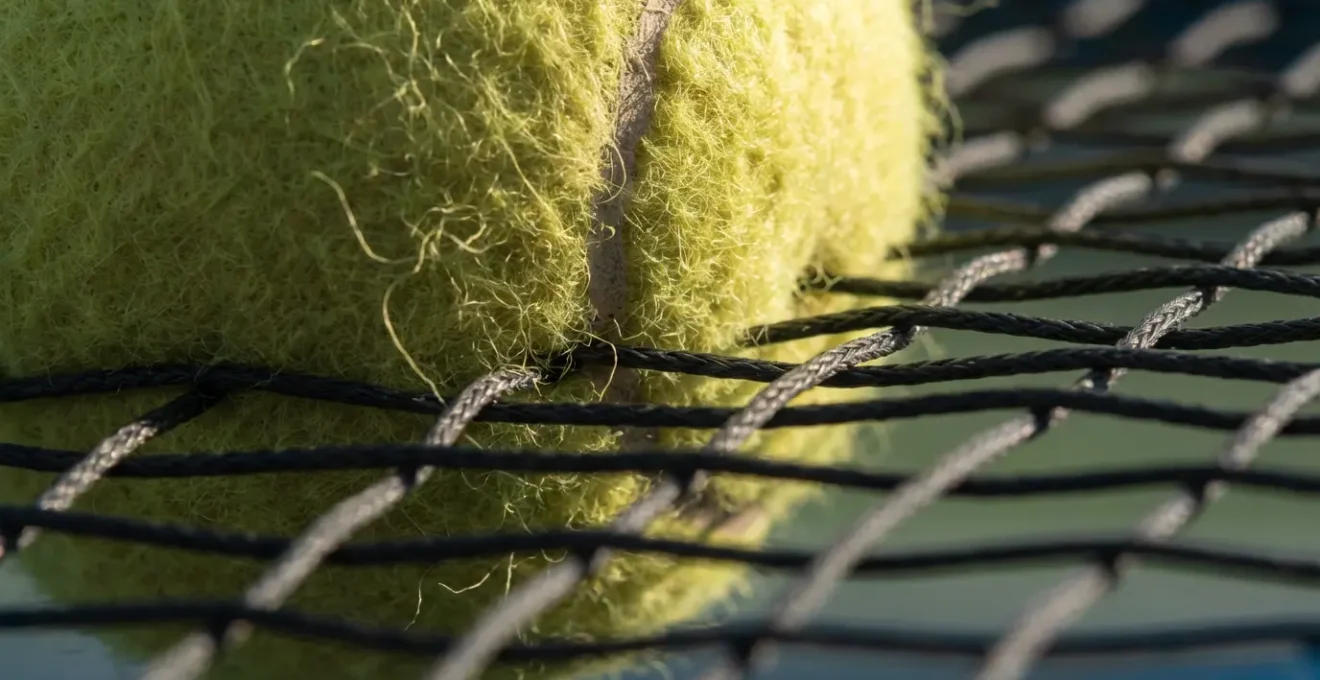
This image of a perfect contact point represents the goal of consistency training. A ball machine allows a player to repeatedly find this ideal impact point by feeding them the same ball over and over again until the correct swing becomes second nature.
While a wall is excellent for developing rhythm and improvisation, a ball machine is a superior tool for the deliberate practice required to build a technically sound, repeatable stroke. It allows you to work on your shots, not just your reactions. By providing a consistent and controllable feed, it accelerates the process of turning a conscious technical thought into an unconscious, reliable weapon.
How to configure a target grid for statistical feedback?
One of the hallmarks of deliberate practice is the use of measurable feedback. Simply hitting balls is not enough; to improve, you need to know if you are hitting your targets. A programmable ball machine, when combined with a physical target grid on the court, transforms a practice session from a simple workout into a data-driven analysis of your accuracy and consistency. This setup provides instant, objective feedback that is crucial for identifying weaknesses and tracking progress over time.
Configuring a target grid is straightforward. You can use cones, training lines, or even just painter’s tape to divide the opposing court into specific zones. A common setup involves creating a 3×3 grid: three zones along the baseline (ad court, middle, deuce court) and three corresponding zones inside the service boxes. For a drill focused on baseline consistency, you might aim to hit 20 balls into the deep ad-court corner. Your “score” is simply the number of balls that land in that zone. This simple act of measurement transforms the drill, adding a layer of pressure and focus.
This quantitative approach allows you to benchmark your performance. You can track your accuracy percentage on your cross-court forehand versus your down-the-line backhand. Are you more consistent when hitting to a wide target or a deep one? This is the kind of granular data that reveals the true state of your game. Advanced training centers are taking this concept even further with technology.
Case Study: Court 16’s AI-Powered Statistical Analysis
Forward-thinking clubs like Court 16 in NYC have integrated multi-camera technology with their ball machine sessions. Three different camera angles capture a player’s entire session. This footage can then be analyzed, and with AI-powered tools that automatically remove the downtime between shots, players receive seamless video highlighting their strokes. This combines the physical repetition from the machine with the visual, statistical feedback of video analysis, representing the next frontier in automated training and providing players with unparalleled insight into their performance.
Key Takeaways
- The primary value of a programmable machine over a static one is its ability to facilitate “structured unpredictability,” which is essential for improving reaction time and match-day performance.
- Realistic training requires a machine that can replicate modern topspin; a featureless machine reinforces reactions to an outdated, flat-ball game.
- The most common timing flaw from ball machine use stems from over-reliance on a predictable rhythm; programmable drills that vary speed, spin, and depth are the solution.
How to Refine Touch Accuracy on Fast Surfaces Without Losing Control?
Mastering fast surfaces like hard courts or grass requires more than just power and consistency; it demands exceptional touch and control. The ball comes at you faster, stays lower, and gives you less time to prepare. In this environment, the ability to absorb pace, execute a delicate drop shot, or play a precise half-volley becomes a critical differentiator. A programmable ball machine is an outstanding tool for honing these fine motor skills, as it can relentlessly feed you the low, hard balls that are characteristic of fast-court play.
The key to developing touch is to practice “absorb and redirect” techniques. Instead of taking a full swing, the focus is on a minimal backswing, using the opponent’s pace, and guiding the ball with soft hands to a specific target. A programmable machine can be set to fire low, fast balls directly at the baseline, forcing you to practice half-volleys. By placing targets just over the net, you can drill your ability to turn a defensive position into a clever offensive play. As the Feel Tennis review team noted about one such machine, this training feels real:
The Sportbot performed flawlessly, sending balls at varying angles, speeds, and spins. This unpredictability felt like playing against a real opponent, sharpening both reaction time and anticipation skills.
– Feel Tennis Review Team, Sportbot Tennis Ball Machine Review
Progressing from absorbing pace to executing finesse shots is a logical next step. You can program the machine to feed you a fast ball, and your goal is to execute a drop shot that lands within a target in the service box. This drill is incredibly difficult but directly translates to match play, giving you a powerful weapon to disrupt a baseliner’s rhythm.
- Start with a simple ball drop reaction drill: have a partner drop a ball from shoulder height 5 meters away, and you must catch it before the second bounce to sharpen initial reaction.
- Set the machine to feed low, hard balls at the baseline to force the practice of half-volleys.
- Focus on the ‘absorb and redirect’ technique, using a compact swing and soft hands to control the ball’s pace and placement.
- Progress to executing drop shots off these fast feeds, aiming for specific targets close to the net.
- Incorporate dedicated drills that combine these elements to improve reaction time, agility, and on-the-fly decision-making skills.
Ultimately, the choice between a static and a programmable machine is an investment in a specific training philosophy. For a player focused on long-term, multi-faceted skill development, the next logical step is to assess which programmable features directly address their current on-court weaknesses and future goals.