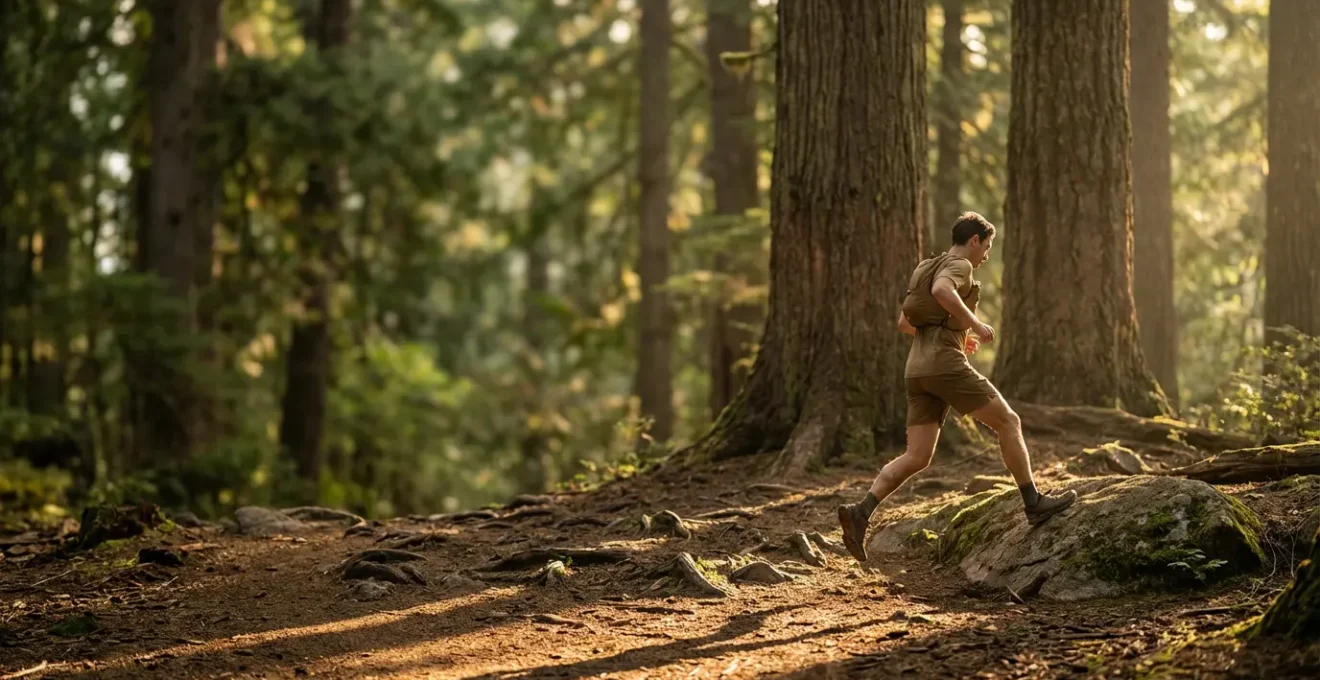
Trail running reduces knee pain not just by being softer, but by fundamentally re-engineering your body’s biomechanics for dynamic force dissipation.
- Variable terrain activates constant proprioceptive feedback, strengthening the stabilizing muscles around your ankles and knees.
- Adopting an effort-based pace (RPE) instead of a speed-based one is crucial to prevent burnout due to the higher metabolic demands of trails.
Recommendation: Begin by integrating short, low-intensity trail sessions focused on technique, not speed, to allow for safe neuromuscular adaptation.
For the urban runner, the rhythmic pounding on pavement is a familiar cadence. It’s predictable, measurable, and for many, a source of both fitness and stress. But it often comes with a persistent ache, a nagging complaint from the knees that the repetitive shock is taking its toll. The common advice is to find “softer surfaces,” a recommendation that is true but fundamentally incomplete. It treats the body like a simple machine that just needs a gentler platform.
This perspective overlooks the sophisticated, adaptive nature of human anatomy. What if the solution to impact-related pain wasn’t merely a passive change of surface, but an active engagement with a more complex environment? The true genius of trail running lies not in the softness of the dirt, but in its variability. The uneven ground, the roots, the rocks, and the inclines demand something more from you. They force your body to abandon its metronomic, repetitive road-running stride and adopt a more dynamic, responsive pattern of movement.
This article moves beyond the simplistic “dirt is softer than asphalt” argument. From the perspective of biomechanics, we will explore how natural terrain acts as a training ground for your entire neuromuscular system. We will dissect how it strengthens your foundational stability, why your road pace is a dangerous metric on the trail, and how this form of movement can fundamentally lower your physiological stress. This guide provides a scientific framework for the urban runner looking to transition to trails not just as an escape, but as a strategic tool for building a more resilient, injury-proof body and a clearer mind.
To understand this transition fully, we will explore the key biomechanical and practical aspects of trail running. The following sections break down everything from ankle stabilization and proper gear selection to safe navigation and the profound mental benefits of immersing yourself in nature.
Summary: The Science of Impact Reduction and Resilience on the Trail
- Why uneven ground strengthens your ankles naturally?
- How to map a safe trail route using topography apps?
- Road vs. Trail Shoes: Do you really need rock plates for light trails?
- The speed mistake: Why trying to hit road paces on trails leads to burnout?
- When to avoid trails: Recognizing dangerous mud and erosion conditions?
- How to schedule trail running sessions without disrupting track intervals?
- Why watching a virtual trail makes you forget leg pain?
- How “Forest Bathing” Lowers Cortisol in High-Stress Athletes?
Why uneven ground strengthens your ankles naturally?
The repetitive, uniform nature of pavement allows your body to operate on autopilot. Your foot strike is nearly identical with every step, which can lead to overuse injuries as the same structures are loaded repeatedly. Uneven trails disrupt this monotony. Every step is a new puzzle for your neuromuscular system to solve. This constant, low-level challenge is the key to building robust ankle stability through a process called proprioception—your body’s ability to sense its position in space.
On an unpredictable surface, the thousands of nerve endings in your feet and ankles send a continuous stream of data to your brain. In response, your brain makes micro-adjustments in muscle activation to maintain balance and stability. This isn’t a conscious effort; it’s a deeply ingrained reflex that becomes faster and more efficient with practice. This “neuromuscular tuning” strengthens the small stabilizing muscles, tendons, and ligaments around the ankle joint in a way that linear, predictable exercise cannot. The result is a stronger, more reactive joint that is better prepared to handle an unexpected twist or misstep. In fact, targeted research on proprioceptive training shows a potential 50% reduction in tibial acceleration, indicating a significant improvement in shock absorption that protects the entire kinetic chain, including the knees.
Your Action Plan: Auditing Your Ankle Stability for the Trails
- Single-leg balance test: Stand on one leg on a firm surface. Can you hold for 30 seconds without wavering? Now try with your eyes closed. This identifies your baseline proprioceptive control.
- Movement pattern assessment: Film yourself doing a few single-leg hops. Does your ankle collapse inward or outward upon landing? This reveals weaknesses in your stabilizing muscles.
- Identify existing routines: Review your current strength training. Does it include multi-directional movements (like lateral lunges) or is it purely linear (like squats)?
- Surface variability check: Do you ever train on grass, sand, or other unstable surfaces? A lack of variety leaves your proprioceptive system undertrained.
- Actionable integration plan: Based on the audit, start by adding two of the following exercises twice a week: single-leg medicine ball tosses, balance pad training, hop and hold drills, or slow eccentric calf raises.
By forcing the ankle to become an active participant in your stride rather than a passive hinge, trail running builds a resilient foundation from the ground up, effectively creating natural bracing against injury.
How to map a safe trail route using topography apps?
Transitioning to trails introduces a new variable that road runners rarely consider: navigation. The freedom of the trail comes with the responsibility of knowing where you are and where you’re going. Relying solely on trail markers can be risky, as they can be sparse, damaged, or confusing. Mastering basic digital navigation with topography apps (like AllTrails, Gaia GPS, or Komoot) is a non-negotiable safety skill.
These apps do more than just show you a line on a map. Their power lies in the topographic layer, which uses contour lines to represent elevation. When these lines are close together, it indicates a steep incline or decline; when they are far apart, the terrain is relatively flat. Before you even set foot on the trail, you can analyze a route to understand its total elevation gain, identify brutally steep sections, and estimate your effort level more accurately. This allows you to choose routes that match your current fitness and avoid getting in over your head.
The most critical safety feature, however, is proactive planning. A study of trail runners highlighted that those who used GPS technology to pre-map bailout points and identify technical sections via satellite imagery had significantly fewer navigation-related incidents. As a rule, you should identify potential escape routes or shortcuts every 2-3 kilometers and make a mental note of key landmarks like water crossings or trail intersections. This turns your run from a hopeful exploration into a well-planned excursion with built-in contingencies.
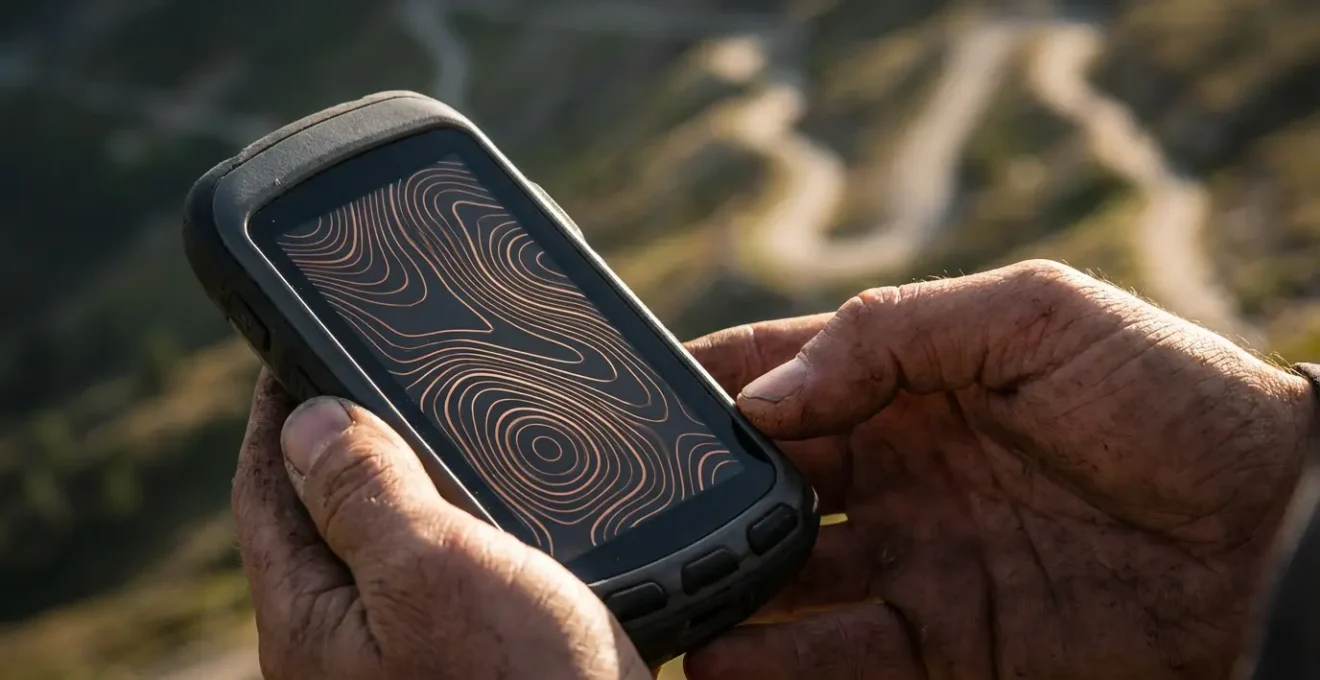
Using these tools transforms the map from a reactive guide into a predictive instrument. It allows you to anticipate the trail’s demands, manage your energy reserves, and run with the confidence that comes from being prepared for the unexpected.
Road vs. Trail Shoes: Do you really need rock plates for light trails?
A common question for runners transitioning to trails is whether their trusty road shoes will suffice. The answer depends entirely on the terrain. For well-groomed park trails or packed-dirt fire roads, a standard road shoe is often perfectly adequate. However, as the terrain becomes more technical—strewn with rocks, roots, and uneven surfaces—the specific design of a trail shoe becomes a matter of both performance and safety.
Trail shoes differ from road shoes in three primary ways: the outsole, the upper, and the midsole protection. The outsole features deeper, more aggressive lugs for superior traction on loose dirt, mud, and rock. The upper is built with more durable, abrasion-resistant materials to protect your foot from debris. Finally, many trail shoes incorporate a rock plate—a thin, flexible sheet of plastic or carbon fiber embedded in the midsole directly under the forefoot. Its sole purpose is to prevent sharp rocks or roots from bruising or puncturing the bottom of your foot.
Do you need one? For light, non-technical trails, a rock plate is generally unnecessary and can add unwanted weight and stiffness. However, on rocky terrain, it provides invaluable protection. The decision is a trade-off between protection and “ground feel”—the ability to feel the texture of the trail beneath you, which is critical for proprioceptive feedback.
This paragraph introduces the table below, which summarizes the key differences. It provides a clear framework for deciding which shoe is appropriate for your run, based on data and analysis found in a recent comparative analysis.
| Terrain Type | Road Shoe Suitability | Rock Plate Needed | Key Consideration |
|---|---|---|---|
| Fire roads/packed dirt | Excellent | No | Lighter weight beneficial |
| Park trails/groomed paths | Good | No | Road shoe grip sufficient |
| Rocky technical trails | Poor | Yes | Protection priority |
| Mixed terrain | Fair | Optional | Consider ground feel preference |
Interestingly, some biomechanics experts argue against overly protective shoes for certain types of training. As noted by Dr. Alena Graboski from the University of Colorado Biomechanics Research:
A shoe with more ground feel forces a higher degree of mindfulness and presence on the trail, preventing the mental ‘zoning out’ common in heavily cushioned road shoes.
– Dr. Alena Graboski, University of Colorado Biomechanics Research
Ultimately, choosing the right shoe is about matching the tool to the task. For a city runner exploring gentle park trails, a road shoe is fine. But as your adventures become wilder, a dedicated trail shoe with the appropriate features becomes an essential piece of equipment.
The speed mistake: Why trying to hit road paces on trails leads to burnout?
One of the biggest mental hurdles for a road runner transitioning to trails is letting go of pace. On the road, pace is a reliable metric of effort. On the trail, it is almost meaningless. Trying to maintain your 10k road pace on a technical, hilly trail is not only impossible but also a recipe for injury and burnout. The reason lies in a concept called metabolic cost.
Running on a trail demands significantly more energy. Your body is constantly working to overcome changes in elevation, navigate obstacles, and stabilize on uneven surfaces. This additional work comes at a high physiological price. In fact, biomechanical research demonstrates a 30-40% higher metabolic cost on technical trails compared to running on roads at the same speed. Chasing a specific pace ignores this reality, pushing your body into an unsustainable anaerobic zone and leading to rapid fatigue.
The solution is to shift your primary metric from pace to effort. This means learning to run by feel, using your Rate of Perceived Exertion (RPE) or a heart rate monitor to maintain a consistent effort level regardless of how fast you’re moving. A slow, grinding uphill climb might feel like a 9/10 effort, while a fast, flowing downhill might feel like a 6/10. By keeping your effort steady, you naturally turn the varied terrain into a form of interval training: the uphills become high-intensity strength work, and the downhills and flats become recovery or tempo sections.
A study on trail runners who switched from pace-based to effort-based training confirmed this approach’s effectiveness. Participants showed significant improvements in race completion times and reported far less mental fatigue. They learned to work with the trail, not against it. For the urban runner, this shift in mindset is liberating. It frees you from the tyranny of the watch and encourages you to tune into your body’s signals, fostering a more sustainable and enjoyable relationship with running.
When to avoid trails: Recognizing dangerous mud and erosion conditions?
While trails offer immense benefits, they are not always the best or safest option. As a responsible runner, it’s crucial to recognize when to stay off the trails to protect both yourself and the natural environment. The primary culprits are typically weather-related: excessive rain can create dangerously slick mud and contribute to long-term trail damage through erosion.
Running on saturated, muddy trails can be treacherous. Wet roots and rocks become incredibly slippery, dramatically increasing the risk of a fall and subsequent injury. Furthermore, mud can conceal underlying hazards like sharp rocks or deep holes. Beyond the personal risk, running on wet trails causes significant environmental damage. Your feet churn up the soft, wet soil, deepening ruts and widening the trail. This process, known as trail braiding, occurs when users go around a muddy patch, creating multiple parallel paths and destroying the surrounding vegetation. Over time, this accelerates erosion, washing away precious topsoil and permanently scarring the landscape.
So, how do you know when a trail is too wet? Here are a few key indicators:
- Lingering Puddles: If the trail has standing water 24-48 hours after a rainstorm, the ground is likely saturated.
- Sticky Mud: If mud is clinging to your shoes in thick clumps, the trail is too soft to be run on.
- Visible Ruts: If you can see deep footprints or tire tracks from other users, it’s a clear sign that the trail is vulnerable to damage.
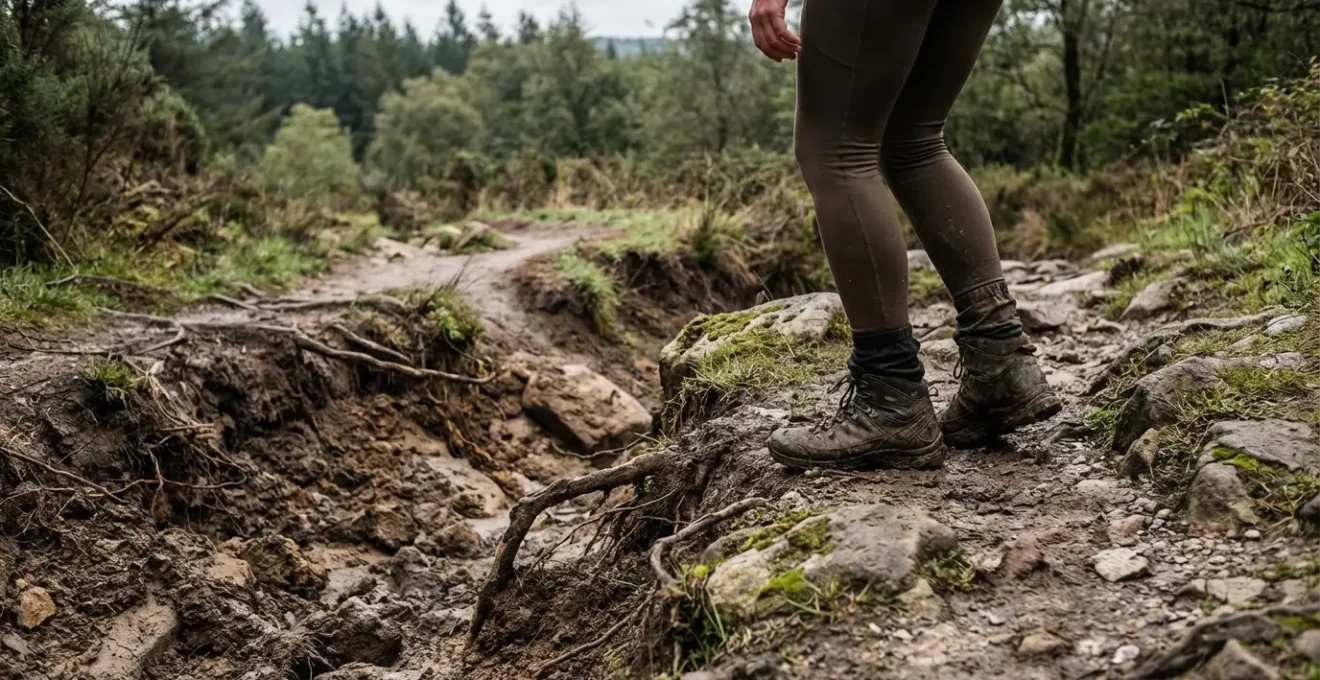
A good rule of thumb is to follow the “Leave No Trace” principle: aim to leave the trail in the same or better condition than you found it. If your presence is causing visible damage, it’s time to turn back. Having a few go-to pavement or gravel path routes for rainy days is an essential part of a sustainable trail running practice. It shows respect for the environment that gives so much back to us.
How to schedule trail running sessions without disrupting track intervals?
For a competitive runner, the idea of adding a new type of training can be daunting. How do you incorporate trail running without sacrificing the specific, high-intensity work done on the track? The key is to stop thinking of trail running as a replacement for a road or track session and start viewing it as a unique form of neuromuscular training and active recovery.
Track intervals are designed to push your cardiovascular system and improve top-end speed. They are highly structured and stressful. A technical trail run, when performed at a low intensity, serves a completely different purpose. It challenges your stability, balance, and coordination without heavily taxing your aerobic system. This makes it a perfect complement to high-intensity work, not a competitor.
The optimal way to schedule this is to place your technical trail run 24 to 48 hours after a hard track session. For example, if you do track intervals on Tuesday, a slow, easy trail run on Thursday is ideal. This timing allows your primary running muscles and cardiovascular system to recover from the intense effort, while the trail run provides a low-load stimulus to your stabilizer muscles and proprioceptive system. A study of elite runners found this “hybrid schedule” approach led to fewer overuse injuries while maintaining top performance, demonstrating its effectiveness.
For these sessions, it is critical to leave your ego and your watch’s pace alerts at home. The goal is not distance or speed, but quality of movement. Focus on maintaining a low heart rate (typically Zone 2, or a conversational effort) and navigating the terrain with light, quick feet. Keep the duration modest, around 45-60 minutes. By treating the trail as a “skill day” rather than a “cardio day,” you can build a more resilient, well-rounded athletic foundation without compromising your speed-focused training goals.
Why watching a virtual trail makes you forget leg pain?
The link between our mental state and our perception of physical exertion is incredibly strong. Anyone who has been distracted during a tough workout only to realize they’ve pushed through a difficult patch knows this firsthand. This phenomenon is particularly potent when the distraction involves natural environments, even virtual ones. The reason lies in two different types of attention: directed attention and soft fascination.
Directed attention is the kind of focus you need for tasks like working on a spreadsheet, driving in heavy traffic, or watching a fast-paced action movie. It requires significant mental effort to inhibit distractions and can lead to mental fatigue. When you’re in pain or physically exhausted, focusing this type of attention becomes even harder, and the sensation of effort can feel overwhelming.
Natural environments, however, engage a different cognitive process. According to Attention Restoration Theory (ART), nature elicits “soft fascination.” This is an effortless form of attention. A view of a forest, a flowing river, or a mountain vista holds our interest without requiring us to concentrate. Our minds can wander, reflect, and recover. This is why a walk in the park feels restorative, while a walk through a crowded mall feels draining. As Dr. Guillaume Millet, a leading sports scientist, explains:
Natural environments engage our attention effortlessly through ‘soft fascination,’ unlike the ‘hard fascination’ required to watch TV, reducing both mental fatigue and perception of physical effort.
– Dr. Guillaume Millet, Université Jean Monnet Sports Science Department
This principle extends to virtual environments. Watching a video of a trail run on a treadmill can tap into this “soft fascination.” The dynamic but natural scenery can hold your attention without effort, effectively distracting your brain from processing the full intensity of pain and fatigue signals coming from your legs. It lowers your RPE (Rate of Perceived Exertion) not by changing the physical load, but by changing your brain’s interpretation of it.
Key Takeaways
- Trail running’s primary benefit is not just a softer surface, but the proprioceptive demand that builds neuromuscular stability.
- Ditch pace-based goals on trails; use Rate of Perceived Exertion (RPE) to manage the higher metabolic cost and prevent burnout.
- Trail running sessions should be scheduled as low-intensity “skill days” to complement, not disrupt, high-intensity road or track training.
How “Forest Bathing” Lowers Cortisol in High-Stress Athletes?
For many athletes, stress is a double-edged sword. While a certain amount is necessary for adaptation and growth (eustress), chronic physical and mental stress can elevate cortisol levels, impair recovery, and suppress the immune system. Trail running offers a powerful antidote, not just through exercise, but through the simple act of being in a natural, forested environment—a practice known as Shinrin-yoku or “forest bathing.”
Cortisol is a primary stress hormone regulated by the Hypothalamic-Pituitary-Adrenal (HPA) axis. In a high-stress state, this axis can become dysregulated, leading to chronically elevated cortisol. Immersion in a forest environment has been scientifically shown to help restore balance. The combination of phytoncides (aromatic compounds released by trees), the calming visual complexity of the forest, and the sounds of nature work together to down-regulate the sympathetic nervous system (our “fight or flight” response) and activate the parasympathetic nervous system (our “rest and digest” response).
This is not just a subjective feeling of calm; it has measurable physiological effects. A recent study found a remarkable 23% decrease in salivary cortisol levels after just 60 minutes of running or walking in a forest setting compared to an urban one. Furthermore, research on professional marathon runners who integrated weekly “forest bathing runs” at a slow, conversational pace demonstrated improved HPA axis regulation, significantly better sleep quality scores, and even an increase in the activity of Natural Killer (NK) cells, which are crucial components of the immune system. The athletes in the forest group also showed significantly lower injury rates over the study period.
For an urban runner, a weekly, low-intensity trail run in a wooded park is more than just a workout for the legs; it’s a therapeutic session for the entire endocrine and nervous systems. It’s an intentional practice of using nature to actively manage the physiological load of training and modern life, leading to better recovery, stronger immunity, and a more resilient state of being.
Frequently Asked Questions about Why Trail Running Reduces Impact Forces Compared to Pavement?
Should trail runs replace my recovery runs?
No, position them as dedicated neuromuscular training days separate from pure recovery, focusing on technical skills at low intensity.
What heart rate zone for post-interval trail runs?
Maintain Zone 2 (65-75% max HR) regardless of pace to ensure proper recovery while gaining proprioceptive benefits.
How long should technical trail sessions be?
Keep to 45-60 minutes initially, focusing on quality movement patterns rather than distance covered.