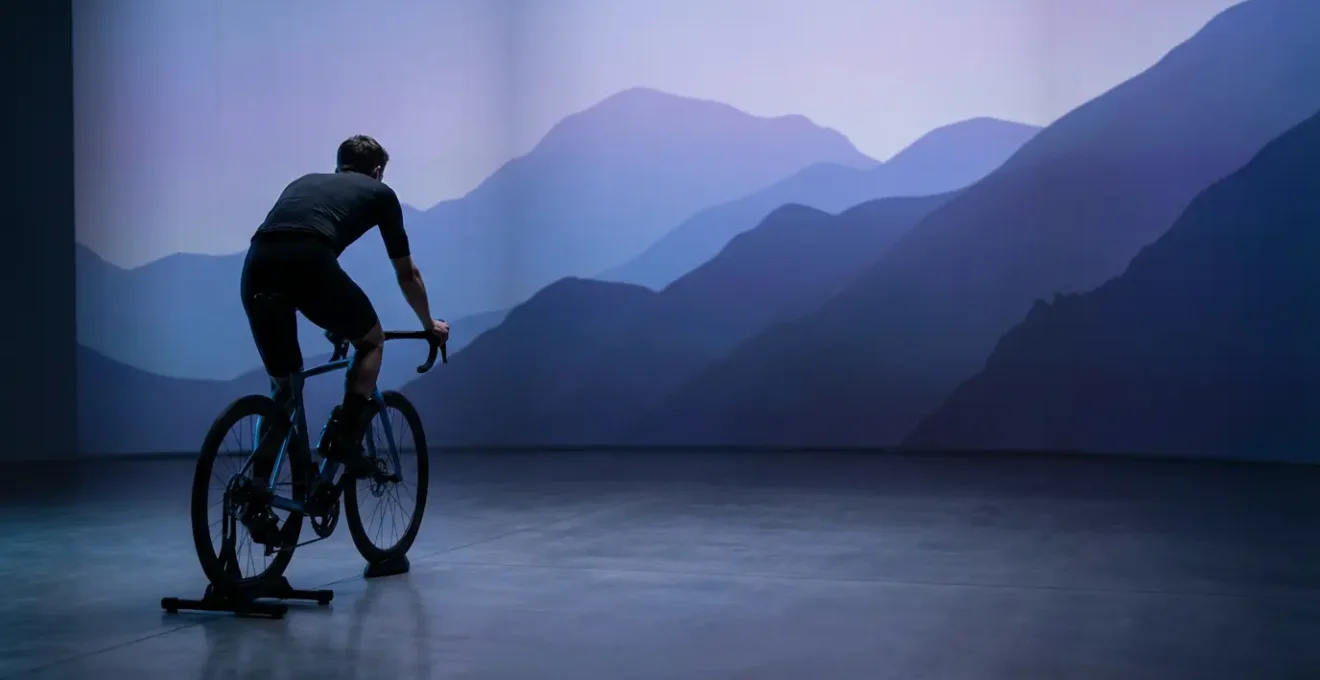
The power of immersive training is not simply distraction; it is the precise neuro-aesthetic tuning of an environment to actively lower the body’s perceived rate of exertion (RPE).
- Specific light frequencies and temperatures (e.g., cool, blue-dominant light) directly manipulate hormonal states like cortisol to heighten alertness.
- A neurological process called “attentional gating” can be triggered by compelling and congruent visual flow, effectively masking the brain’s perception of muscle pain.
Recommendation: Treat your facility’s visual display not as a passive screen, but as an active biofeedback tool to program physiological outcomes.
The monotonous grind of indoor training is a universal challenge for athletes and fitness enthusiasts. The unchanging walls of a spin studio or the digital display of a treadmill can amplify the perception of effort, turning a one-hour session into a mental battle against boredom and fatigue. The conventional solution has been to add a screen—playing a movie, a music video, or a pre-recorded race. While this offers a degree of distraction, it barely scratches the surface of what is neurologically possible. This approach treats the environment as a passive backdrop rather than what it truly is: an active variable in performance training.
But what if the key to unlocking greater endurance and power wasn’t just about distracting the mind, but about fundamentally reprogramming its perception of effort? The emerging field of neuro-aesthetics provides a compelling answer. It posits that the visual environment is not just something we look at; it is a system of inputs that directly interfaces with our physiology. By understanding the mechanisms behind this connection, we can move beyond generic “distraction” and begin to architect training experiences that actively modulate exertion, hormonal responses, and even pain perception.
This article deconstructs the science behind the immersive training effect. We will dissect the specific visual levers—from the color temperature of light to the complexity of a virtual landscape—that can be precisely tuned to enhance athletic output. We will explore how to create sensory congruence to achieve flow states and why a poorly designed visual experience can be more detrimental than no visuals at all. It is time to stop thinking about screens and start thinking about sensory programming.
This exploration will provide a clear framework for understanding how to design and implement immersive environments that are not just engaging, but are scientifically optimized to make hard work feel easier. Here is a breakdown of the key variables we will examine.
Summary : The Neuroscientific Principles of Immersive Training Environments
- How blue-light dominance in screens affects wakefulness during training?
- Nature Scenes vs. Urban Chaos: Which visual stimulus boosts sprint performance?
- Projectors vs. LED Walls: Which creates better immersion for spin studios?
- The headache risk of high-contrast visuals during max effort
- Music BPM and Visual Flow: How to sync them for flow state?
- What color temperature maximizes alertness during technical drills?
- Why watching a virtual trail makes you forget leg pain?
- How to Break the Monotony of Indoor Training During Winter?
How blue-light dominance in screens affects wakefulness during training?
The question of alertness during exercise is not merely a matter of motivation; it is deeply rooted in our chrono-biology. Our bodies are programmed to respond to environmental light cues, and the screens ubiquitous in modern gyms are powerful signaling devices. The high proportion of blue light emitted by LED displays mimics the spectral quality of midday sun, triggering a specific and measurable physiological response. This process, known as chrono-biological priming, involves the suppression of melatonin (the sleep hormone) and the elevation of cortisol, a key hormone associated with stress and wakefulness.
From a neuro-aesthetic perspective, this is not an incidental side effect but a tunable parameter. Exposing an athlete to a blue-dominant visual environment before and during a morning or midday session can serve as a primer for peak performance. Research provides a quantitative basis for this effect; one study confirmed that blue light exposure can result in a 30% increase in cortisol levels compared to dim light conditions. This hormonal shift translates directly to heightened alertness and readiness to perform, making blue-light-rich visuals a strategic tool for high-intensity intervals or sessions requiring intense focus.
However, this tool must be wielded with precision. The same mechanism that enhances daytime performance can disrupt circadian rhythms if applied during evening training sessions. A facility manager or user must consider the time of day, modulating the color balance of displays to align with the desired physiological state. Warmer tones with reduced blue light should be favored for later sessions to prevent interference with natural sleep cycles, treating the screen’s color profile as a dynamic element of the training regimen.
Nature Scenes vs. Urban Chaos: Which visual stimulus boosts sprint performance?
The choice between displaying a serene forest path or a chaotic city street during a cycling sprint is more than an aesthetic preference; it’s a decision about managing an athlete’s perceptual load. The human brain has a finite capacity for processing sensory information. Overwhelming it with complex, high-frequency visual data—like fast-moving traffic, dense architectural details, and flashing lights—can divert cognitive resources away from the primary task of physical exertion, potentially increasing perceived effort.
As the Italian research team behind a study published in the Journal of Functional Morphology and Kinesiology sought to explore, the goal is to leverage virtual environments as a tool for “green exercise.” They note:
This study aimed to evaluate the acute effects of a brief cycling session outdoors and indoors on psychological and physiological outcomes, and secondly, investigate the potential of VR/ER-mediated nature experiences as a tool to promote green exercise.
– Italian Research Team, Journal of Functional Morphology and Kinesiology
Visuals of nature often possess a lower “fractal complexity” than urban scenes. The organic, repeating-yet-varied patterns of trees, foliage, and landscapes are processed more efficiently by our visual cortex. This efficiency frees up cognitive resources, allowing the brain to focus more on motor output and less on deciphering a chaotic environment. For a high-intensity sprint, where maximal power output is the goal, a visually efficient and calming natural scene is theoretically superior as it minimizes extraneous cognitive drain.
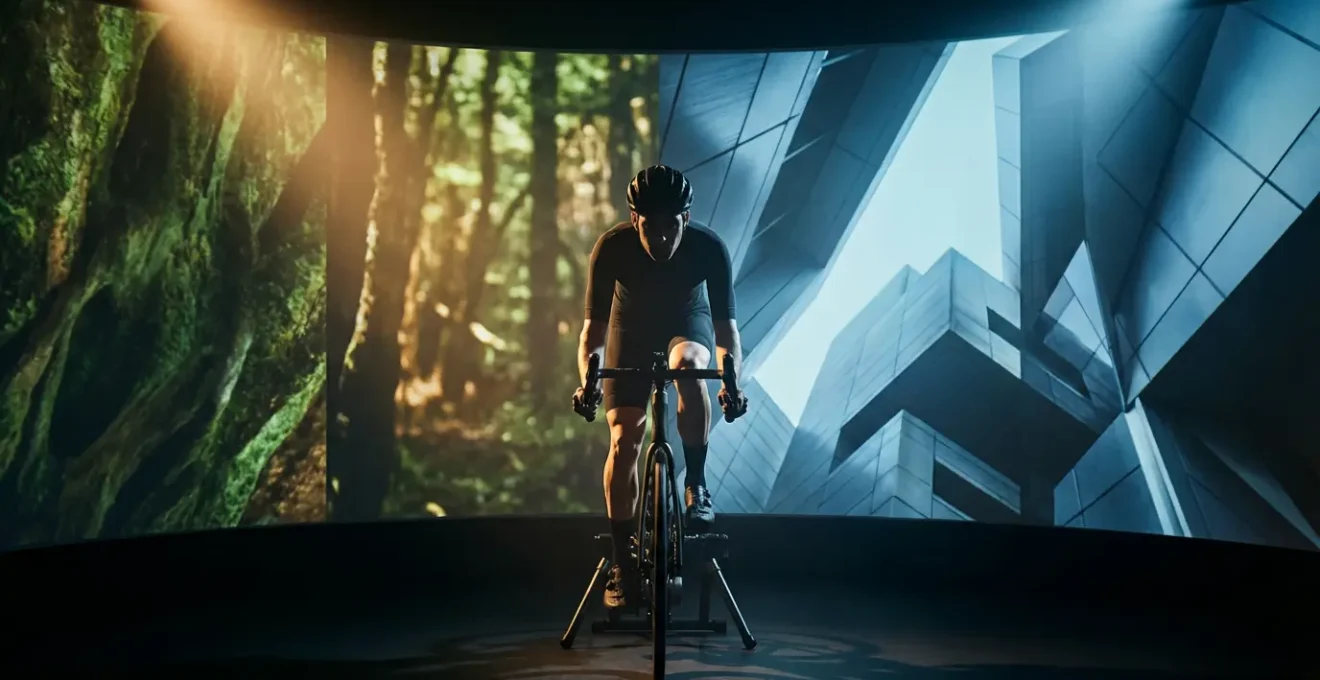
Conversely, an urban environment, while potentially exciting, introduces a high degree of visual noise that can increase the overall perceptual load. While this might be engaging for a low-intensity, steady-state session, it risks becoming a cognitive burden during a max-effort interval. The optimal visual stimulus is therefore not necessarily the most “exciting” one, but the one that is most cognitively efficient for the specific training goal.
Projectors vs. LED Walls: Which creates better immersion for spin studios?
For a facility manager, the choice between projection systems and direct-view LED walls is a significant capital investment with profound implications for the user experience. While LED walls often boast superior brightness and contrast, the neuro-aesthetic ideal of “immersion” is more nuanced than a simple spec sheet comparison. The goal is to create a believable and comfortable virtual space, and the method of light delivery plays a crucial role. A projector creates a reflective, diffused image, whereas an LED wall is an emissive source, with each pixel a tiny, direct light aimed at the user’s eyes.
This technical difference has practical consequences for perceived comfort and strain during a demanding 45-minute spin class. The direct pixel emission of LED walls, while sharp, can contribute to greater eye fatigue over time. The following technical comparison, based on data from specialists at Immersive Studio Solutions, highlights the key trade-offs.
| Feature | Projectors | LED Walls |
|---|---|---|
| Brightness | 2,000-5,000 lumens | 1,200-2,500 nits |
| Contrast Ratio | 2,000:1 | 5,000:1 |
| Black Level | Gray/washed | True black |
| Response Time | 16-32ms | <1ms |
| Eye Strain Risk | Lower (diffused light) | Higher (direct pixels) |
While an LED wall’s true black levels and near-instantaneous response time create unparalleled contrast and clarity, the lower eye strain risk associated with diffused projector light is a significant advantage in a fitness context. A high-quality projection setup in a light-controlled room can achieve a highly immersive effect without the harshness of direct pixel emission. Ultimately, the decision hinges on the primary goal: for pure, cinematic impact in short bursts, LED may prevail. For sustained, comfortable immersion during endurance exercise, a well-implemented projection system often represents the superior neuro-aesthetic choice.
The headache risk of high-contrast visuals during max effort
The promise of immersive training can quickly sour if the visual experience induces discomfort, headaches, or even a form of cybersickness. This adverse reaction is often a result of a breakdown in sensory congruence—a mismatch between the visual information the brain receives and the physical sensations it expects from the body’s proprioceptive and vestibular systems. When you are pedaling hard on a stationary bike but the visual flow stutters, lags, or presents jarring, high-contrast patterns, the brain struggles to reconcile the conflicting data streams. This conflict is not just disorienting; it can trigger a genuine physiological stress response.
Research demonstrates that this is more than a subjective feeling. Studies on incongruent virtual reality experiences show that such a mismatch can lead to a significantly elevated mean arterial blood pressure. This indicates that the body is entering a state of physiological stress, working against itself rather than being aided by the virtual environment. High-contrast, strobing, or rapidly oscillating visuals, especially during moments of maximum physical effort, can exacerbate this conflict and are a primary culprit for exercise-induced headaches in immersive settings.
The key to mitigating this risk lies in designing visuals that prioritize smoothness and consistency over jarring intensity. The brain craves predictable patterns and clear orientation cues to maintain its equilibrium. By adhering to specific design principles, facility managers and content creators can create thrilling visual experiences that enhance, rather than hinder, performance.
Action Plan: Preventing Visual-Induced Headaches During Training
- Visual Design: Use smooth color and light gradients instead of hard, flashing edges in visual displays.
- Effect Pacing: Limit the use of stroboscopic or flashing effects to very brief, peak moments of a workout, not sustained periods.
- Comfort Filters: Apply subtle software filters that create a slight peripheral blur, helping the user focus on the center of motion.
- Pattern Avoidance: Avoid high-frequency, repetitive patterns like dense stripes or tight checkerboards that can trigger visual stress.
- Spatial Orientation: Always provide a clear visual horizon line or a stable focal point to help the user maintain spatial orientation.
Music BPM and Visual Flow: How to sync them for flow state?
Achieving a “flow state,” that elusive psychological space where action and awareness merge, is a primary goal of performance training. In an immersive environment, this state is often born from the harmonious synchronization of auditory and visual stimuli. However, true synchronization goes far beyond simply playing a high-energy song with a fast-paced video. The key is to match the rhythm of the visuals with the beats per minute (BPM) of the music, a concept known as audiovisual entrainment.
This means that the rate of visual “flow”—the speed at which the virtual landscape passes by the user—should be algorithmically tied to the music’s tempo. When a song’s BPM increases for a chorus, the visual speed should accelerate in perfect concert. When the beat drops for a bridge, the visual motion should decelerate smoothly. This creates a powerful form of sensory congruence where the auditory drive of the music is perfectly reinforced by the visual motion, pulling the athlete into a state of deep focus.
This tight coupling of sound and sight helps the brain establish a predictable, coherent rhythm. The nervous system naturally entrains, or synchronizes, to this external rhythm, which can help regulate motor output, streamline cognitive processing, and reduce the perception of time and effort. The athlete stops consciously thinking about pedaling or running and becomes one with the unified sensory experience. This is the essence of neuro-aesthetic tuning for a flow state.
For facility managers, this implies investing in software platforms that allow for true BPM-to-visual-flow syncing, rather than just curated playlists alongside generic videos. It’s the difference between a passive viewing experience and an active, responsive environment designed to induce a specific and highly desirable psychological state of peak performance.
What color temperature maximizes alertness during technical drills?
When an athlete is performing complex, technical drills that demand high levels of concentration and precision, every environmental factor matters. One of the most potent yet overlooked variables is the color temperature of the ambient and screen lighting. Measured in Kelvin (K), color temperature describes the appearance of light, from warm (lower K, reddish-yellow) to cool (higher K, bluish-white). This is not just an aesthetic choice; it is a direct signal to the brain’s alertness systems.
Cooler color temperatures, particularly around 6500K, closely mimic the spectral composition of natural daylight on a clear day. Our brains are hardwired through millennia of evolution to associate this type of light with peak daytime wakefulness. Exposure to this light quality triggers a cascade of neurological and endocrine responses, most notably the suppression of melatonin and the modulation of cortisol. Scientific inquiry has validated this connection, with research showing that 6500K LED lighting significantly affects both melatonin and cortisol levels, directly influencing our position on the sleep-wake continuum.
For a training context, this provides a powerful tool. By setting the environmental lighting and the dominant color temperature of visual displays to a cool 6500K during a session focused on technical skill acquisition, a coach or facility manager can effectively prime the athlete’s brain for maximal alertness. This can translate to improved reaction times, better decision-making, and a greater capacity to absorb and execute complex motor patterns. It is a subtle but potent form of neuro-aesthetic tuning aimed at optimizing cognitive function when it matters most.
The application should be strategic: use cool light for high-focus, technical work, and transition to warmer temperatures (e.g., 2700K-3000K) for cool-down and recovery periods to signal to the body that it is time to wind down. This dynamic use of color temperature transforms lighting from a static utility into an active component of the training protocol.
Why watching a virtual trail makes you forget leg pain?
The remarkable ability of virtual reality environments to reduce perceived exertion and pain is not merely “distraction.” It is a sophisticated neurological process known as attentional gating. The brain has a limited bandwidth for conscious attention. When presented with a sufficiently rich, engaging, and congruent sensory input—such as a smoothly flowing virtual trail—it allocates a significant portion of its resources to processing that stimulus. Consequently, less bandwidth is available to process competing internal signals, such as the afferent nerve signals of muscle fatigue and pain from the legs.
The brain effectively “gates” or turns down the volume on the pain signals because it is preoccupied with the more dominant task of navigating the virtual world. This phenomenon is supported by compelling empirical evidence. For instance, a VR exercise bike study found participants had higher pedal revolution counts with a lower reported rate of perceived exertion (RPE) when immersed in a virtual environment compared to a standard, non-immersive condition. The work output objectively increased, while the subjective feeling of effort decreased.
A detailed case study involving 48 college students further solidifies this principle. Participants completed 20-minute cycling sessions on a VR bike, an exergame bike, and a traditional bike. The results were unequivocal: RPE was significantly lower on the VR bike, while power output and pedal revolutions were highest. The immersive virtual trail was not just more “fun”; it was actively modulating the brain’s interpretation of physical strain. The key is the quality of the immersion: the visual flow must be compelling and, critically, congruent with the athlete’s physical effort to fully engage the attentional gating mechanism and make them “forget” the pain.
Key Takeaways
- It’s not distraction, it’s attentional gating: Compelling visuals actively command the brain’s focus, neurologically diminishing the perception of pain signals.
- Light is a biological tool: Specific color temperatures (like 6500K) and blue light directly alter hormonal states like cortisol to manipulate alertness.
- Congruence is king: Mismatched sensory inputs (e.g., jarring visuals during smooth pedaling) increase physiological strain and can cause headaches, negating any benefits.
How to Break the Monotony of Indoor Training During Winter?
The principles of neuro-aesthetics offer a powerful antidote to the monotony of winter indoor training. Instead of enduring mind-numbing sessions, athletes and facility managers can design a training week built around strategic environmental variability. By purposefully altering the visual and auditory stimuli for different workouts, you can target specific physiological and psychological states, keeping the mind engaged and the body progressing. This transforms the indoor trainer from a tool of last resort into a versatile performance laboratory.
A well-structured plan might alternate between different types of virtual experiences throughout the week. One day could be a high-intensity race against other users in a competitive, graphically rich environment to spike motivation and adrenaline. Another session might be a long, slow recovery ride through a tranquil, aesthetically beautiful fantasy world, designed to lower cognitive load and promote mental restoration. Another could involve tackling a virtual replica of a famous mountain pass to build muscular endurance, with visuals and physics that realistically model the climb.
This approach leverages all the concepts we’ve discussed: using competitive visuals to increase arousal, employing serene landscapes to manage perceptual load, and syncing audio-visual cues to induce flow. The goal is to create a weekly schedule where no two sessions feel the same, breaking the psychological drag of repetition. Here is an example of what such a plan could look like:
- Monday: High-intensity competitive virtual race with public leaderboards to maximize motivation.
- Wednesday: Long, slow recovery exploration in a low-complexity, visually beautiful fantasy world.
- Friday: Threshold-effort workout climbing a famous mountain pass in a realistic VR simulation.
- Weekend: Use a GPX file to virtually recreate a favorite outdoor route for a mix of nostalgia and targeted training.
- Social Ride: Join a scheduled group ride with real-time voice chat to add a crucial social engagement layer.
To implement these neuro-aesthetic principles effectively, the next step is to conduct a thorough audit of your current training environment and develop a deliberate programming strategy. Begin by assessing your display technology, content library, and software capabilities to design workouts that are not just visually appealing, but physiologically purposeful.