True tennis agility isn’t built on the court alone; it’s forged by strategically borrowing athletic traits from other sports.
- Sports like soccer and basketball directly transfer crucial footwork patterns essential for dynamic court coverage.
- Activities like boxing and table tennis sharpen reaction time and energy system efficiency for high-intensity rallies.
Recommendation: Stop training in a silo. Integrate 1-2 complementary sessions per week focusing on specific athletic traits to break plateaus and prevent overuse injuries.
If you’re a dedicated tennis player, you know the feeling. You’ve hit thousands of balls, run countless drills, and yet your progress has stalled. Your movement feels a step slow, your reactions aren’t quite sharp enough, and you’re starting to feel the nagging aches of repetitive strain. The common advice is often to “just play other sports” to mix things up. While well-intentioned, this advice misses the fundamental point. The goal isn’t just to do something different; it’s to do something different with a purpose.
A truly holistic athletic development plan looks beyond the tennis court. It understands that the explosive first step of a soccer player, the core stability of a rower, and the lightning-fast reflexes of a boxer are not isolated skills. They are athletic attributes that can be systematically integrated to build a more resilient, powerful, and agile tennis player. The secret lies in understanding the specific movement transferability between disciplines and how to periodize your training to target different energy systems without causing burnout.
This guide moves beyond generic recommendations. We will dissect how specific sports can directly enhance your tennis performance, from footwork patterns and hand-eye coordination to injury prevention and managing intensity. This is your roadmap to breaking through plateaus by building a more complete athlete from the ground up.
This article provides a detailed breakdown of how to leverage cross-training for total athletic development. You will discover the specific skills each complementary sport offers and learn how to integrate them effectively into your schedule.
Summary: Unlocking Tennis Agility Through Cross-Training
- Why playing soccer improves footwork patterns for racquet sports?
- How to fit a boxing class into a competitive squash schedule?
- Basketball vs. Swimming: Which is the safer off-season option for runners?
- The overuse injury that strikes 60% of single-sport teenagers
- Hand-Eye Coordination: What table tennis teaches you about volleying?
- Rower vs. Ski-Erg: Which provides the best full-body low-impact burn?
- How to perform a “Deep Water Running” session that mimics track intervals?
- How to Manage Intensity Spikes Without Triggering Burnout Symptoms?
Why playing soccer improves footwork patterns for racquet sports?
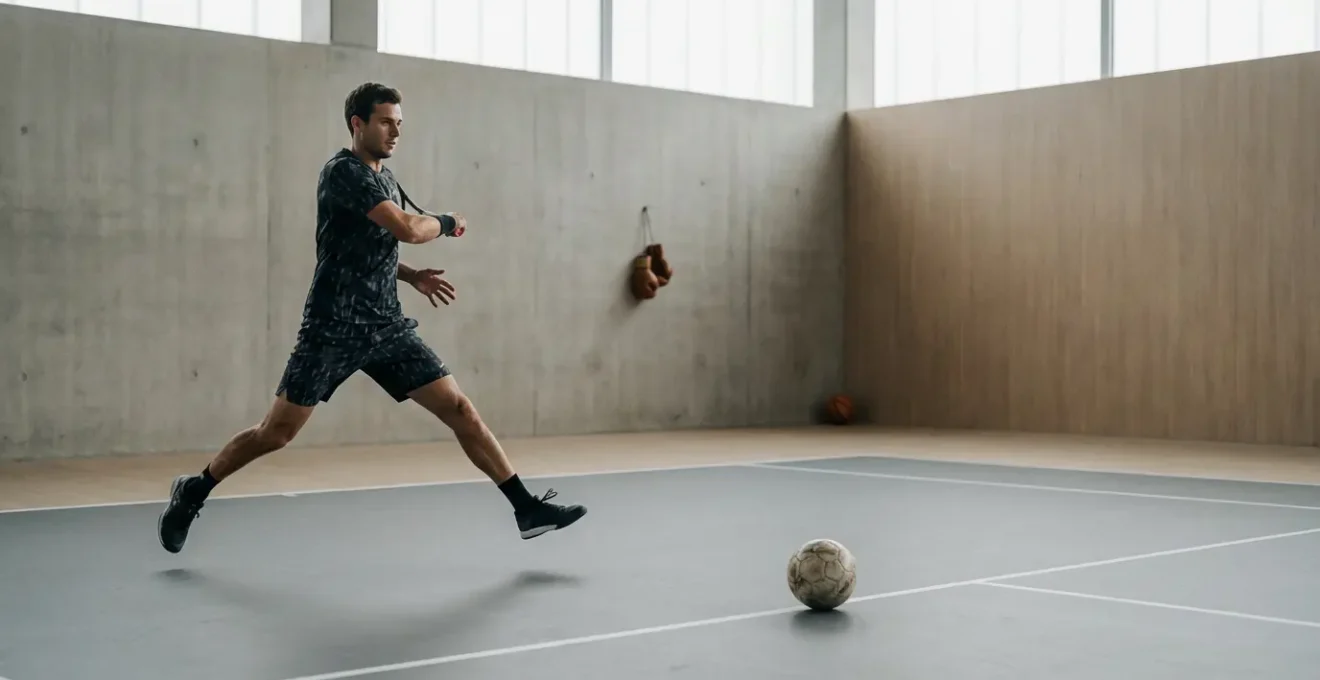
Tennis is often described as a game of a thousand small sprints and direction changes. The ability to accelerate, decelerate, and change direction efficiently is paramount. While tennis drills are essential, they can create rigid, pre-programmed movements. Soccer, on the other hand, forces reactive agility in an open, unpredictable environment. Every moment requires you to read a situation, anticipate an opponent’s move, and adjust your foot position in a fraction of a second.
This directly translates to the tennis court. The constant low center of gravity and the quick, shuffling steps used to jockey for position in soccer are nearly identical to the movements required to cover the baseline. More importantly, soccer develops the crucial “split-step” in a dynamic way. A goalkeeper prepares to make a save with a split-step, a motion that keeps them balanced and ready to explode in any direction. This is the exact same preparatory hop every tennis player uses before returning a serve or a groundstroke.
By engaging in soccer, you’re not just getting a cardio workout; you’re programming your nervous system with a richer library of movement solutions. You learn to solve footwork puzzles on the fly, developing a natural speed and quickness that feels less mechanical and more intuitive when you’re back on the tennis court.
Practical Integration: Soccer Ball Split-Step Drill
- Practice the split-step motion used in both sports. Think of a goalkeeper getting ready to dive for a save; this keeps you balanced and prepared to move laterally.
- Have a partner lightly roll a soccer ball towards your feet while you perform shadow swings with your racquet.
- React with soccer-style footwork (using the inside or outside of your foot) to control the ball with a light touch.
- Immediately reset into a tennis-ready position, focusing on getting your feet back under your center of gravity.
- The goal is to focus on developing the speed and quickness that transfers extremely well from soccer to tennis.
How to fit a boxing class into a competitive squash schedule?
For athletes in high-intensity racquet sports like squash or tennis, managing energy is everything. A match isn’t a marathon; it’s a series of explosive bursts separated by brief recovery periods. Integrating another high-intensity sport like boxing can be incredibly beneficial, but doing it randomly can lead to overtraining. The key is to understand and align the energy system demands of both activities.
As sports science experts Bompa & Buzzichelli explain in their foundational work, “Periodization Training for Sports,” intermittent sports rely on multiple energy systems. They note:
In sports characterized by intermittent activity like racket sports and boxing, all three energy systems are used according to the intensity, rhythm, and duration of the competition. Most of these sports use the anaerobic energy pathway during the active part of competition and rely on strong aerobic power for quick recovery and regeneration between actions.
– Bompa & Buzzichelli, Periodization Training for Sports, Third Edition
This means your training week should strategically target different systems. You can’t just pile high-intensity on top of high-intensity. A boxing session focused on heavy bag rounds (Anaerobic Glycolytic system) shouldn’t be scheduled the day before a competitive squash match, which places similar demands. Instead, it could replace a squash practice early in the week. A lighter boxing session focused on shadowboxing and footwork (Aerobic system) could serve as an excellent active recovery workout the day after a tough match.
This table illustrates how to think about periodizing your training based on the primary energy system used, ensuring boxing complements your squash training instead of competing with it.
| Energy System | Duration | Squash Application | Boxing Integration |
|---|---|---|---|
| ATP-PC (Phosphagen) | 0-10 seconds | Quick rallies, explosive movements | Explosive combinations, power punches |
| Anaerobic Glycolytic | 10s-2min | Extended rallies | Heavy bag rounds |
| Aerobic | 2min+ | Recovery between points | Active recovery, shadowboxing |
Basketball vs. Swimming: Which is the safer off-season option for runners?
For any athlete in a high-impact sport—whether a runner pounding the pavement or a tennis player stressing their joints on a hard court—the off-season presents a critical choice: how to maintain fitness while allowing the body to heal? The debate between a high-impact sport like basketball and a no-impact sport like swimming offers a powerful lesson in load management and athletic development.
Basketball offers fantastic crossover benefits for tennis. The constant shuffling sidestep movement used on defense in basketball translates directly to the lateral court coverage needed in every tennis point. It builds explosive power and reactive agility in a game-like setting. However, it comes at a cost. The impact forces from jumping and landing on a hardwood court can create even higher G-forces than running, placing significant stress on the knees, ankles, and back—the very joints that need a break.
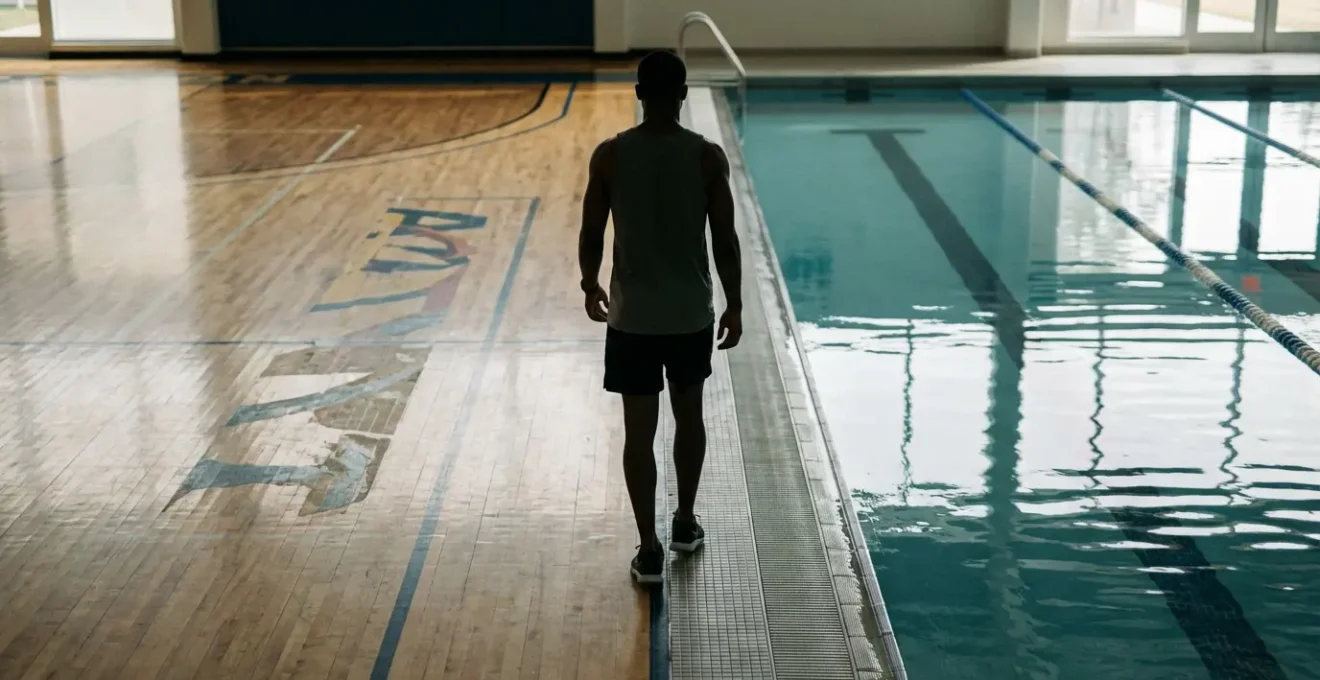
Swimming, on the other hand, is the ultimate antidote to impact. It’s considered one of the best forms of cardiovascular fitness training available, building incredible muscular endurance through repetitive movement against the gentle resistance of water. The zero-impact environment allows an athlete to train their heart and lungs intensely without adding any compressive load to their skeletal system. This gives overworked joints and connective tissues precious time to repair and strengthen.
For the tennis player looking to build a more robust aerobic base and give their body a break, swimming is the unequivocally safer and more restorative choice. Basketball can be a fun and useful tool, but it should be used sparingly and with an awareness of its high-impact nature. The off-season is about rebuilding, and swimming provides the perfect environment for that.
The overuse injury that strikes 60% of single-sport teenagers
The statistic is startling but reflects a growing reality in youth sports: a significant percentage of teenagers who specialize in a single sport early on suffer from overuse injuries. Tennis, with its highly repetitive, one-sided movements, is a prime culprit. The constant cycle of serving, forehands, and backhands creates powerful, dominant pathways on one side of the body, leading to significant movement asymmetry and muscular imbalances. This is a ticking time bomb for injury.
When one side of the body is significantly stronger or more mobile than the other, the weaker side is forced to compensate, leading to strained muscles, tendonitis, and stress fractures. The solution isn’t to stop playing tennis, but to counterbalance its one-sided nature with multi-directional, symmetrical activities. As the Cagney Tennis Academy noted about a young prodigy:
Cagney Tennis Academy developed the game of a young male athlete who showed tremendous tennis potential but needed guidance in movement/footwork/agility. We arranged for him to join gymnastics and indoor soccer programs. This helped develop his agility, movement, cardiovascular endurance, and 5 years later at age 12, he was ranked #2 in Australia in 12&U.
– Cagney Tennis Academy, The Importance of Cross Training For Tennis Players
This real-world example demonstrates the power of cross-training to build a more balanced, resilient athlete. Sports like gymnastics, swimming, and soccer force the body to work symmetrically, strengthening underused muscles and improving overall coordination. The first step is to identify your own imbalances. This simple self-screening process can reveal asymmetries that need to be addressed.
Action Plan: Movement Asymmetry Self-Screen
- Single-Leg Squat: Perform 10 reps on each leg in front of a mirror. Note any significant wobbling, hip drop, or inward collapse of the knee on one side compared to the other.
- Overhead Squat: Hold a racquet or dowel directly overhead with a wide grip. Squat as low as you can while keeping your heels on the ground. Check if one arm drifts forward or if your torso twists.
- Torso Rotation Test: Stand with your side to a wall, arm’s length away. Rotate your torso to touch the wall with both hands. Measure the range of motion on each side and note any significant differences.
- 5-0-5 Agility Test: This test can identify differences between your dominant and non-dominant sides. Research shows that even in elite athletes, 4.2-4.6% performance differences can exist between sides when fatigued, indicating an imbalance.
- Record and Act: Record your results to identify clear imbalances. These are the areas where your cross-training should be targeted, using exercises that strengthen your non-dominant side.
Hand-Eye Coordination: What table tennis teaches you about volleying?
Elite tennis volleyers seem to operate on a different timeline. Their hands are impossibly fast, their touch delicate, and their decisions instantaneous. This isn’t just a result of hitting thousands of volleys; it’s a reflection of a highly-tuned neuromuscular system. One of the most effective ways to sharpen this system off-court is by playing table tennis.
The genius of table tennis as a training tool lies in its scale. The incredibly short distance the ball travels forces your brain to process visual information, predict trajectory, and trigger a motor response at a speed that is three to four times faster than in regular tennis. This creates an accelerated training environment for your entire eye-brain-hand loop. You are essentially putting your reaction skills into overdrive.
Case Study: Enhancing the Eye-Brain-Hand Speed Loop
Regular practice of table tennis acts as a form of high-speed neurological training. Players are forced to read spin and make micro-adjustments with their wrist and forearm at an accelerated pace. This intense processing demand creates new, faster neural pathways. Professional tennis players who incorporate table tennis into their routines often report significantly improved reaction times at the net, better feel on difficult drop volleys, and an almost “pre-cognitive” ability to anticipate where the ball is going. It’s this accelerated processing that creates the “effortless” appearance seen in elite volleyers.
This training doesn’t just make you faster; it makes you smarter. You become more adept at reading subtle cues and spin, a skill that is directly transferable to reading the ball off an opponent’s racquet strings. To make this transfer explicit, you can use a simple drill that bridges the two activities.
Practical Integration: Table Tennis to Tennis Transfer Drill
- Begin with 5 minutes of continuous rallying in table tennis, focusing purely on blocking the ball back and maintaining the rally.
- During the rally, concentrate on reading the spin and making micro-adjustments with your wrist and forearm to control the ball’s direction.
- Immediately transition to a tennis court for 5 minutes of short-court mini-tennis, focusing only on volleying back and forth from the service line.
- Consciously try to apply the same feeling of quick recognition and soft-handed reaction you just used in table tennis to your tennis volleys.
- Repeat this cycle 3-4 times to reinforce the neural pathways and help your brain connect the skills between the two different scales.
Rower vs. Ski-Erg: Which provides the best full-body low-impact burn?
For low-impact, full-body conditioning, the rowing machine and the Ski-Erg are two of the best tools available in any gym. Both offer a phenomenal cardiovascular workout without the joint-pounding of running. However, they are not interchangeable. As a tennis player, choosing between them depends on what specific aspect of your physical chain you want to strengthen: the pulling muscles of your back and legs or the core and upper body linkage vital for serves and overheads.
The rower is a horizontal, pull-dominant machine. It’s a fantastic developer of the posterior chain—the glutes, hamstrings, and back muscles—which are the engine for groundstroke power. The core challenge on a rower is anti-extension; you must maintain a strong, upright posture and resist the urge to slump as you drive with your legs. It’s ideal for building a powerful aerobic base and leg endurance.
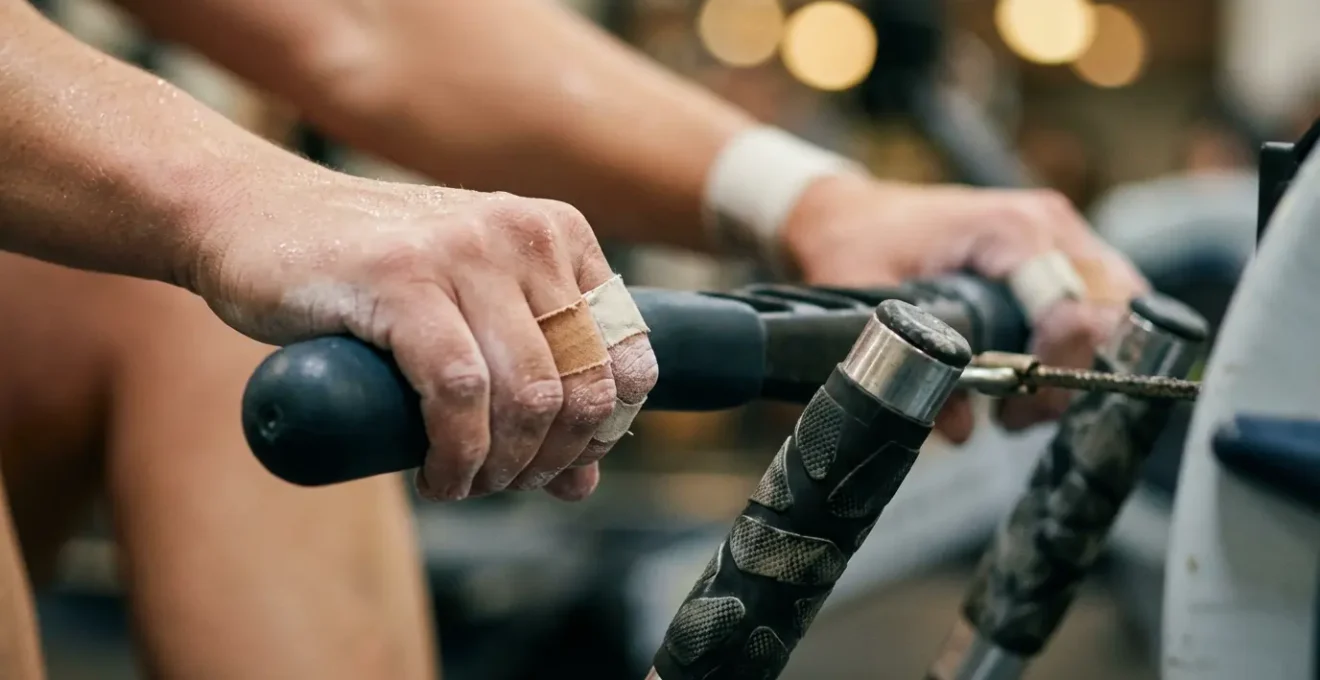
The Ski-Erg, by contrast, is a vertical, pull-dominant machine. The movement mimics the “hip hinge to extension” pattern seen in a tennis serve or a powerful overhead. It heavily engages the lats, triceps, and core. The challenge here is anti-flexion; you must use your core to resist being pulled forward, connecting the power from your upper body to the ground. Because the movement is faster and more explosive, it is better suited for high-intensity interval training (HIIT) and developing peak power.
Ultimately, both are excellent. The rower is better for building a sustained aerobic engine, while the Ski-Erg is superior for developing the explosive power needed for serving. A smart training plan would incorporate both on different days.
This table breaks down the key differences to help you decide which machine best fits your training goal for the day.
| Aspect | Rower | Ski-Erg |
|---|---|---|
| Movement Pattern | Horizontal pull-dominant | Vertical pull-dominant |
| Core Challenge | Anti-extension, maintaining posture | Anti-flexion, resisting forward pull |
| Metabolic Signature | Sustained rhythmic cardio | Higher peak power, HIIT-suitable |
| Best For | Aerobic base building | Power development |
How to perform a ‘Deep Water Running’ session that mimics track intervals?
Deep water running is one of the most effective and underutilized cross-training methods for high-impact athletes. It allows you to perfectly mimic the biomechanics of running and perform high-intensity intervals with absolutely zero impact on your joints. To get the most out of it, however, you can’t just flail around in the deep end. You need to approach it with the same structure and intensity as a track workout.
First, you’ll need a flotation belt to keep you upright and buoyant, allowing your legs to move freely without touching the bottom of the pool. The goal is to replicate your on-land running form as closely as possible: maintain an upright posture, drive your knees up, and use a powerful arm swing. Focus on a high cadence (turnover) rather than trying to travel forward quickly.
A critical factor to understand is how water affects your heart rate. The cooling effect and hydrostatic pressure of water naturally lowers your heart rate. This means your normal training zones won’t apply. According to training guidelines, you must account for a heart rate that is 10-15 beats per minute lower in the water for the same perceived effort. If your Zone 4 on the track is 160-170 bpm, your equivalent in the pool would be around 145-155 bpm. Forgetting to make this adjustment is the most common mistake and will lead to undertraining.
Sample Deep Water Interval Session:
- Warm-up (10 minutes): Easy deep water jogging, focusing on form. Include some dynamic movements like high knees and butt kicks.
- Main Set (20 minutes): Perform a ladder of intervals.
- 1 minute hard, 1 minute easy recovery
- 2 minutes hard, 2 minutes easy recovery
- 3 minutes hard, 3 minutes easy recovery
- 2 minutes hard, 2 minutes easy recovery
- 1 minute hard, 1 minute easy recovery
- Cool-down (5-10 minutes): Very light deep water jogging, followed by stretching outside the pool.
Key Takeaways
- Focus on Skill Transfer: Choose complementary sports based on the specific athletic traits they develop (e.g., footwork, reaction time) that directly transfer to tennis.
- Balance High- and Low-Impact: Manage your body’s overall training load by strategically mixing high-impact sports like basketball with zero-impact activities like swimming or rowing.
- Periodize Your Training: Don’t just add workouts randomly. Structure your week to target different energy systems (aerobic vs. anaerobic) to maximize adaptation and avoid burnout.
How to Manage Intensity Spikes Without Triggering Burnout Symptoms?
As a competitive athlete, you walk a fine line. To improve, you must push your body, creating periods of fatigue. But push too hard for too long, and you risk falling into a state of non-functional overreaching, or burnout. The key to sustainable progress is learning to distinguish between productive fatigue and destructive exhaustion. It’s about understanding that not all fatigue is created equal.
A periodized training approach classifies fatigue into three tiers. The first is normal post-workout fatigue, which is desirable and from which you recover in 24-48 hours. The second is functional overreaching, a planned phase of deep fatigue lasting several weeks, designed to shock the system into a new level of adaptation. This is where real gains are made. The third, however, is non-functional overreaching (burnout), a state of chronic fatigue where performance drops and extended recovery is required. The goal is to live in the first two tiers and avoid the third at all costs.
Managing intensity spikes—like adding a new sport or preparing for a tournament—is about intelligently navigating this model. After a high-intensity session, your body needs to recover. This doesn’t always mean complete rest. Active recovery, such as a light swim or foam rolling, can be more effective. Crucially, you must also consider cognitive de-loading. Mental burnout often precedes physical burnout. Scheduling time for non-athletic activities is not a luxury; it’s a critical component of nervous system recovery.
By listening to your body, tracking objective metrics like Heart Rate Variability (HRV), and understanding the difference between feeling tired and being truly worn down, you can embrace intensity as a tool for growth rather than a path to injury and exhaustion.
Your journey to becoming a more complete athlete starts with the decision to train smarter, not just harder. Begin today by identifying one asymmetry from the self-screen and choosing one complementary activity from this guide to address it. This is the first step toward building a more resilient, agile, and powerful version of yourself on and off the court.
Frequently Asked Questions About Cross-Training for Tennis
How can I track readiness beyond subjective ‘feel’?
Use Heart Rate Variability (HRV) as a daily readiness score. A low HRV after an intensity spike signals the need to prioritize recovery over another hard workout.
What are active recovery options after high-intensity work?
Light activities that use different energy systems are ideal. Since the ATP-PC system provides explosive output for only about 10 seconds before burning out, recovery activities should utilize the glycolytic and aerobic systems through gentle work like light walking, stretching, or foam rolling.
How important is cognitive de-loading?
Mental burnout often precedes physical burnout. Schedule non-athletic time (meditation, reading, social outings) with the same commitment as training sessions to allow your central nervous system to recover.