Chronic ankle sprains on clay courts are not a matter of bad luck but of a clinical mismatch between your footwear’s design and your personal biomechanics.
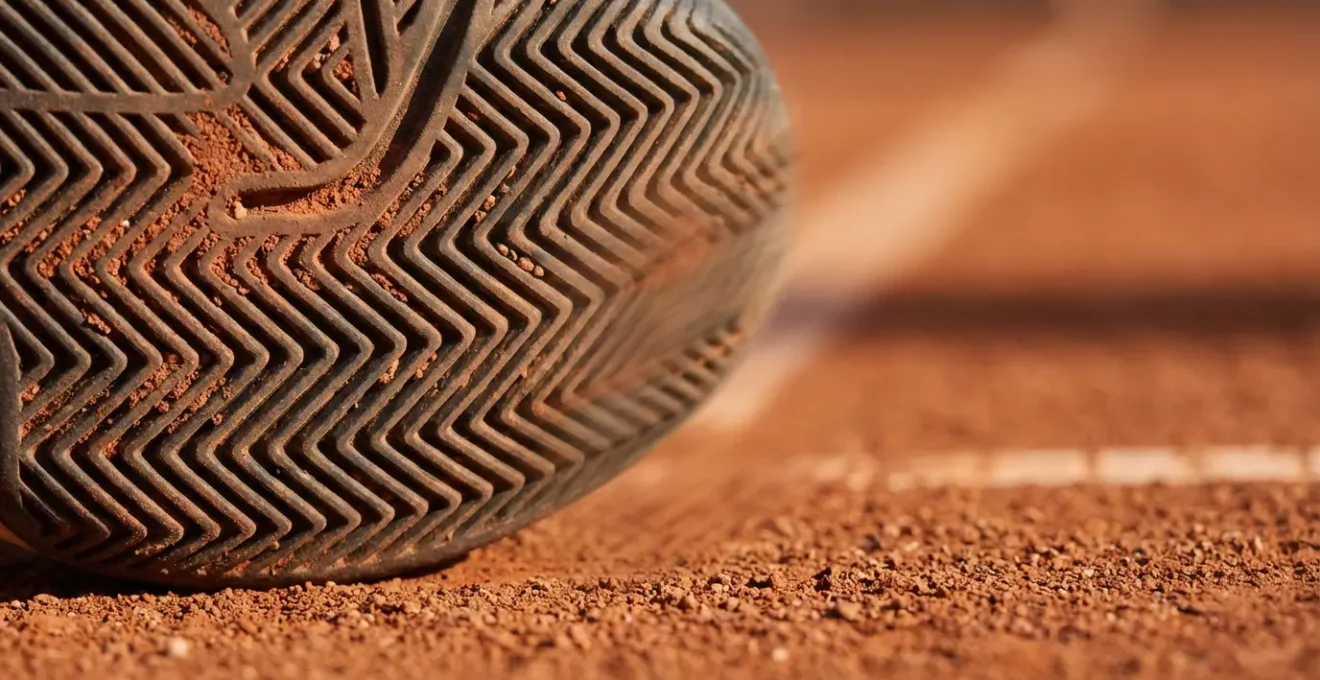
- The key is a full herringbone outsole that allows controlled sliding, reducing dangerous rotational forces on the ankle.
- Internal stability, assessed by your foot’s natural toe splay and the shoe’s midsole integrity, is more critical than superficial ‘support’ features.
Recommendation: Use the physical diagnostic tests in this guide to evaluate your current shoes and make a clinically informed choice for your next pair.
For players with a history of ankle instability, stepping onto a clay court can feel like a gamble. Each slide, each sudden change of direction, carries the risk of another painful sprain. The common advice is to get “supportive shoes,” but this vague recommendation often leads players down a path of trial and error, focusing on brand marketing rather than biomechanical science. Many believe a stiffer, more restrictive shoe is the answer, when in fact, the opposite can sometimes be true.
The problem is that most discussions about tennis footwear overlook the fundamental physics at play. The interaction between your foot, the shoe, and the court surface is a complex system of forces. Ankle sprains occur when these forces are mismanaged, leading to excessive, uncontrolled rotation. True prevention isn’t about simply bracing the ankle; it’s about selecting a shoe that works in harmony with the surface to dissipate these forces safely.
But if the solution isn’t just a “good” shoe, what is it? The answer lies in a clinical approach. This involves understanding how specific outsole patterns affect the friction coefficient, how midsole materials absorb shock versus return energy, and how to read the wear patterns on your old shoes as a diagnostic tool. This guide moves beyond generic advice to provide a podiatric framework for analyzing and selecting footwear. It will equip you with the knowledge to assess a shoe’s torsional rigidity, its accommodation for toe splay, and its overall structural integrity.
We will dissect the shoe from the ground up, starting with the outsole and moving through the midsole to the fit, providing you with actionable tests to evaluate any shoe. This isn’t about finding a magic bullet; it’s about learning a process to ensure your footwear becomes a tool for injury prevention, not a contributing factor.
This article provides a comprehensive clinical breakdown of tennis shoe selection for injury prevention. The following summary outlines the key areas we will cover to help you make an informed decision.
Summary: A Podiatrist’s Guide to Clay Court Footwear
- Why Herringbone Patterns Work on Clay but Slide Dangerously on Hard Courts?
- How to Measure “Toe Splay” to Ensure Stability During Lateral Cuts?
- Gel vs. Foam: Which Mid-sole Material Protects Knees Better?
- The Wear Sign on Your Heel That Indicates You Need Orthotics
- When to Retire a Match Shoe: The Mileage Limit Before Support Fails?
- The Footwear Error on Grass Courts That Leads to ACL Tears
- Road vs. Trail Shoes: Do You Really Need Rock Plates for Light Trails?
- Which Tennis Surface Best Protects Knees After Age 40?
Why Herringbone Patterns Work on Clay but Slide Dangerously on Hard Courts?
From a clinical perspective, the single most important feature for preventing ankle sprains on clay is the outsole’s ability to manage friction. The ideal interaction is not maximum grip, but controlled sliding. A full herringbone pattern, with its deep, unbroken zigzag grooves, is specifically engineered for this. On a loose surface like clay, the fine particles get channeled through these grooves, allowing the shoe to slide predictably when you brake or change direction. This sliding motion extends the time over which forces are applied to your joints, lowering the peak force and dramatically reducing the risk of the foot planting awkwardly while the body’s momentum continues—a primary mechanism for ankle rolls.
The danger arises when this same shoe is used on a hard court. The high friction coefficient of an acrylic hard court causes the aggressive herringbone pattern to grip instantly and excessively. Instead of a smooth slide, the shoe stops dead. This abrupt halt can create immense rotational torque on the ankle and knee. In contrast, hard court shoes use a modified herringbone pattern, often with pivot points and shallower, V-shaped grooves, designed for grip and give on a surface that has no slide. Using the wrong shoe for the surface fundamentally alters the biomechanics of movement and is a leading, preventable cause of injury. The distinction is not trivial; it’s a matter of fundamental physics.
How to Measure “Toe Splay” to Ensure Stability During Lateral Cuts?
While the outsole manages interaction with the court, a shoe’s internal stability starts with its ability to accommodate your foot’s natural mechanics. During powerful lateral movements, your toes naturally spread apart—a mechanism called toe splay. This splaying action widens the base of your forefoot, creating a more stable platform to push off from and resist rolling. A shoe with a narrow, tapered toebox constricts this natural movement, effectively compromising your body’s own stability system and forcing the ankle joint to compensate, increasing sprain risk.
It is crucial to ensure your shoe’s toebox is wide enough to allow for this dynamic expansion. You can perform a simple “Wet Footprint Test” to measure your required width. This test provides a visual, objective measure of your foot’s needs, moving beyond subjective feelings of comfort.
- Wet the sole of your foot and step onto a piece of cardboard or heavy paper to create a baseline print.
- Trace the outline of this standing footprint.
- Next, perform a deep lateral lunge to the side, mimicking a tennis movement, and hold the position.
- Have someone re-trace your footprint while you are in this lunging position.
- Compare the two tracings. The difference in width at the forefoot is your dynamic toe splay. Your shoe’s toebox must be wide enough to accommodate this second, wider measurement without causing the foot to bulge over the sole.
This measurement ensures the shoe’s structure supports your foot’s natural stabilizing function, rather than hindering it.
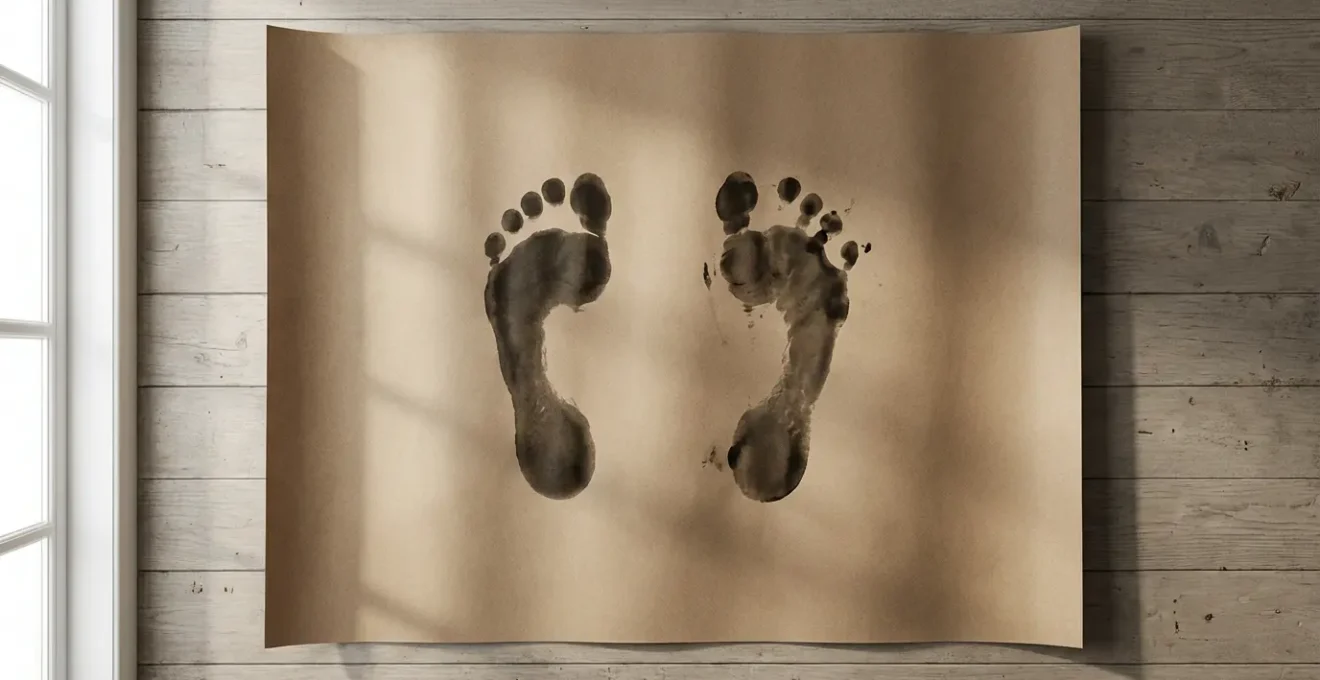
As the image demonstrates, the expansion of the forefoot during a lunge is significant. Selecting a shoe based only on your standing foot size ignores this critical biomechanical reality. A properly sized toebox is an active component of your stability system.
Gel vs. Foam: Which Mid-sole Material Protects Knees Better?
The midsole is the engine of your shoe’s cushioning system, responsible for shock absorption. As former Tennis Magazine Editor in Chief Donna Doherty noted, “Hard courts are tough on the joints, just from the lack of give.” While clay is more forgiving, the repetitive impact of a long match still takes a toll. The primary materials used for this protection are gel and foams like EVA (Ethylene Vinyl Acetate) or TPU (Thermoplastic Polyurethane), each with distinct clinical trade-offs.
Gel-based midsoles excel at localized shock dispersion. They are highly effective at absorbing impact forces in key areas like the heel and forefoot. However, they tend to be heavier and offer less energy return, which can make the shoe feel less responsive or “slower.” Foam-based midsoles (EVA/TPU) are lighter and provide a bouncier, more responsive feel due to higher energy return. The downside is that foam physically compresses over time and eventually “dies,” losing its cushioning properties permanently. For players with a history of joint issues, particularly in the knees or lower back, a gel system’s superior shock absorption often outweighs the benefits of a foam’s responsiveness. For aggressive, high-energy players without pre-existing conditions, a lightweight foam midsole might be preferred.
| Feature | Gel Midsole | Foam (EVA/TPU) Midsole |
|---|---|---|
| Shock Dispersion | Excellent localized shock absorption | Good overall cushioning |
| Energy Return | Lower – feels less responsive | Higher – provides bounce |
| Weight | Heavier | Lighter |
| Durability | More durable, but can harden in cold | Compresses and ‘dies’ over time |
| Best For | Players with joint issues | Aggressive baseline players |
Ultimately, the choice is not about which is “better,” but which is medically appropriate for your body’s needs and playing style. Prioritizing joint protection with a gel-based system can be a crucial long-term strategy, especially on less forgiving surfaces.
The Wear Sign on Your Heel That Indicates You Need Orthotics
Your old tennis shoes are a diagnostic history of your foot’s biomechanics. Specific wear patterns can reveal underlying issues like excessive pronation (foot rolling inward) or supination (foot rolling outward), which are significant contributors to ankle instability. For players who have suffered a previous injury, this is particularly critical; tennis players who sustained an ankle sprain are twice as likely to sustain another, often due to unaddressed biomechanical faults. A normal wear pattern shows primary contact on the postero-lateral (outer back) edge of the heel and across the ball of the foot. Severe, asymmetrical wear is a red flag.
If you see the inside edge of your heel is worn down significantly more than the outside, it indicates excessive pronation. This causes the arch to collapse and the ankle to roll inward, placing chronic strain on the ligaments. If your shoe fails a simple stability check, it’s a strong sign that the shoe’s built-in support is insufficient for your needs and that custom or semi-custom orthotics may be required to provide proper alignment.
Your Action Plan: The Wobble Test for Heel Wear Assessment
- Place your tennis shoes on a flat, level surface like a table.
- View them from behind at eye level. Check if the shoes tilt significantly inward (pronation) or outward (supination) on their own.
- Examine the heel’s wear pattern. Confirm if the wear is concentrated on the normal postero-lateral heel or if it is excessively asymmetrical (e.g., heavily on the medial/inner side).
- Look at the shoe’s upper material. Check for any bulging on the medial or lateral sides, which indicates your foot is spilling over the midsole.
- If your shoes visibly tilt or show severe asymmetrical wear, they have failed the wobble test. This indicates your biomechanics are overpowering the shoe’s structure.
Failing this test means it is time to consult a podiatrist. Placing a new orthotic in an old, broken-down shoe is ineffective; you will need a new, stable pair of shoes in conjunction with the corrective orthotic to properly manage your foot mechanics and prevent future injury.
When to Retire a Match Shoe: The Mileage Limit Before Support Fails?
Many players retire their shoes based on the outsole’s appearance—once the tread is bald, the shoes are replaced. This is a critical error. A shoe’s structural integrity, particularly its torsional rigidity, fails long before the outsole rubber wears through. Torsional rigidity is the shoe’s resistance to twisting. A new shoe has a stiff midfoot shank that prevents the forefoot and rearfoot from twisting against each other. This feature is paramount for preventing the foot from rolling during lateral cuts. As the midsole foam breaks down and the shank fatigues, this essential support vanishes, even if the tread looks fine.
Instead of relying on mileage—which varies wildly by player weight, style, and court surface—you should use a physical test to determine if a shoe is “dead.” The Torsion Test is a simple, reliable method to assess a shoe’s remaining structural support.
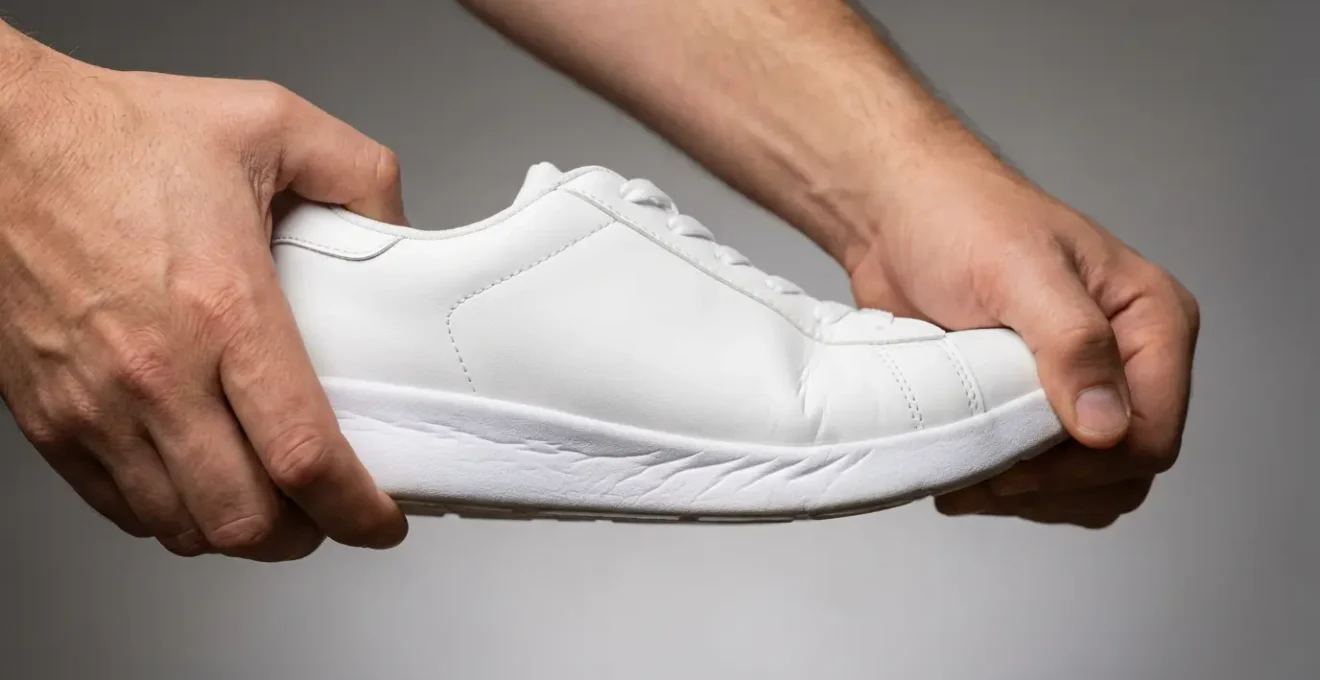
To perform the test, hold the shoe firmly by the heel and the toe and attempt to twist it as if you were wringing out a wet rag. A new, structurally sound shoe will resist this motion significantly. A “dead” shoe, whose midsole and shank are compromised, will twist easily with little resistance. Another clear sign is the presence of deep compression wrinkles in the midsole foam, indicating the material has lost its ability to cushion and support. A shoe that fails the torsion test offers a dangerously low level of protection and must be retired from match play immediately, regardless of its outward appearance.
The Footwear Error on Grass Courts That Leads to ACL Tears
To fully appreciate the importance of matching footwear to a clay surface, it is instructive to examine the opposite problem on grass courts. While both are “soft” surfaces, their mechanical properties are vastly different. Grass is slippery, and to compensate, grass-court shoes feature outsoles with nubs or “pimples” that act like miniature cleats, digging into the turf for grip. While ankle sprains are still an issue, a more severe danger arises when the grip is too aggressive.
The critical footwear error occurs when a player uses a brand-new pair of grass shoes with sharp, deep nubs. These can anchor the foot to the turf with too much force. If the player then performs a rapid rotational movement, the foot can remain locked in place while the knee and upper body continue to rotate. This creates a powerful shearing force on the knee, a classic mechanism for an ACL (Anterior Cruciate Ligament) tear. While ankle sprains and midfoot stress injuries are more common on grass, the risk of a catastrophic knee injury from excessive grip is a unique concern. This illustrates a universal biomechanical principle: injury occurs at the extremes of the friction spectrum, both from too little grip (uncontrolled sliding) and too much (abrupt planting).
Road vs. Trail Shoes: Do You Really Need Rock Plates for Light Trails?
The principle of sport-specific footwear is not unique to tennis. A clear analogy can be found in running. Using a road running shoe on a technical trail is just as hazardous as using a hard court shoe on clay. Road shoes are designed to be light, flexible, and cushioned for a repetitive, linear motion on a predictable surface. They offer minimal lateral stability or torsional rigidity because side-to-side movement is not a primary concern. Trail running shoes, by contrast, are built like tanks. They feature aggressive outsoles for grip on dirt and rock, reinforced uppers, and high torsional rigidity to prevent the foot from twisting on uneven terrain. Many include a “rock plate,” a stiff plate in the midsole to protect the foot from sharp objects.
Wearing a flimsy road shoe on a trail invites ankle sprains. Conversely, wearing a heavy, rigid trail shoe with a rock plate for a light jog on a flat, gravel path is overkill; it adds unnecessary weight and reduces the “feel” for the ground. This demonstrates the importance of matching the level of protection to the specific demands of the environment. For tennis players, this is the core lesson: a running shoe, designed for forward motion, provides almost no protection against the powerful lateral forces of tennis and should never be worn on court.
| Feature | Road Shoes | Trail Shoes with Rock Plate |
|---|---|---|
| Torsional Rigidity | Moderate | High |
| Ground Feel | High | Low |
| Protection | Minimal | Maximum |
| Best For | Paved surfaces | Technical rocky trails |
The takeaway is clear: the features that protect you in one context can be inappropriate or even dangerous in another. Just as a runner chooses a shoe for a specific trail, a tennis player must choose a shoe for a specific court surface.
Key Takeaways
- Clay court safety relies on a full herringbone outsole that enables controlled sliding to dissipate force, unlike hard court shoes which are designed for grip.
- A shoe’s toebox must be wide enough to accommodate your foot’s natural “toe splay” during lateral movements; this is a critical, self-contained stability feature.
- Shoe retirement should be based on failed structural integrity (using the Torsion Test), not on outsole wear, as internal support degrades first.
Which Tennis Surface Best Protects Knees After Age 40?
For players over 40, longevity in the sport is intrinsically linked to joint preservation. While ankle sprains are an acute concern, the chronic, cumulative impact on the knees is equally important. From a clinical standpoint, clay is unequivocally the most forgiving surface for the aging body. The reason goes back to the principle of sliding. As explained by Medical Press research, “We tend to slide when friction is lower and this increases the time over which the force is produced, and the peak force is lower. The lower force is less likely to cause injury.” This reduction in peak impact force on every step, slide, and landing directly translates to less stress on the knee cartilage and other joint structures.
The statistics bear this out. Hard courts, with their unforgiving nature and high friction, are associated with a significantly higher rate of injury. In fact, a systematic review found that hard courts showed a 9.7% injury rate compared to just 3.5% on clay courts. This is a staggering difference. For a player looking to protect their knees after decades of play, choosing to play predominantly on clay is one of the most effective preventative strategies available. It allows for longer play with less post-match soreness and a lower risk of developing or exacerbating chronic conditions like osteoarthritis.
By combining the right surface (clay) with the right shoe (one that facilitates sliding and provides appropriate cushioning), an older player can create a synergistic system that actively works to protect their joints, extending their playing career for years to come.
To put these principles into practice, begin by critically evaluating your current shoes using the Torsion and Wobble tests. This diagnostic first step is the most important action you can take toward preventing your next injury and ensuring a long, healthy future on the court.